

Previous Article
News
Presentations 2nd Education and Training Meeting now available!
On the 19th of June the second Expert Meeting on Education and training took place in Ljubljana, Slovenia with the purpose of including education and training within the sector of probation on the European agenda.
With a fast developing European criminal justice sector, a clear need has emerged for more knowledge on education and training. For this reason, CEP has started up a project on this topic and has appointed the University of Applied Sciences (UAS) in Utrecht to conduct a survey among EU member states on pre-employment training and incareer continuous training for probation and community supervision practitioners at an European level. At the first CEP expert meeting on Education and Training in Utrecht, December 2018, the first results from the survey were presented. It was also a starting point for creating a network of experts on education and training both within the probation sector as well as the pre-employment academic sector.
At this second meeting, CEP’s Policy Officer Maria Lindström started off with an introduction to the topic of the day together with Joep Hanrath, researcher from Utrecht University of applied science in the Netherlands. The opening was followed by a presentation by Nicola Carr, one of the authors of the drafted guidelines regarding recruitment, selection training and professional development of prison and probation staff. Her presentation was about the question: “What challenge do the guidelines pose for the professional execution of probation?”.
Séverine Dubaïssi, responsible for the development of training at L Ecole Nationale d ´Administration Penitentiaire (ENAP) held a presentation on the formation of the probation worker in the French context, and the facilitation of the transfer between school based learning and workplace learning. Séverine gave an overview on how the recruitment process and the first two years of education for probation officers is carried out in France. ENAP is a national organisation with around 380 staff trainers and they provide training for 500 probation officers every year.
The next presentation was held by Anneke Menger, emeritus professor at the University of Applied science, Utrecht the Netherlands. She introduced the participants to the basic principles of the working alliance and the challenges of working with mandated clients.
The final presentation was held by Danijela Mrhar Prelić, Director General for the Slovenian Probation Administration. She reflected on the presentations from the perspective of being Director of the youngest probation service in Europe. The Slovenian probation service started in April 2018. The decision to start a probation service was taken in 2006, but there was no real political support until 2015. Education and training were one of the most crucial topics in their action plan to set up the probation service.

Related News
Keep up to date with the latest developments, stories, and updates on probation from across Europe and beyond. Find relevant news and insights shaping the field today.
Recap
Framework Decisions
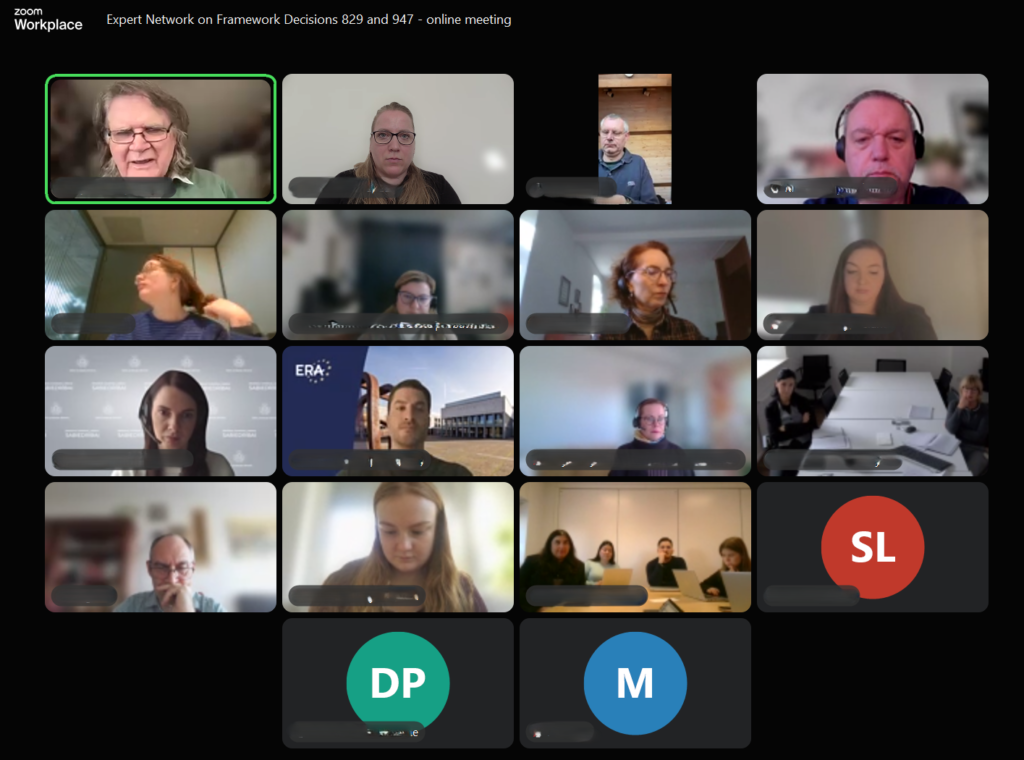
Recap: annual meeting of the Expert Network on Framework Decisions 829 and 947
09/11/2026
On Thursday 5 November an annual meeting of the Expert Network on Framework Decisions 829 and 947 took place online. Bringing together 20 participants from 12 EU jurisdictions including representatives of the Academy of European Law and European Judicial Network, the meeting provided an opportunity to exchange experiences, discuss current implementation challenges and identify priorities for enhancing cross-border cooperation in the application of the two Framework Decisions.
New

Education and Training, Probation in Europe
Justice programme: the judicial training call is open for applications!
09/11/2026
Are you ready to help address the training needs of justice professionals from different EU countries in the fields of civil law, criminal law and fundamental rights? This call supports cross-border training projects contributing to the effective and consistent application of EU law. In line with the new European Judicial Training Strategy, the call also supports the digitalisation of justice. Don’t miss this opportunity! Apply by 4 March 2027, 17:00 Brussels time.
Recap

CEP Board, Foreign Nationals in Prison and Probation, Probation in Europe
CEP at the 16th Plenary Meeting of the Council for Penological Co-operation
06/11/2026
From 3 to 5 November 2026, representatives of the Confederation of European Probation (CEP) participated in the 16th Plenary Meeting of the Council for Penological Co-operation (PC-CP).
New

CEP
Newsletter October 2026 out now
29/10/2026
CEP’s latest newsletter is out now! It includes:
- Deadline approaching for the Workshop on Technology and Alternatives to Detention
- Recap of the 14th EM and CEP Excellence Leadership Training
- New publications from Expert Groups on Technology and Expert Group on Violent Extremism
- Call for Proposals: Evaluation of CEP Expert Groups
- Engaging with Research – a new section in our newsletter
- and much more!
New
Violent Extremism
Understanding Youth Radicalisation: What Can Probation Services Do? | New Report from CEP’s Expert Group
27/10/2026
In recent decades, the violent radicalisation of juveniles and young adults has become a pressing concern for policymakers, researchers, practitioners, and communities worldwide. While considerable attention has been devoted to psychological vulnerabilities, socio-economic marginalisation, and community-level influences, the broader context in which violent radicalisation develops is often overlooked. At the same time, the increasing involvement of young people in violent extremist offences highlights the urgent need for effective prevention efforts. Addressing youth radicalisation has become a complex and evolving challenge for families, educators, mental health professionals, law enforcement agencies, probation services, and security authorities.
Recap

Probation in Europe
Reflections on the European Society of Criminology Conference 2026 | From Criminological Research to Probation Practice
26/10/2026
At CEP, we are fascinated by research from across Europe and beyond, and by helping it reach the people who can use it. Ruth Armstrong, CEP Research and Policy Officer, went to the 26th Annual Conference of the European Society of Criminology (EuroCrim 2026 – Working Group on Community Sanctions and Measures) that took place in Warsaw, Poland, from 9–12 September 2026.
Against a backdrop of overcrowded prisons and net-widening (with ever more people drawn into supervision), three questions kept coming up in the research: how time shapes justice, what we mean by success, and how we define harm.
Subscribe to our bi-monthly email newsletter!
"*" indicates required fields
- Keep up to date with important probation developments and insights.