

Skip to content

News

Guidelines on Caseload and Workload

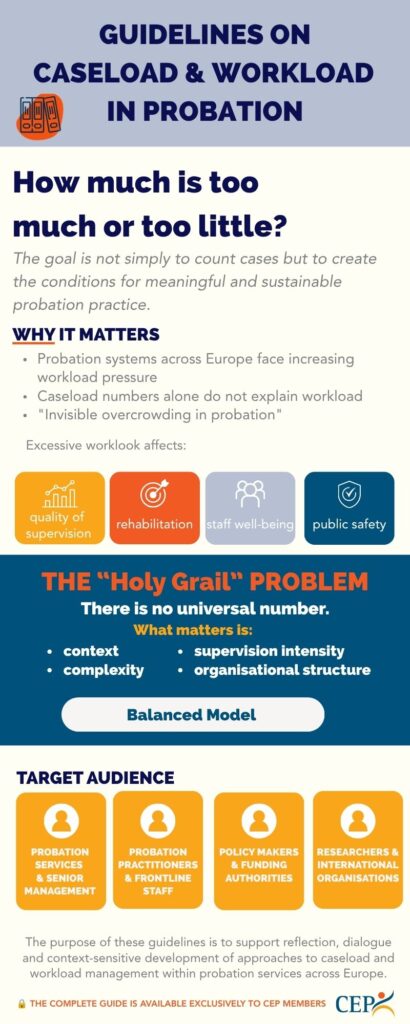
CEP Expert Group on Caseload and Workload is proud announce the publication of the Guidelines on Caseload and Workload. 

The comprehensive document, first presented at the Workshop on Caseload and Workload: Supporting Sustainable Probation Through the Human Dimension (27–28 May, Bucharest, Romania), aims to support CEP members in understanding and managing caseload and workload.

Through benchmarks, comparative patterns, and guiding principles, the Expert Group helps probation services develop context-sensitive standards, enabling jurisdictions to find an evidence-informed balance between quality, sustainability, and public safety.

These Guidelines, created by the CEP Expert group on Caseload and Workload, are addressed to a broad range of stakeholders involved in probation policy and practice. Caseload and workload are not merely operational issues — they are organisational, political and ethical matters that affect multiple actors.

The document provides an overview of caseload and workload models applied in probation services, starting with key definitions and a review of relevant research. It explores different approaches across jurisdictions and presents a snapshot of practices in CEP member countries. Based on this analysis, it offers interpretation, sets out criteria for developing caseload and workload frameworks, and concludes with practical guidelines and recommendations to support quality, sustainability, and public safety.

The document wraps up with a practical section—a structured roadmap as a way of analysing local realities, identifying pressure points, setting thresholds and establishing defensible and transparent approaches to caseload and workload management—as well as a workload formula model, which provides a hands-on tool that services can adapt to their own context.

The goal is not simply to count cases but to create the conditions for meaningful and sustainable probation practice.


The guidelines are only available for CEP members with a login through the CEP Members page.

How to access the member page?

Once logged in, click the avatar in the top-right corner of the CEP website to access the Members page, or click here.


Related News

Keep up to date with the latest developments, stories, and updates on probation from across Europe and beyond. Find relevant news and insights shaping the field today.

New

CEP

Newsletter August 2026 out now

27/08/2026

CEP’s latest newsletter is out now! It includes:

. >> Read here

>>Read previous newsletters

New

Caseload and workload

Do you work in probation? We need your voice!

24/08/2026

As part of its long-standing cooperation with research, CEP invites its members to contribute to a special edition of the European Probation Journal on the topic of Workload in Probation.

New

Alternatives to pre-trial detention, Foreign Nationals in Prison and Probation, Gender Equality, Probation in Europe

SPACE II report is now available

24/08/2026

The use of community sanctions and measures that allow individuals to remain in the community – also known as alternatives to imprisonment – continues to grow overall in Europe, although at a moderate pace, according to the latest Council of Europe annual penal statistics on persons under the supervision of probation agencies (2025 SPACE II survey).

Read more

Read the report

New

Victims rights

Adoption of the revised Victims’ Rights Directive and call for evidence on EU strategy on victims’ rights

05/08/2026

The Council of the European Union has formally approved a new directive strengthening the rights of victims of crime across the EU. The updated law improves access to information, support, and protection by introducing an EU-wide victim support helpline (116 006), making it easier to report crimes through digital tools, strengthening safeguards for victims’ personal data, expanding child-friendly support services, improving access to legal aid, and helping ensure that victims receive compensation more quickly.

This directive updates the 2012 EU Victims’ Rights Directive and aims to ensure that victims receive more consistent and effective support across all Member States. Following its publication in the Official Journal, Member States will have 24 months to transpose the new rules into national law. For more information, see the Council of the European Union’s press release: Council greenlights law reinforcing protection of victims’ rights and check out the revised Victims’ Rights.

Probation Journal

juvenile offenders, Probation in Europe

Overview of Probation Procedures for Juveniles and Adults in Albania

22/07/2026

The Albanian Probation Service plays an important role in the implementation of alternative sanctions and measures for both juveniles and adults. Through supervision, assessment, and rehabilitation-oriented interventions, the Service aims to support compliance with court decisions, reduce the risk of reoffending, and promote the successful reintegration of individuals into society.

Community Sanctions and Measures

Nelson Mandela day

18/07/2026

Nelson Mandela Day reminds us that justice is not only about accountability – it is also about hope. Mandela believed in the dignity of every person and in the possibility of change. These principles are at the heart of probation.

Across Europe, probation professionals work every day to support people in taking responsibility for their actions, rebuilding their lives and successfully reintegrating into their communities. By promoting rehabilitation, social inclusion and human dignity, probation helps reduce reoffending and contributes to safer, more resilient societies.

Subscribe to our bi-monthly email newsletter!