Skip to content

News

CEP 15th General Assembly and International Conference on Gender-Based Violence in Probation

From 14 to 16 October 2025, Vienna hosted the 15th CEP General Assembly and the CEP International Conference on Gender-Based Violence in Probation: Challenges and Lessons Learned. The event, organized in cooperation with NEUSTART, brought together over 100 CEP members, probation professionals, policymakers, and researchers from across Europe to reflect, exchange experiences, and discuss the topic of gender-based violence from the perspective of probation, restorative justice and prison.

The General Assembly, held in the morning of 15 October, is CEP’s triennial gathering and an important moment for members to review achievements and set the organisation’s direction for the coming years. The agenda included the reflection of the past three years as well as it addressed the years to come, with the strategy and budget approved. New members of the CEP Board including President and Vice-Presidents, were elected and co-opted.

The Assembly followed a welcome reception hosted on the evening of 14 October at the Ministry of Justice in Vienna, where participants were greeted by a representative of the Ministry, NEUSTART and CEP President Annie Devos.

In the afternoon of 15 October, CEP launched the International Conference on Gender-Based Violence in Probation, organised in cooperation with the Austrian member organisation NEUSTART. The conference addressed one of the most pressing challenges facing probation systems today: how to respond effectively to gender-based violence.

The two-day programme featured contributions from European experts, practitioners, and policymakers. Sessions explored European policy priorities on gender-based violence, the Austrian approach to working with GBV-related cases, and the increasing importance of addressing gender-based violence within probation work. Workshops on the second day focused on good practices in rehabilitation, interagency cooperation, and restorative justice and victim-centred perspectives.

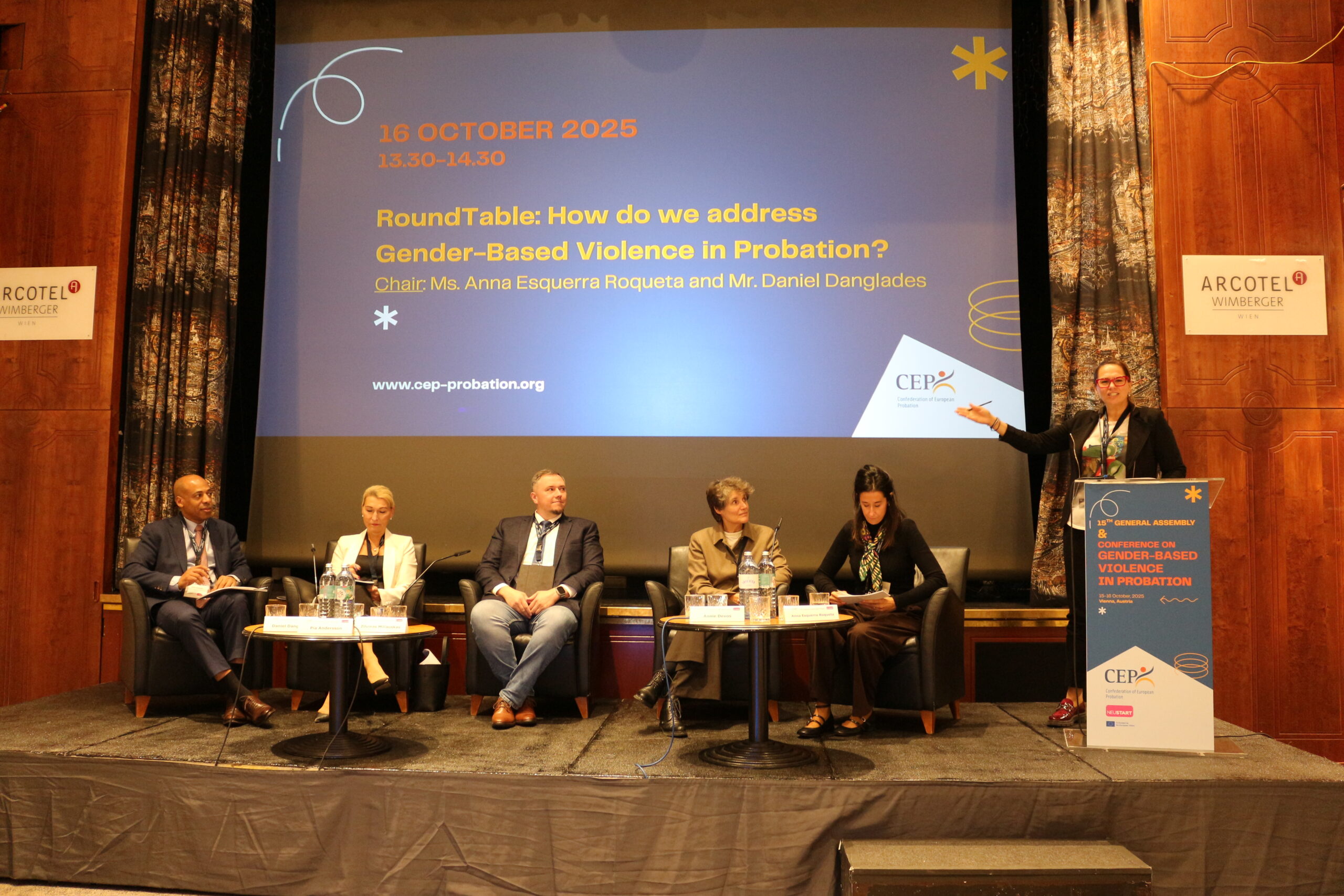
The conference concluded with a roundtable discussion featuring experts from several European jurisdictions, who shared national approaches and challenges, followed by closing remarks from CEP President Annie Devos and the CEP Secretary General Jana Spero Kamenjarin.

CEP awards

The evening of 15 October also featured the CEP Awards Ceremony, celebrating outstanding initiatives and contributions to probation across Europe. More information about the award winners can be found here.

Pictures

Reception CEP members – pictures by Markus Hechenberger

15th General Assembly

Conference on Gender-Based Violence – pictures by Markus Hechenberger + extra pictures conference

Gala dinner – pictures by Markus Hechenberger

Recap video


Related News

Keep up to date with the latest developments, stories, and updates on probation from across Europe and beyond. Find relevant news and insights shaping the field today.

New

CEP

Newsletter August 2026 out now

27/08/2026

CEP’s latest newsletter is out now! It includes:

. >> Read here

>>Read previous newsletters

New

Caseload and workload

Do you work in probation? We need your voice!

24/08/2026

As part of its long-standing cooperation with research, CEP invites its members to contribute to a special edition of the European Probation Journal on the topic of Workload in Probation.

New

Alternatives to pre-trial detention, Foreign Nationals in Prison and Probation, Gender Equality, Probation in Europe

SPACE II report is now available

24/08/2026

The use of community sanctions and measures that allow individuals to remain in the community – also known as alternatives to imprisonment – continues to grow overall in Europe, although at a moderate pace, according to the latest Council of Europe annual penal statistics on persons under the supervision of probation agencies (2025 SPACE II survey).

Read more

Read the report

New

Victims rights

Adoption of the revised Victims’ Rights Directive and call for evidence on EU strategy on victims’ rights

05/08/2026

The Council of the European Union has formally approved a new directive strengthening the rights of victims of crime across the EU. The updated law improves access to information, support, and protection by introducing an EU-wide victim support helpline (116 006), making it easier to report crimes through digital tools, strengthening safeguards for victims’ personal data, expanding child-friendly support services, improving access to legal aid, and helping ensure that victims receive compensation more quickly.

This directive updates the 2012 EU Victims’ Rights Directive and aims to ensure that victims receive more consistent and effective support across all Member States. Following its publication in the Official Journal, Member States will have 24 months to transpose the new rules into national law. For more information, see the Council of the European Union’s press release: Council greenlights law reinforcing protection of victims’ rights and check out the revised Victims’ Rights.

Probation Journal

juvenile offenders, Probation in Europe

Overview of Probation Procedures for Juveniles and Adults in Albania

22/07/2026

The Albanian Probation Service plays an important role in the implementation of alternative sanctions and measures for both juveniles and adults. Through supervision, assessment, and rehabilitation-oriented interventions, the Service aims to support compliance with court decisions, reduce the risk of reoffending, and promote the successful reintegration of individuals into society.

Community Sanctions and Measures

Nelson Mandela day

18/07/2026

Nelson Mandela Day reminds us that justice is not only about accountability – it is also about hope. Mandela believed in the dignity of every person and in the possibility of change. These principles are at the heart of probation.

Across Europe, probation professionals work every day to support people in taking responsibility for their actions, rebuilding their lives and successfully reintegrating into their communities. By promoting rehabilitation, social inclusion and human dignity, probation helps reduce reoffending and contributes to safer, more resilient societies.

Subscribe to our bi-monthly email newsletter!