

Previous Article
News
VIDEO: facts, figures, and human stories about probation during wartime in Ukraine
On November 22, 2022, in Riga, the State Probation Service of Latvia (SPS) held an online stream with Inna Popova, Head of the Public Relations Department of the Penitentiary Department of the Ministry of Justice of Ukraine, and Katerina Denisyuk, Head of the Public Relations Department of the Probation Service of Ukraine for all the employees of SPS.
Probation client’s message to his probation officer: “I wanted to find out about the visits to the probation service these days. Sorry, but today I won’t come to my visit, not because I don’t want to, but because I have gone to fight as a volunteer in Kyiv, you can check this information. I understand that I have to report to the probation service by law, but I’ll be here till we win or I’m killed.”
The online meeting was devoted to daily professional issues, challenges, and solutions in probation work in Ukraine during the war. Within the framework of this meeting, the Ukrainian colleagues reflected on the experience of the probation system and its employees from the beginning of the war. In the video recording of the stream, Ukrainian colleagues talk about the probation system in Ukraine: work organization, security for the employees and probation clients, information protection, resumption of work in the de-occupied territories, and further development of the probation system. Colleagues illustrate their stories not only with facts and figures but also with people’s personal stories, which provide a unique opportunity to look into the strenuous daily life of our Ukrainian colleagues.
Probation in Ukraine continues and develops even under war conditions, operates in shelters and continues to perform its functions. On 24 February 2021, we faced a new challenge: security, not only the security of the country but the security of every person. No matter how strange it might appear, our colleagues did not worry about their safety or the safety of their loved ones… when talking to our colleagues from regions under a greater threat, they were even thinking about how to safeguard the clients’ files, how to preserve material values. Many colleagues, at risk to their own lives, withdrew the documents, because they understood that they constituted the lives of thousands of people. Every fourth probation service office was or is under occupation; 10% of probation service employees experienced what occupation was. 30% of probation service clients were or still are in the occupied territories. Currently, 80 out of 600 probation service departments are unavailable, 66 probation service employees and more than 7,000 probation service clients remained in Donetsk and Luhansk regions, which are now impossible to leave. But even in these areas, our officers continue to communicate with the probation clients. More than 100 probation officers and more than 2,500 probation service clients from various regions of Ukraine have joined the Armed Forces of Ukraine as part of territorial defense units to help maintain law, order and security. These and other stories of Ukrainian colleagues can be heard on the embedded video that was recorded at Latvia’s Probation Service, Riga, on 22.11.2022.
The Ukrainian colleagues had come to Latvia to gain new experience in the field of public relations, and to upgrade their graphic and audiovisual communication skills. The visit of the Ukrainian colleagues to Latvia took place within the framework of the MATRA project “Probation and Alternative Sanctions in Ukraine” project (Netherlands Helsinki Committee, The Center for International Legal Cooperation, Reclassering). The activity in Latvia was made possible in cooperation with the State Probation Service of Latvia.
article written by State Probation Service of Latvia

Related News
Keep up to date with the latest developments, stories, and updates on probation from across Europe and beyond. Find relevant news and insights shaping the field today.
New
CEP
CEP annual report
07/04/2026
The Confederation of European Probation (CEP) has published its Annual Report 2025, showcasing a year marked by growth, cooperation, and continued commitment to strengthening probation across Europe.
Bringing together more than 100 member organisations across 42 countries and 59 jurisdictions, CEP continued to serve as a central platform for knowledge exchange, professional development, and collaboration within the European criminal justice field.

Uncategorized
ProtectEU: Commission presents new counterterrorism agenda
07/04/2026
On 26 February 2026, the European Commission presented ProtectEU, a renewed EU counterterrorism agenda aimed at strengthening the Union’s capacity to prevent, detect and respond to evolving terrorist threats.
New
Probation in Europe
New Vodcast Episode: Jana Spero Kamenjarin on the Confederation of European Probation (CEP)
07/04/2026
The 19th episode of Division_Y features Jana Spero Kamenjarin, Secretary General of the Confederation of European Probation (CEP), based in Utrecht, the Netherlands.
New

Electronic monitoring
Electronic Monitoring in Europe: Insights from the 13th Electronic Monitoring conference Questionnaire
30/03/2026
The 13th Electronic Monitoring (EM) conference Questionnaire has now been released, offering a comprehensive overview of how EM is applied across Europe today.ion.
New
CEP members
New CEP member: Guernsey Probation Service
25/03/2026
In recent weeks, CEP has interviewed individual members and representatives of the new member organisations that joined CEP at the beginning of 2026. In these interviews, the new member organisations or individual members will share information on why they decided to become members, how they would like to contribute to the development of CEP and many more.
Enjoy reading!
Recap
Probation outside Europe
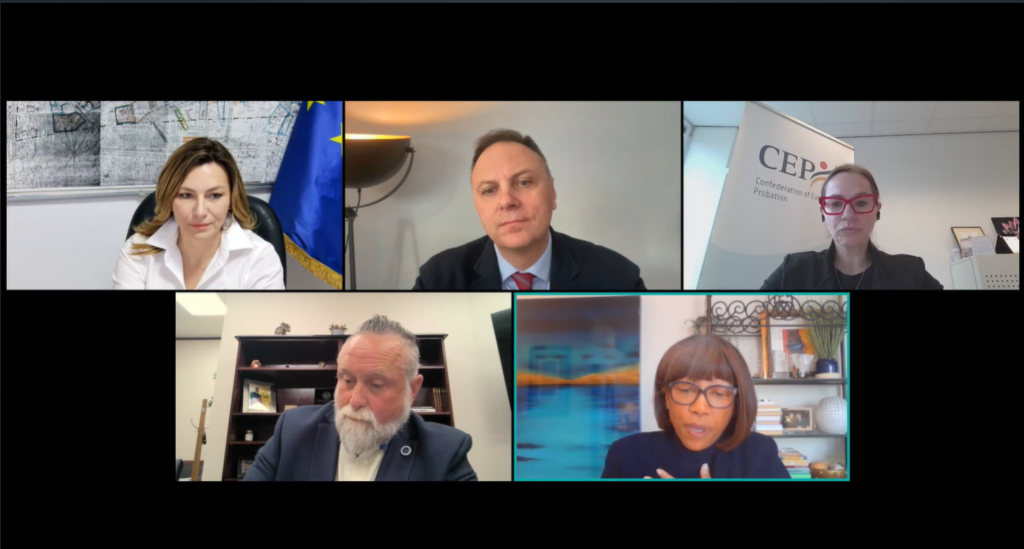
Recap: CEP and APPA webinar
25/03/2026
Confederation of European Probation (CEP) and American Probation and Parole Association (APPA) hosted the second joint webinar on 24 March 2026, this time on “Integrity of Performance: Ensuring Meaningful and Ethical Outcomes”.
The overarching theme of integrity of performance was explored through two distinct perspectives on this fundamental concept.
Subscribe to our bi-monthly email newsletter!
"*" indicates required fields
- Keep up to date with important probation developments and insights.