

Previous Article
Probation library
Trying to understand young people in Italy – the Summer School project
Summer Schools on adolescents’ rights, where young people and professionals from the criminal justice community try to understand each other. That is one of the innovations carried out by the Italian Juvenile Justice system. Gemma Tuccillo, head of the Department of Juvenile Justice and Probation since March 2017, held a speech on the subject during the 22nd Council of Europe Conference of Directors of Prison and Probation Services in Lillestrøm (Norway) last June. “This was for us a new way of trying to understand how young people think and live and which dangers they encounter.”
The aim of the Summer School is to find ways on how adolescents and social and youth workers can relate to each other. “It is a bit like experimenting”, Gemma Tuccillo explains. “We want to realise opportunities of growth for both groups. We also want to raise awareness and have both groups acquiring new skills. The first Summer School was organised in July 2012. The Summer School was about the language the youth speak to each other. This certain language frequently appears incomprehensible to adults. It is important for professionals within the Juvenile Justice system to have the tools to decode these languages. In that way we can better understand young people, prevent troubles, encourage their talents and try to help to make their wishes come true. Knowing the language of young people is understanding them better. Many professionals in the Juvenile Justice system are still young themselves. On the other hand, the very fast evolution of lifestyles and of the language itself makes continuous updating of knowledge in these fields necessary.”
Organised crime
So far four Summer Schools have been organised, each time in different ways and on different topics. Gemma Tuccillo: “We have, for example, tried to ‘re-read the city’ by looking at cities through the eyes and experiences of adolescents. This was for us a new way of trying to understand how young people think and live and which dangers they encounter. Drugs, for instance. Or organised crime, that tries to recruit young people and for which the weakest among them have a dangerous fascination. We try to fight that by presenting a correct narrative about the mafia and by showing valid and satisfying alternatives for young people.”
200 persons
Each Summer School has involved about 200 persons: adolescents (from different communities), Juvenile Justice social workers, volunteers, mediators, lawyers, judges and professionals working in schools, healthcare, social cooperatives and other associations. The Summer Schools have been organised by the Central Training Institute of the Department of Juvenile Justice and Probation. The date for the next Summer School has not been set. “One of the reasons for this is the reorganisation of the entire Ministry of Justice. Before this reorganisation a Directorate within the Department of Prison Administration was in charge of community sanctions and measures. Now it has been transferred to the Department of Juvenile Justice and Probation. Training has become the responsibility of a Directorate General that works for both Departments. The Juvenile Justice administration itself has not undergone a major reorganisation itself. We have more gradual reforms, innovations and improvements of the way we work.”
Results
The Juvenile Justice system and its eleven Juvenile Justice Centres all over Italy have achieved significant results in the last thirty years of its existence, says Gemma Tuccillo. “Prison really is the last resort. On average there are fewer than five hundred minors in juvenile penal institutions. The vast majority of minors that have committed offences benefit from alternative sanctions or follow tailored treatment projects. Ten per cent of them follow probation programmes that suspend the trial. If they fulfil their obligations it will extinguish the crime. In this way they will not have a traumatic passage through the criminal circuit (including prison). In total, some twenty thousand young people are engaged in educational projects in the community.”

Probation library
Probation Journal

Women, youth
Understanding the needs of girls and young women in youth justice
10/03/2026
New research highlights the underlying needs that influence girls’ and young women’s contact with youth justice systems and calls for more gender responsive approaches in policy and practice. Drawing on a review of recent studies, the authors identify several factors shaping girls’ pathways into the justice system, including persistent abuse, trauma, gendered expectations, and systemic failures. Girls involved in youth justice are often affected by multiple forms of victimisation, such as sexual abuse, neglect, and domestic violence, with experiences frequently beginning in early childhood.
Reading corner

Probation in Europe
The Routledge Handbook of European Penology
05/01/2026
The Routledge Handbook of European Penology, published by Routledge. This comprehensive volume has been edited by Sonja Snacken, Gaëtan Cliquennois, Ioan Durnescu, Diete Humblet and Elena Larrauri.
Reading corner

Criminal Justice
Bridging Research and Practice in Forensic Social Work: An interview with the editors of Forensic Social Work – Supporting Desistance
17/12/2025
Supporting desistance while managing risk is at the heart of criminal justice social work across Europe. In Forensic Social Work – Supporting Desistance, editors Jacqueline Bosker, Anneke Menger and Vivienne de Vogel bring together scientific insights and everyday professional practice to support those working with justice-involved individuals. In this interview, they reflect on the motivation behind the English edition of the book, its core themes, and how professionals can use its tools and approaches in their daily work.
Probation Journal

Domestic violence, Gender-based violence
New evaluation on whole family approach to domestic abuse
26/11/2025
Interventions Alliance has published a new evaluation of a Hub coordinated on behalf of police forces in the south of England, focused on tackling violence against women and children through a whole family approach. The Hub supports victims and perpetrators of domestic abuse and works across policing, health and social services.
Reading corner
Probation in Europe
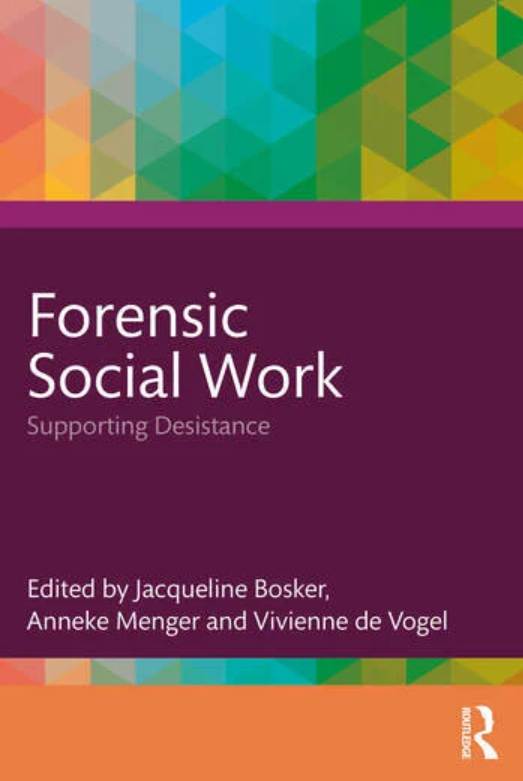
New Release: Forensic Social Work – Supporting Desistance
13/11/2025
This book, Forensic Social Work – Supporting Desistance, has been released by Routledge. It is a practice-oriented resource exploring how forensic social work can support desistance and foster meaningful change in the lives of justice-involved individuals.
Reading corner

Criminal Justice
Parole Futures
18/08/2025
At a time when many parole systems are experiencing considerable strain, the aims of this collection are twofold: first, to encourage systematic and critical reflection on the rationalities, institutions and practices of parole. Second, to think big, and pose ambitious ‘what if’ questions about the possible futures of parole and prison release. Offering novel insights from Asia, Australia, Europe, North America and South America, this collection builds the case for, and then showcases, a ‘way of doing’ parole research that is global in outlook, interdisciplinary in approach and unapologetically normative in character.
Probation Journal

Violent Extremism
2025 EU Guidance document responding to the needs of victims of terorrism
23/06/2025
To mark the EU Day of Remembrance for Victims of Terrorism on 11 March, the EU Centre of Expertise for Victims of Terrorism has published a new Guidance Document on the Needs of Victims. This document is a significant step forward in reinforcing a victim-centred approach within counter-terrorism efforts across the European Union.
Research
Launch of the CEP Research and Development Strategy Summary
17/06/2025
We’re thrilled to announce that the Confederation of European Probation (CEP), in cooperation with the University of Glasgow (led by CEP Honorary Member Professor Fergus McNeill), and with the support of the CEP Expert Group on Research, has produced the CEP Research and Development Strategy. We are happy to share the summary with you!
Probation Journal

Alternatives to pre-trial detention
Unpacking criminal detention rules and regulations across the EU
21/05/2025
The EU Agency for Fundamental Rights (FRA) has updated its online criminal detention database, which includes national standards, laws, and monitoring reports on detention conditions in the EU and the UK.
Probation Journal

Technology
Is AI Putting Remote Probation Supervision at Risk Before It Even Starts?
09/04/2025
David Jackson and Jed Stone focus on the use of AI in probation and advocate for investigations to understand the opportunity, address issues and innovate for the good of all.
Subscribe to our bi-monthly email newsletter!
"*" indicates required fields
- Keep up to date with important probation developments and insights.