

Next Article
News
Recap: Expert Meeting on Radicalisation in prison and probation
Spain has 11/3. The UK has 7/7 and 21/7. And for those who this doesn’t make sense, there is 9/11. Since these dates (the first three referring to the terrorist attacks on the public transport in Madrid and London) addressing violent extremism is a top priority of the EU. CEP co-organised an expert meeting on Radicalisation in prison and probation, held from 27th till 29th of January in Segovia, in the framework of the Spanish EU presidency. “One of the strong points of the meeting was that prison and probation were brought together”, states Per-Olov Humla, Deputy Head of Security Section, Swedish Prison and Probation Service. “Convicted extremists will try to win over other inmates for their cause. Those inmates who are susceptible for these extremist ideas and who are convicted for minor crimes, will almost all be paroled one day. Therefore an early warning system in prison and in aftercare, as well as the interaction between the two, is vital.”
The expert meeting was a part of the EU-funded project Reducing Influences that Radicalise Prisoners (RIRP). This project is led by London Probation and is executed by prison & probation organizations and research institutes from England, Germany and Spain, along with CEP. In a first stage of the project, influencing factors that can radicalise offenders are being identified. In a second stage a range of training materials is developed. These materials are designed in such a way that they can be used across the EU to train criminal justice staff working in prisons or with prisoners released on license in the community to be aware of these factors. The expert meeting in Segovia was the first moment that the RIRP project partners presented their findings to a broader public.
“The conference took place at the right time” Per-Olov Humla says. “Last year in July, in the framework of the Swedish EU Presidency, the Swedish prison service had organized a conference on combating violent extremism. The focus was mainly on violent radicalization, and not so much on rehabilitation. Nevertheless, rehabilitation is essential for preventing reoffending. Therefore I was happy that Spain and England had taken the initiative to broaden the topic of radicalisation with the aspect of probation.”
This set-up of the expert meeting lead to a vivid exchange of information between almost 60 delegates, representing 9 countries in Europe. “I was struck, throughout the expert meeting, at just what an ambitious and challenging agenda this is for prison and probation services”, Richard Pickering, Head of NOMS Security Group, reacts. “How can offender management systems deal with people who choose not to integrate into, and remain in opposition to, modern European societies? What are we trying to achieve? Is it desistance – stopping people from acting on anti-social ideas, or is it something more fundamental – the term “occidentalisation” was used at one point? How can we manage the risks presented by terrorist offenders – within the prison walls and to our societies at large – without a robust evidence base? Their numbers are so small we cannot yet say ‘what works’. These are just a few of the fascinating challenges which were highlighted at the conference.”
Also Per-Olov Humla was impressed by the contents of the expert meeting. “That was particularly the case with two speakers from the Muslim community in England”, Per-Olov Humla comments. “In their presentations they outlined the intercultural and interreligious aspects in countering radicalization and extremism. For me, their presentations stressed the importance to take into account the background of terrorist offenders. In Sweden, in order to avoid stigmatizing a specific group in the community, we tend to address violent extremism as a whole. However, dealing with offenders can only be done successfully when we look at the individual situation of the offenders. Therefore we have to identify what is motivating violent extremists. Is it their religious beliefs? Are they politically motivated? Or other? Once we know that, we can address each offender ‘in his own language’ . And as has been pointed out in the presentations, it therefore is crucial to engage people who are from the community of the inmates, but who are also pragmatic, skilled and also have the knowledge needed to change and challenge extremist behavior.”
Richard Pickering adds: “We also have to be very aware, and we returned to this several times over the course of the conference, how important it is to get our language right for our own understanding of what we are trying to achieve. A loose use of language which links concepts such as terrorism and violence to the language of legitimate faith might suggest difficulties in getting clear picture of this. There is a big risk in talking loosely about extremism and radicalisation in ways which do not respect religious and cultural diversity, and the proper place of faith and political ideology and activity in pluralist democracies. If we do so, we risk perpetuating perceptions of hostility to Islam, and strengthening the radicalisers’ case.”
On communications, Per-Olov Humla also identified another ‘best practice’ at the expert meeting. “Networking is very important in these kind of topics. However, when participating at meetings on violent extremism, I usually meet personnel from Security Departments and Law Enforcement Agencies. Now I have met with people from both prison and probation. This encounter has strengthened my opinion that probation and prison should work closer together in addressing violent extremism. As both sectors have a different approach in their work, I imagine this cooperation as a joint-venture in which a common approach to the problem is developed, and in which both parties learn more from each other. Next March, the Department I work for organizes a meeting on violent extremism. The Prison Unit, the Probation Unit, the Research and Evaluation Unit, and the Placement Unit, which takes care for the placement of inmates, will all participate at this meeting. I will propose that together we’ll design scenarios of possible cases we may encounter, and see how we should jointly respond to them. Should we engage religious leaders in the process? How do we manage the contact between extremists and other inmates? How do we disseminate literature on the topic? Those kind of things we need to discuss together. So you can call this a very concrete outcome of the expert meeting.”
According to the planning of the RIRP project, a second event will be held by the end of the year in England, in order to further disseminate the project results. “I am looking forward to it “, reacts Per-Olov Humla with enthusiasm. “At the expert meeting in Segovia I heard that in the framework of RIRP a training programme for Probation Officers has been developed. I already pointed out the importance of communications in fighting violent extremism. This implies that staff working in prison and probation is being trained thoroughly. Therefore I am very eager to know more about the training programme of London Probation. I am also curious for the experiences of frontline staff and probation staff working with violent extremists. For instance, has it ever occurred that staff has been ‘won over’ by extremist offenders? And what should be done in that case? Before we launch any training programme in probation, for instance as part of the normal probation, we need to gain lots of best practices, within the prison system and in the probation system. And to this end these kind of meetings are excellent.”
Richard Pickering can subscribe to this point of view. “For me the conference reaffirmed our common aims”, he says. ” Yet we have different offender management systems, and the composition of our terrorist offender populations is varied. Ongoing bilateral dialogue between individual member states, where we can share practice and experience of similar situations, is very helpful. Therefore I look forward to the next RIRP event this autumn, and to engaging with an even broader set of European colleagues. In the meantime, we have a range of existing structures and programmes across Europe, where I hope the RIRP project can locate itself, through the remainder of the Spanish Presidency and beyond.”

Related News
Keep up to date with the latest developments, stories, and updates on probation from across Europe and beyond. Find relevant news and insights shaping the field today.
Recap
Framework Decisions
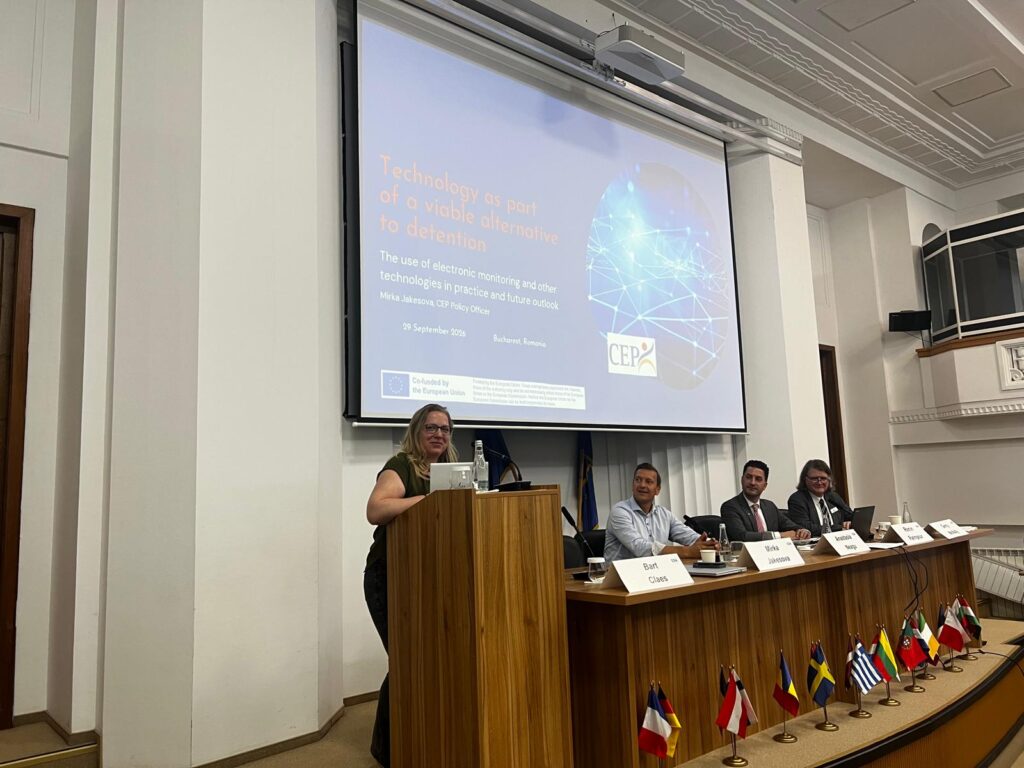
Recap: ERA workshop on Framework Decisions 829 and 947 in Bucharest
02/10/2026
CEP Vice-President Daniel Danglades, Ambassador Gerry McNally and Policy Officer Mirka Jakesova participated in the Seminar on Framework Decisions 829 and 947 and their Impact on Alternatives in the EU organized under the EU project run by the Academy of European Law on 28-29 September in Bucharest, Romania. The seminar brought together judges, prosecutors, probation practitioners, academics, and policy experts to discuss the growing role of alternatives to detention within European criminal justice systems.
New
CEP
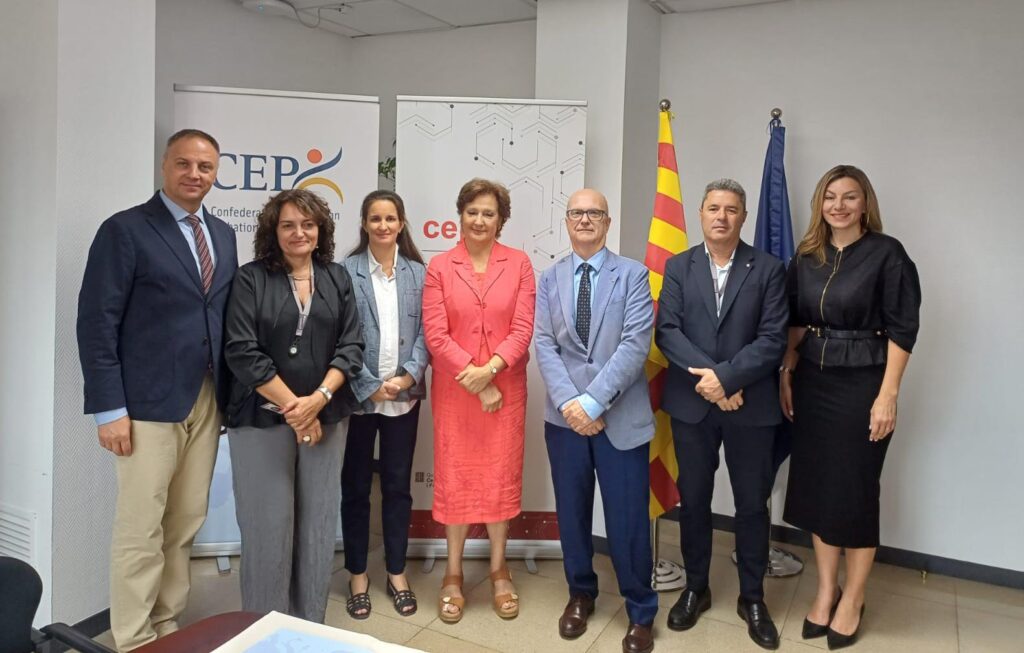
CEP and Catalan justice leaders reaffirm longstanding cooperation
29/09/2026
Representatives of the Confederation of European Probation (CEP) met with senior officials from the Catalan Department of Justice and Democratic Quality in Barcelona on 28 September 2026, alongside the opening of the sixth International Training School on Core Correctional Skills. The meeting offered an opportunity to recognise a longstanding partnership and discuss its continued development.
Updated
Mental Health
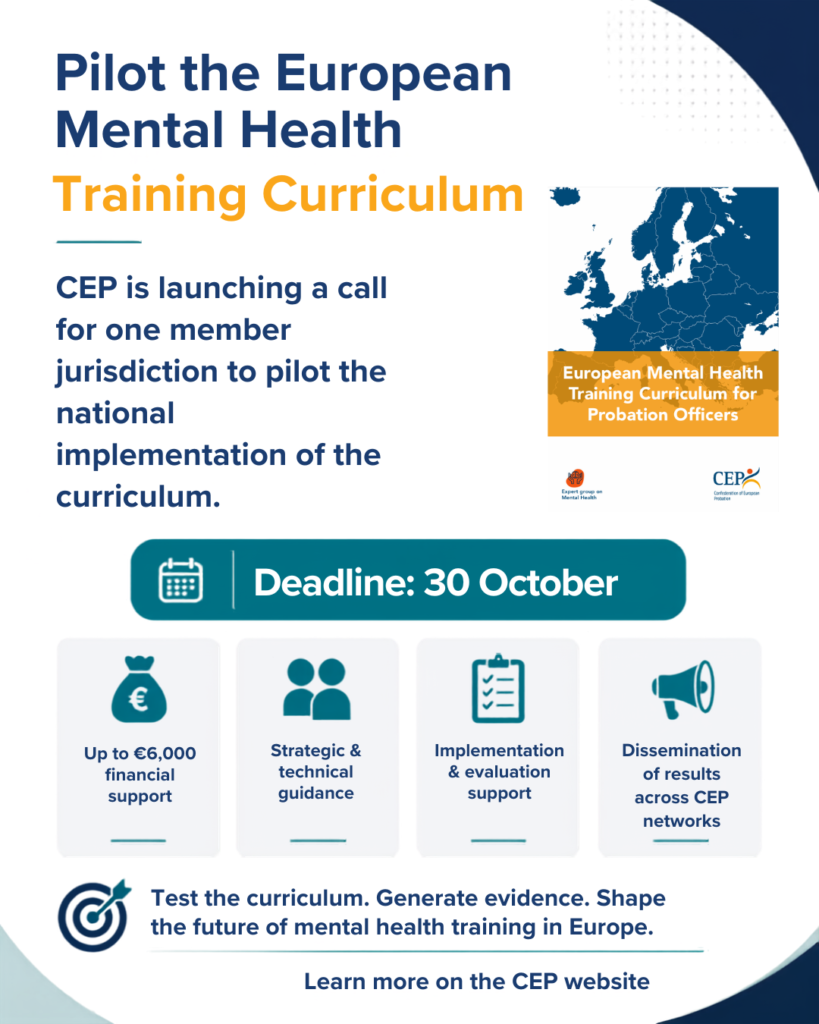
DEADLINE EXTENDED: Call for Pilot Implementation of the European Mental Health Training Curriculum
29/09/2026
Good news for CEP members! Following requests from our members, CEP has extended the deadline to apply for the pilot implementation of the European Mental Health Training Curriculum for Probation Officers.
Recap

ITSCCS, Technology
6th International Training School opens in Barcelona with a focus on digital probation
28/09/2026
How can probation professionals use new technologies in their interactions while building trust, showing empathy and supporting change? This question is at the heart of the sixth International Training School on Core Correctional Skills, which opened in Barcelona on 28 September 2026.
Recap
Probation in Europe
CEP at 42nd PC-CP Working Group Meeting
23/09/2026
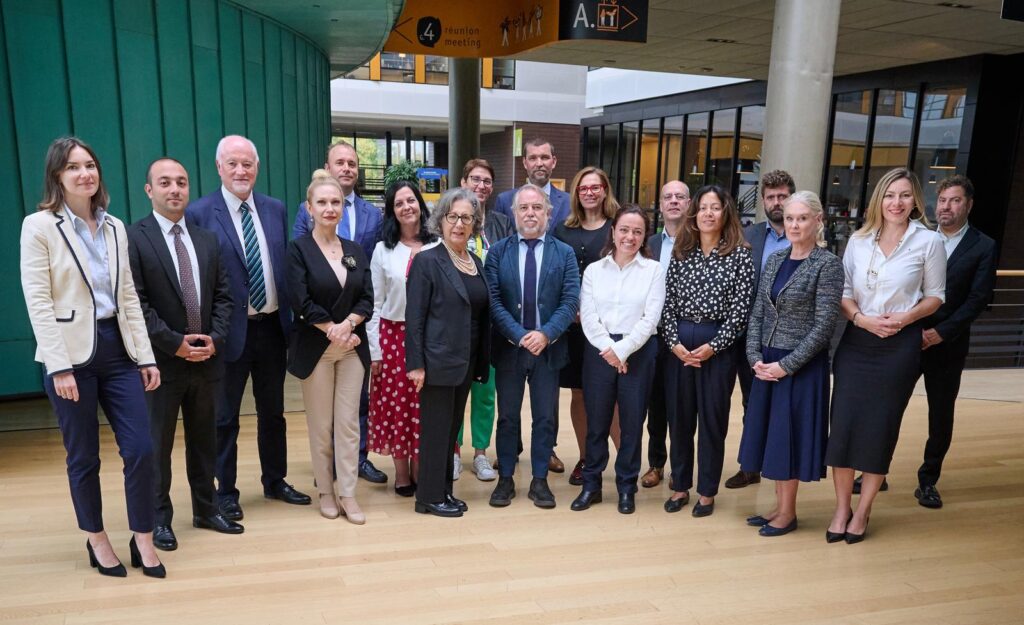
The Council for Penological Co-operation (PC-CP) Working Group held its 42nd meeting from 15–17 September 2026 in Strasbourg. CEP was represented by Secretary General Jana Špero Kamenjarin.
New
Probation in Europe
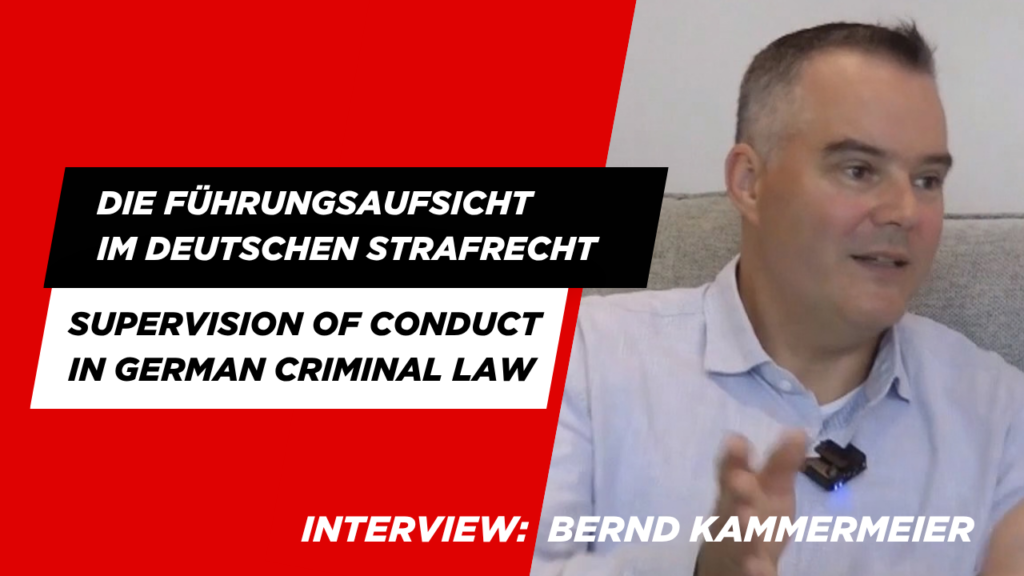
New Division episode: Bernd Kammermeier on Supervision of Conduct
23/09/2026
The 22nd episode of Division_Y features Bernd Kammermeier from Rostock, Mecklenburg-Western Pomerania.
Bernd is a unionist, practitioner and academic expert on supervision of conduct (Führungsaufsicht) in Germany. His recent PhD thesis examines the development and legal framework of this important instrument.
Subscribe to our bi-monthly email newsletter!
"*" indicates required fields
- Keep up to date with important probation developments and insights.