

Previous Article
News
Presentations and materials of the 4th Framework Decisions Expert Meeting now available!
33 participants from 17 countries gathered in Brussels, Belgium for the 4th edition of the Framework Decisions Expert Meeting on the 25th of September 2018. The meeting was organised to support and promote the implementation of the Framework Decisions throughout Europe and make recommendations/actions on how to enhance the implementation. The meeting was kindly hosted by Maisons de Justice, the probation service for the French speaking part of Belgium.
Since the last Expert Meeting in September 2017, CEP has worked hard on the actions that were agreed upon during this meeting. A questionnaire was send out and an analysis was made. CEP also produced a leaflet for the offenders, an informative guideline for probation officers and an animation video about the framework decisions on probation. These were presented during the meeting by CEP Policy Officer Maria Lindström. These are all preliminary versions of the materials. After the meeting, the participants are given the chance to suggest improvements.
Prof. Ioan Durnescu presented the new project “Probation Observatory Training and Network (PONT), which will start soon. The project aims at mapping and identifying local networks that work together in the EU Framework Decisions, and to provide training to them. He also presented a Framework Decision 2008/947 case study. After having presented the case, Ioan emphasized the importance for offenders to know what to expect regarding their supervision in another country. In fact, if there is not enough information that can be provided to them and if they are not fully aware of what to expect, is it really possible for them to agree on a transfer?
The final presenter was Mr. Ralph Bunche, Regional Director Europe of Fair Trials. He told the participants about the project Beyond Surrender. This EU-wide project that has looked into the use of the European Arrest Warrant (EAW) and the impact on the life of extradited people. Ralph Bunch stressed that European Arrest Warrant (EAW) is used too much in some countries where the European Supervision Order (ESO) could and should be used instead. There is an over use of the EAW instead of using the legislation with ESO that allows people to be in their home countries and which would make things more humane and better for both the person his-/herself and his/her family and/or children. After his presentation he showed the participants a short documentary about the impact of the European Arrest Warrant on the life of the person that is arrested, his or her family and children.
Presentations and report
Report Framework Decisions Expert Meeting
Presentation by Maria Lindström
Presentation about the PONT project by Ioan Durnescu

Related News
Keep up to date with the latest developments, stories, and updates on probation from across Europe and beyond. Find relevant news and insights shaping the field today.
Recap
Framework Decisions
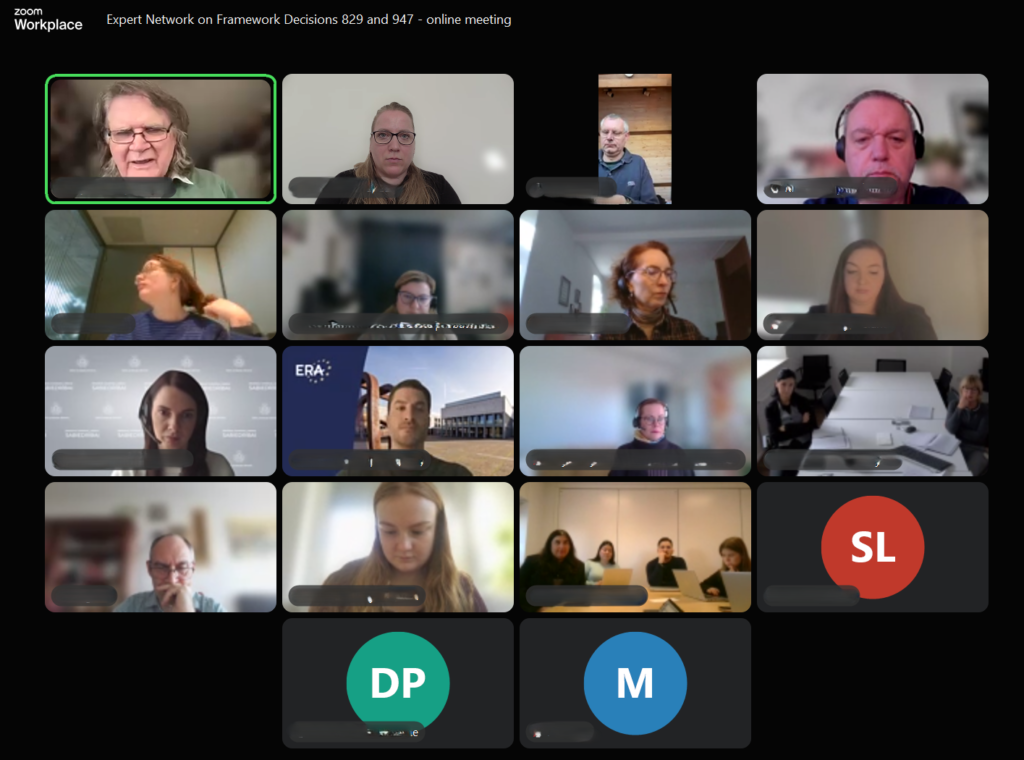
Recap: annual meeting of the Expert Network on Framework Decisions 829 and 947
09/11/2026
On Thursday 5 November an annual meeting of the Expert Network on Framework Decisions 829 and 947 took place online. Bringing together 20 participants from 12 EU jurisdictions including representatives of the Academy of European Law and European Judicial Network, the meeting provided an opportunity to exchange experiences, discuss current implementation challenges and identify priorities for enhancing cross-border cooperation in the application of the two Framework Decisions.
New

Education and Training, Probation in Europe
Justice programme: the judicial training call is open for applications!
09/11/2026
Are you ready to help address the training needs of justice professionals from different EU countries in the fields of civil law, criminal law and fundamental rights? This call supports cross-border training projects contributing to the effective and consistent application of EU law. In line with the new European Judicial Training Strategy, the call also supports the digitalisation of justice. Don’t miss this opportunity! Apply by 4 March 2027, 17:00 Brussels time.
Recap

CEP Board, Foreign Nationals in Prison and Probation, Probation in Europe
CEP at the 16th Plenary Meeting of the Council for Penological Co-operation
06/11/2026
From 3 to 5 November 2026, representatives of the Confederation of European Probation (CEP) participated in the 16th Plenary Meeting of the Council for Penological Co-operation (PC-CP).
New

CEP
Newsletter October 2026 out now
29/10/2026
CEP’s latest newsletter is out now! It includes:
- Deadline approaching for the Workshop on Technology and Alternatives to Detention
- Recap of the 14th EM and CEP Excellence Leadership Training
- New publications from Expert Groups on Technology and Expert Group on Violent Extremism
- Call for Proposals: Evaluation of CEP Expert Groups
- Engaging with Research – a new section in our newsletter
- and much more!
New
Violent Extremism
Understanding Youth Radicalisation: What Can Probation Services Do? | New Report from CEP’s Expert Group
27/10/2026
In recent decades, the violent radicalisation of juveniles and young adults has become a pressing concern for policymakers, researchers, practitioners, and communities worldwide. While considerable attention has been devoted to psychological vulnerabilities, socio-economic marginalisation, and community-level influences, the broader context in which violent radicalisation develops is often overlooked. At the same time, the increasing involvement of young people in violent extremist offences highlights the urgent need for effective prevention efforts. Addressing youth radicalisation has become a complex and evolving challenge for families, educators, mental health professionals, law enforcement agencies, probation services, and security authorities.
Recap

Probation in Europe
Reflections on the European Society of Criminology Conference 2026 | From Criminological Research to Probation Practice
26/10/2026
At CEP, we are fascinated by research from across Europe and beyond, and by helping it reach the people who can use it. Ruth Armstrong, CEP Research and Policy Officer, went to the 26th Annual Conference of the European Society of Criminology (EuroCrim 2026 – Working Group on Community Sanctions and Measures) that took place in Warsaw, Poland, from 9–12 September 2026.
Against a backdrop of overcrowded prisons and net-widening (with ever more people drawn into supervision), three questions kept coming up in the research: how time shapes justice, what we mean by success, and how we define harm.
Subscribe to our bi-monthly email newsletter!
"*" indicates required fields
- Keep up to date with important probation developments and insights.