

Previous Article
News
A new project: Probation Observatory. Network and Training (PONT)!
Although they were adopted in 2008 and 2009, the Council of Europe Framework Decision 2008/947/JHA and Framework Decision 2009/829/JHA (FDs, in short), are still underused by the member states. For example, in 2017 FD 2008/947 was only used in 369 incoming cases and 396 outgoing cases. Despite a small progress in 2018 (544 incoming cases and 548 outgoing cases), its potential is far from being fulfilled. The use of FD 2009/829 is even more critical. Statistical data regarding its utilisation is not even available as there is no dedicated agency dealing with it in the member states.
In order to enhance the use of these two FDs, the European Commission through DG Justice Grants decided to fund the project Probation Observatory. Network and Training (PONT), initiated by the University of Bucharest, in partnership with University Loyola Andalucía, University of Latvia, Ministry of Justice Bremen and the Confederation of European Probation (CEP).
The objectives of the project for the next two years are to offer training to the competent authorities on the two FDs and to create a sustainable network of experts in this field.
Literature and Training
To this end, the project team will conduct a thorough literature review, covering academic papers, grey literature and previous training content. At the same time, based on questionnaires and interviews, they will run a training gap analysis aiming at identifying the training needs of the competent authorities and probation staff in relation to the FDs.
Based on the training gap analysis and the literature review, they will elaborate a comprehensive training platform and deliver training to at least 60 representatives of the competent authorities and probation staff from at least twelve jurisdictions.
As the training will be conducted in a training of trainers fashion, it is expected that the trainees will become resources (trainers and experts) for their own jurisdictions and the surrounding areas.
Information Request
The project builds on the previous projects dedicated to mutual trust and FDs. Therefore, the project team would be grateful for receiving information about any brochure, manual, article or training content that was used in your jurisdiction when preparing for the implementation of the FDs. With your consent, they could be stored in a comprehensive bank of training materials that will be open for anyone interested and could also be used on the training platform developed by this project. This information and others that you think might be of use could be directed to the project leader, prof. Ioan Durnescu, email: idurnescu@gmail.com.
Thank you for your cooperation.
Prof. Ioan Durnescu

Related News
Keep up to date with the latest developments, stories, and updates on probation from across Europe and beyond. Find relevant news and insights shaping the field today.
Recap
Framework Decisions
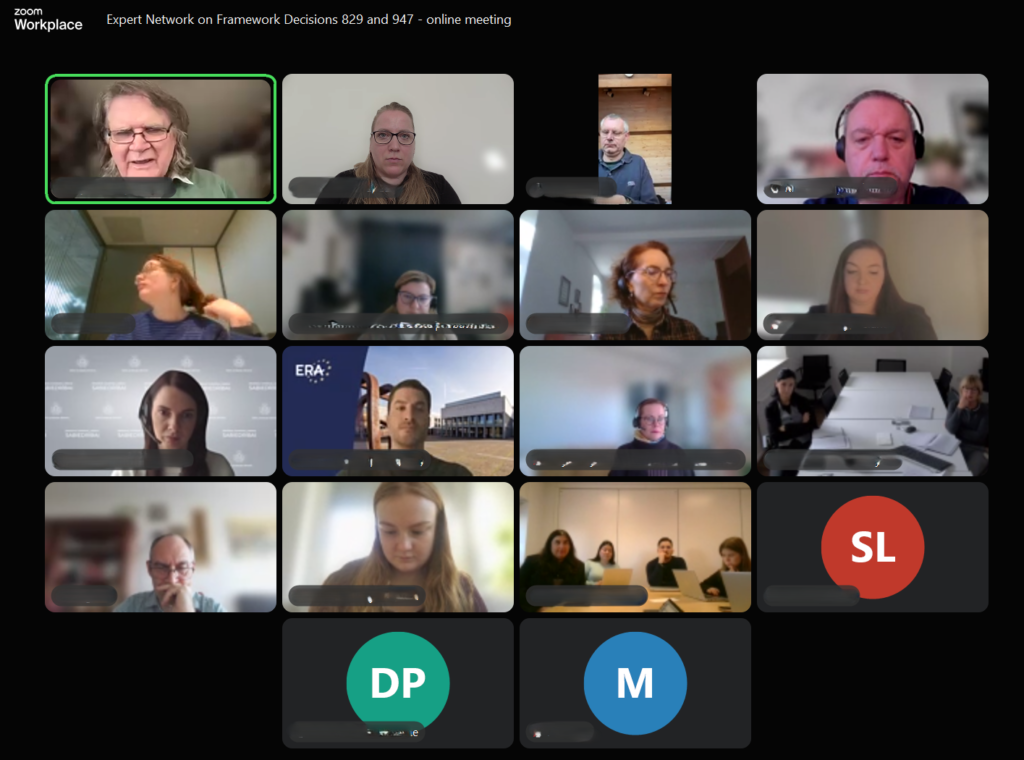
Recap: annual meeting of the Expert Network on Framework Decisions 829 and 947
09/11/2026
On Thursday 5 November an annual meeting of the Expert Network on Framework Decisions 829 and 947 took place online. Bringing together 20 participants from 12 EU jurisdictions including representatives of the Academy of European Law and European Judicial Network, the meeting provided an opportunity to exchange experiences, discuss current implementation challenges and identify priorities for enhancing cross-border cooperation in the application of the two Framework Decisions.
New

Education and Training, Probation in Europe
Justice programme: the judicial training call is open for applications!
09/11/2026
Are you ready to help address the training needs of justice professionals from different EU countries in the fields of civil law, criminal law and fundamental rights? This call supports cross-border training projects contributing to the effective and consistent application of EU law. In line with the new European Judicial Training Strategy, the call also supports the digitalisation of justice. Don’t miss this opportunity! Apply by 4 March 2027, 17:00 Brussels time.
Recap

CEP Board, Foreign Nationals in Prison and Probation, Probation in Europe
CEP at the 16th Plenary Meeting of the Council for Penological Co-operation
06/11/2026
From 3 to 5 November 2026, representatives of the Confederation of European Probation (CEP) participated in the 16th Plenary Meeting of the Council for Penological Co-operation (PC-CP).
New

CEP
Newsletter October 2026 out now
29/10/2026
CEP’s latest newsletter is out now! It includes:
- Deadline approaching for the Workshop on Technology and Alternatives to Detention
- Recap of the 14th EM and CEP Excellence Leadership Training
- New publications from Expert Groups on Technology and Expert Group on Violent Extremism
- Call for Proposals: Evaluation of CEP Expert Groups
- Engaging with Research – a new section in our newsletter
- and much more!
New
Violent Extremism
Understanding Youth Radicalisation: What Can Probation Services Do? | New Report from CEP’s Expert Group
27/10/2026
In recent decades, the violent radicalisation of juveniles and young adults has become a pressing concern for policymakers, researchers, practitioners, and communities worldwide. While considerable attention has been devoted to psychological vulnerabilities, socio-economic marginalisation, and community-level influences, the broader context in which violent radicalisation develops is often overlooked. At the same time, the increasing involvement of young people in violent extremist offences highlights the urgent need for effective prevention efforts. Addressing youth radicalisation has become a complex and evolving challenge for families, educators, mental health professionals, law enforcement agencies, probation services, and security authorities.
Recap

Probation in Europe
Reflections on the European Society of Criminology Conference 2026 | From Criminological Research to Probation Practice
26/10/2026
At CEP, we are fascinated by research from across Europe and beyond, and by helping it reach the people who can use it. Ruth Armstrong, CEP Research and Policy Officer, went to the 26th Annual Conference of the European Society of Criminology (EuroCrim 2026 – Working Group on Community Sanctions and Measures) that took place in Warsaw, Poland, from 9–12 September 2026.
Against a backdrop of overcrowded prisons and net-widening (with ever more people drawn into supervision), three questions kept coming up in the research: how time shapes justice, what we mean by success, and how we define harm.
Subscribe to our bi-monthly email newsletter!
"*" indicates required fields
- Keep up to date with important probation developments and insights.