

Previous Article
News
Making Framework Decisions support information more accessible
At 26th and 27th August, CEP organised an expert meeting on the Framework Decisions on the transfer of probations sentences and on alternatives to pre-trial detention. A clear learning point for CEP was that results from actions and projects that supported the implementation and the application of these Framework Decisions should be made available more easily for those who are involved in transfer processes. “It was a loud and clear message and we do not hesitate to take this on”, announces Willem van der Brugge, CEP Secretary General.
In the past years CEP has been involved in many actions and projects that aimed the uniform implementation of Framework Decision 2008/947/JHA (on the transfer of probation sanctions) and 2009/829/JHA (on transfer of alternatives to pre-trial detention). “We have had DOMICE of course, which resulted in descriptions of case management stream in probation in most jurisdictions in Europe”, clarifies Willem van der Brugge. “But we also initiated the project ISTEP. Central in the project website is a module with which you can check whether a certain type of probation sanction used in one jurisdiction also is used in another. We have of course Probation in Europe, in which probation systems in 34 jurisdictions in Europe have been described. But there are many more examples, such as the presentations on the Framework Decisions at our conferences.”
However, all this information is to be found at different websites that are maintained by CEP. DOMICE and ISTEP have their own websites (these websites are no longer available, all the project information is published on the CEP project page), whereas Probation in Europe is on the CEP website. The presentations are on different places in the CEP knowledgebase. “It would be so much better if we brought all this information together on one particular place on our CEP website”, concludes Willem van der Brugge. “It is a huge job for sure, but it will add greatly to the profile of CEP as a service provider in the field of European probation, both to its members as well to its stakeholders. Therefore this is one of the priorities for CEP in 2016.”
The job, executed by the Communication Officer, will be done parallel to the updating of the different information. “The updating process of the country descriptions of Probation in Europe is continuous”, clarifies Willem van der Brugge. “We have commissioned Tony Grapes to update and upgrade the schematic overviews of probation systems and services from DOMICE. And CEP itself will update and complete the information from the ISTEP website.”
Still CEP has more plans for the development of its website with regard to supporting the implementation of the Framework Decisions. Willem van der Brugge: “When we were preparing the expert meeting in Brussels, we learned that the European Judicial Network (EJN) has a wonderful website with lots of up-to-date information on the legal aspects of Framework Decision 2008/947/JHA, 2009/829/JHA and other EU legal instruments for judicial cooperation. We should not replicate this information on the CEP website, but promote the EJN website instead. We could further add to this legal information by making a webpage on the CEP website where we will make links to relevant websites, articles and online tools that support the practical use of the Framework Decisions 2008/947/JHA and 2009/829/JHA. Before the end of the year, we will have this webpage online

Related News
Keep up to date with the latest developments, stories, and updates on probation from across Europe and beyond. Find relevant news and insights shaping the field today.
New

CEP Board
CEP board visit France
16/11/2026
On 13 November 2026, the CEP Board visited its French member organisation, the Direction Générale de l’Administration Pénitentiaire of the French Ministry of Justice. The visit coincided with the final CEP Board meeting of the year, hosted by CEP Vice-President Mr Daniel Danglades, who represents the French institution.
Recap
Framework Decisions
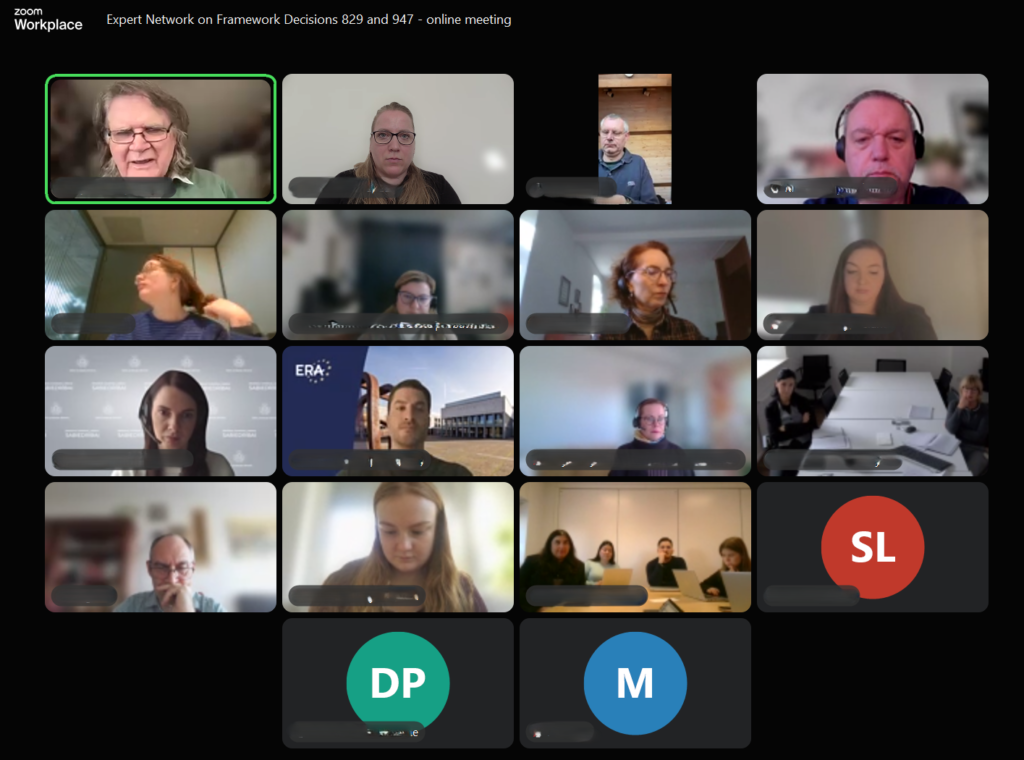
Recap: annual meeting of the Expert Network on Framework Decisions 829 and 947
09/11/2026
On Thursday 5 November an annual meeting of the Expert Network on Framework Decisions 829 and 947 took place online. Bringing together 20 participants from 12 EU jurisdictions including representatives of the Academy of European Law and European Judicial Network, the meeting provided an opportunity to exchange experiences, discuss current implementation challenges and identify priorities for enhancing cross-border cooperation in the application of the two Framework Decisions.
New

Education and Training, Probation in Europe
Justice programme: the judicial training call is open for applications!
09/11/2026
Are you ready to help address the training needs of justice professionals from different EU countries in the fields of civil law, criminal law and fundamental rights? This call supports cross-border training projects contributing to the effective and consistent application of EU law. In line with the new European Judicial Training Strategy, the call also supports the digitalisation of justice. Don’t miss this opportunity! Apply by 4 March 2027, 17:00 Brussels time.
Recap

CEP Board, Foreign Nationals in Prison and Probation, Probation in Europe
CEP at the 16th Plenary Meeting of the Council for Penological Co-operation
06/11/2026
From 3 to 5 November 2026, representatives of the Confederation of European Probation (CEP) participated in the 16th Plenary Meeting of the Council for Penological Co-operation (PC-CP).
New

CEP
Newsletter October 2026 out now
29/10/2026
CEP’s latest newsletter is out now! It includes:
- Deadline approaching for the Workshop on Technology and Alternatives to Detention
- Recap of the 14th EM and CEP Excellence Leadership Training
- New publications from Expert Groups on Technology and Expert Group on Violent Extremism
- Call for Proposals: Evaluation of CEP Expert Groups
- Engaging with Research – a new section in our newsletter
- and much more!
New
Violent Extremism
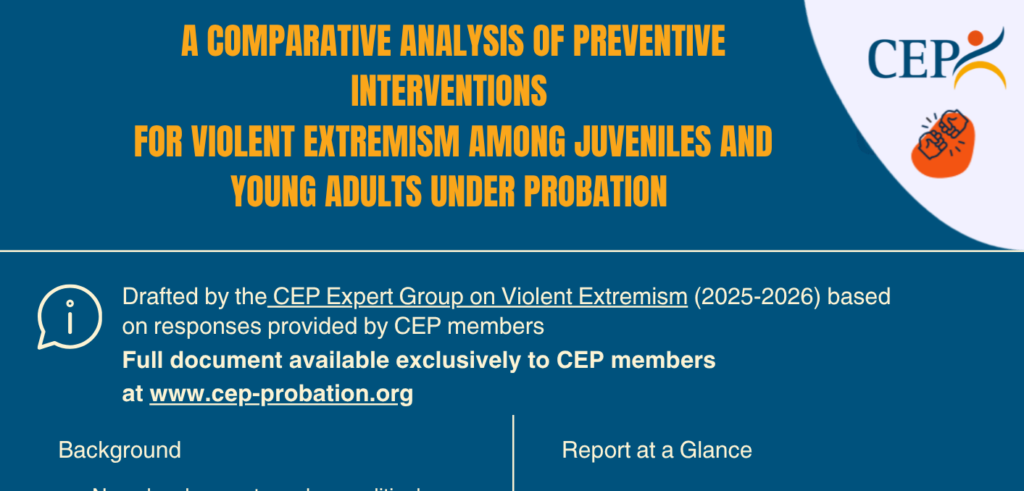
Understanding Youth Radicalisation: What Can Probation Services Do? | New Report from CEP’s Expert Group
27/10/2026
In recent decades, the violent radicalisation of juveniles and young adults has become a pressing concern for policymakers, researchers, practitioners, and communities worldwide. While considerable attention has been devoted to psychological vulnerabilities, socio-economic marginalisation, and community-level influences, the broader context in which violent radicalisation develops is often overlooked. At the same time, the increasing involvement of young people in violent extremist offences highlights the urgent need for effective prevention efforts. Addressing youth radicalisation has become a complex and evolving challenge for families, educators, mental health professionals, law enforcement agencies, probation services, and security authorities.
Subscribe to our bi-monthly email newsletter!
"*" indicates required fields
- Keep up to date with important probation developments and insights.