

Previous Article
News
Interview with new CEP board member Eva Fernandes
During the General Assembly in Austria, a new CEP Board got elected for the upcoming three years. In the coming weeks we will publish interviews with all newly-elected board members where they will share information on their professional background, how they would like to contribute, what challenges lie ahead and many more.
Enjoy reading!
Can you shortly introduce yourself?
I am Eva Fernandes, with more than thirty years of experience in the probation and community sanctions system, particularly in coordinating multidisciplinary teams. I began my career during the 1982 criminal justice reform, joining the former Institute for Social Reintegration, where I contributed to the transition from a model focused on general social integration to one increasingly centred on crime prevention, grounded in criminological principles and evidence-based interventions aimed at reducing reoffending.
From 2001 onwards, in management positions, I focused on ensuring that the execution of sentences fully respected judicial decisions, the rights of convicted individuals, and the protection of victims and society. I contributed to the development of technical guidelines, standardised procedures, continuous training, and tools for assessing risk and criminogenic needs, promoting a culture of quality, consistency, and continuous improvement. Externally, I closely followed legislative developments that strengthened the role of probation services in the implementation of community sanctions, including the introduction of electronic monitoring.
Currently, as Deputy Director General, I am responsible for pre-sentence advisory services, community-based sentence execution — including electronic monitoring — and juvenile justice. I maintain a strong belief in people’s capacity for change and guide my work by the values of social reintegration and human rights.
Why did you decide to run for the CEP Board?
My decision to run for the CEP Board reflects my long-standing commitment to developing social reintegration and recidivism prevention policies, as well as strengthening international cooperation in the field of probation. The CEP is a key European platform for knowledge exchange, innovation, and the dissemination of good practice, and I believe that my professional experience, combined with my work in community-based sentence execution, can contribute meaningfully to its strategic objectives.
My candidacy is therefore an opportunity to enhance my country’s participation in European structures, to highlight the technical expertise of our professionals, and to support the development of more effective, humane, and evidence-based responses within the probation field.
How would you like to contribute to the development of CEP in the upcoming three years, and what impact do you hope to have?
Over the next three years, I aim to contribute to the CEP’s development through three priority areas: strengthening international cooperation, enhancing the professional capacity of staff, and promoting evidence-based practice.
First, I intend to deepen cooperation among European probation services by creating more regular opportunities for sharing knowledge, challenges, and solutions. The diversity of probation models across Europe is a valuable resource that should be mobilised more systematically so that all member states can benefit from shared experience.
Second, I aim to strengthen the professional recognition and development of probation staff by promoting training initiatives, exchange programmes, and technical accreditation. The quality of frontline work depends directly on the continuous development of teams, and the CEP can play a decisive role in fostering learning networks and professional growth.
Finally, I hope to reinforce the use of evidence-based policies and practices by encouraging the production, dissemination, and application of research relevant to probation. Informed decision-making is essential to ensuring interventions that are effective, humane, and responsive to the needs of individuals under supervision.
The impact I hope to achieve is the consolidation of a more participatory organisation, closer to its members and more influential in the European justice landscape. I aspire to contribute to a CEP that continues to lead innovation in probation, promoting models that strengthen public safety, protect victims, and uphold human dignity.
What are your main priorities or topics you would like to address as a CEP Board member, and how would you like to make use of your knowledge for the development of CEP?
As a member of the CEP Board, I would focus on four strategic priorities essential for the future of Probation in Europe.
First, I aim to strengthen the technical quality and coherence of probation practice, supporting the development of common guidance that helps member states implement effective, ethical, and evidence-based models. My experience in designing standardised procedures, assessment tools, and quality assurance mechanisms can contribute to this work at the European level.
Second, I would prioritise the recognition and professional development of probation staff, acknowledging their central role in supporting behavioural change and social reintegration. The CEP can play a crucial role in promoting specialised training, staff exchanges, and well-being initiatives that address current challenges, including burnout and the need for increasingly diverse competencies.
Third, I consider it essential to strengthen the link between research and practice, promoting the production and dissemination of scientific knowledge that supports informed policy and operational decisions. I hope to help bring researchers, policymakers, and practitioners closer together, fostering a culture of continuous learning and rigorous evaluation.
Finally, I aim to reinforce the CEP’s visibility and influence within the broader European institutional landscape, contributing to a stronger presence in discussions on criminal justice, human rights, and reintegration policies. My experience in legislative implementation and interinstitutional coordination can support this strategic positioning.
Through these priorities, I hope to place my experience at the service of the CEP, contributing to a stronger, more innovative organisation aligned with the values of human dignity, social inclusion, and public protection.
What are the challenges that lie ahead for CEP in the future?
In the coming years, the CEP will face challenges that require adaptability, technical leadership, and a coherent European vision. One of the main challenges is the increasing complexity of the profiles of individuals under probation supervision, which demands more specialised and multidisciplinary interventions.
A particularly critical challenge will be the rise in burnout among professionals, resulting from high workloads, continuous exposure to emotionally demanding situations, and insufficient resources. Strengthening staff well-being, training, and retention will therefore be essential to ensuring sustainable and high-quality services.
Another significant challenge is the need to harmonise practices across countries with very different probation models, promoting knowledge exchange without undermining national diversity. Digitalisation and the integration of new technologies — from case management systems to monitoring tools — will require ethical, technical, and strategic guidance.
Finally, the CEP will need to reinforce its influence within European institutions, ensure financial sustainability, and support member states in responding to social, economic, and migratory pressures that directly affect Probation.

Related News
Keep up to date with the latest developments, stories, and updates on probation from across Europe and beyond. Find relevant news and insights shaping the field today.
Recap
Electronic monitoring, Technology
14th Electronic Monitoring Conference, Electronic Monitoring in a Changing World – Perception vs Reality
08/10/2026
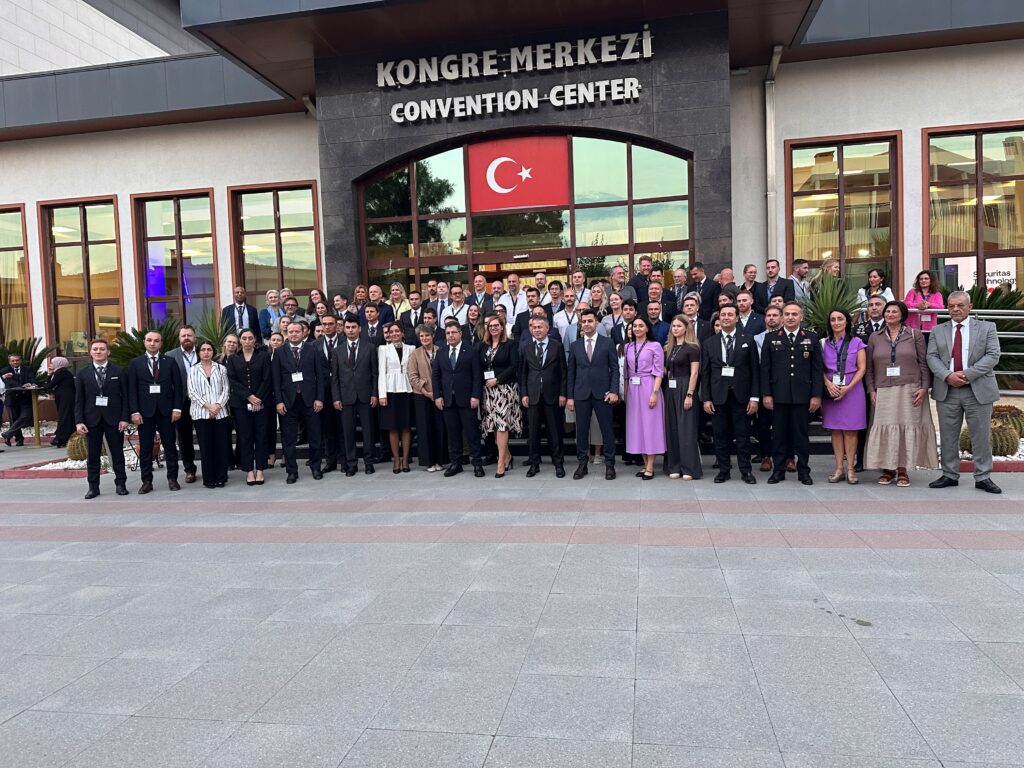
On 6-8 October 2026, Antalya hosted the 14th Electronic Monitoring Conference “Electronic Monitoring in a Changing World – Perception vs Reality”. More than 350 participants coming from 30 countries across Europe and worldwide representing probation services, Ministries of Justice, victims´ services, EM providers, researchers as well as local participants representing the Turkish Prison and Probation Service gathered to discuss how electronic monitoring (EM) is understood by all stakeholders involved including the victims and the public, and how these perceptions compare to the evidence and experiences of those affected. While the gap between perception and reality in electronic monitoring has been recognised for over a decade, the rapid expansion of EM into areas such as victim protection, high-risk supervision and digital innovation has brought new challenges and questions to the forefront.
Recap

ITSCCS
Core Correctional Skills in Digital Probation: highlights from the 6th ITSCCS in Barcelona
05/10/2026
The sixth International Training School on Core Correctional Skills (ITSCCS) took place in Barcelona from 28 September to 2 October 2026, bringing together 26 participants for a week of learning, practical training and international exchange. Organised by the Confederation of European Probation (CEP) and the Centre for Legal Studies and Specialised Training (CEJFE), the programme focused on “Clicks and Empathy: Core Correctional Skills in Digital Probation.”
Recap
Framework Decisions
Recap: ERA workshop on Framework Decisions 829 and 947 in Bucharest
02/10/2026
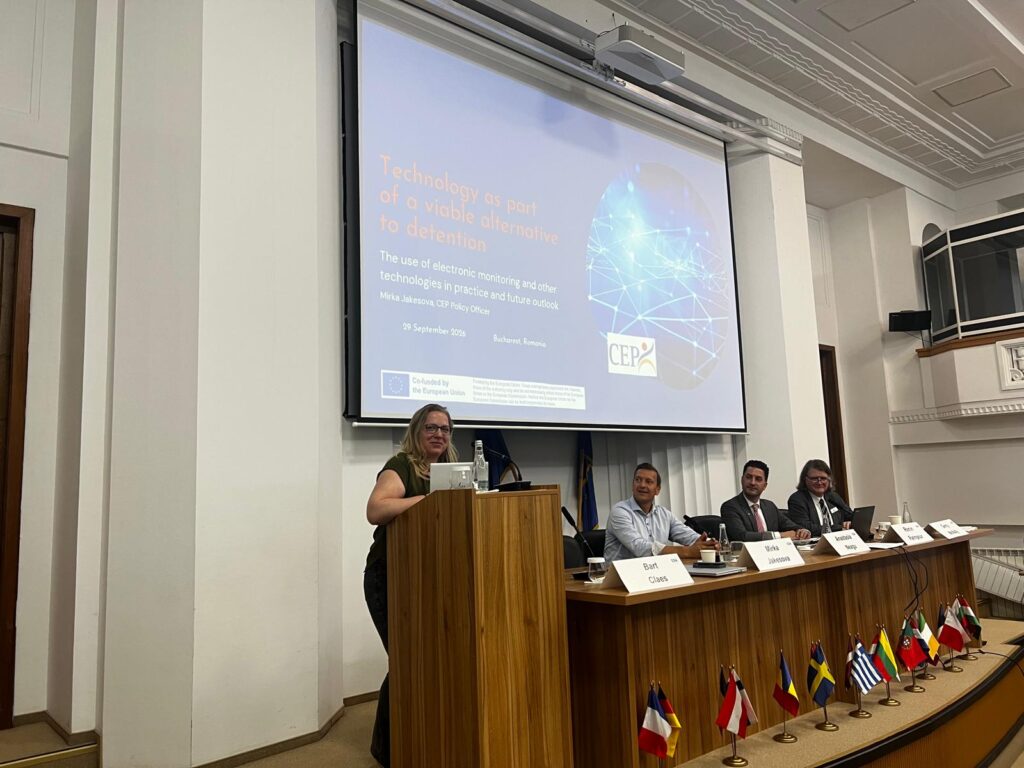
CEP Vice-President Daniel Danglades, Ambassador Gerry McNally and Policy Officer Mirka Jakesova participated in the Seminar on Framework Decisions 829 and 947 and their Impact on Alternatives in the EU organized under the EU project run by the Academy of European Law on 28-29 September in Bucharest, Romania. The seminar brought together judges, prosecutors, probation practitioners, academics, and policy experts to discuss the growing role of alternatives to detention within European criminal justice systems.
New

CEP
CEP and Catalan justice leaders reaffirm longstanding cooperation
29/09/2026
Representatives of the Confederation of European Probation (CEP) met with senior officials from the Catalan Department of Justice and Democratic Quality in Barcelona on 28 September 2026, alongside the opening of the sixth International Training School on Core Correctional Skills. The meeting offered an opportunity to recognise a longstanding partnership and discuss its continued development.
Updated
Mental Health
DEADLINE EXTENDED: Call for Pilot Implementation of the European Mental Health Training Curriculum
29/09/2026
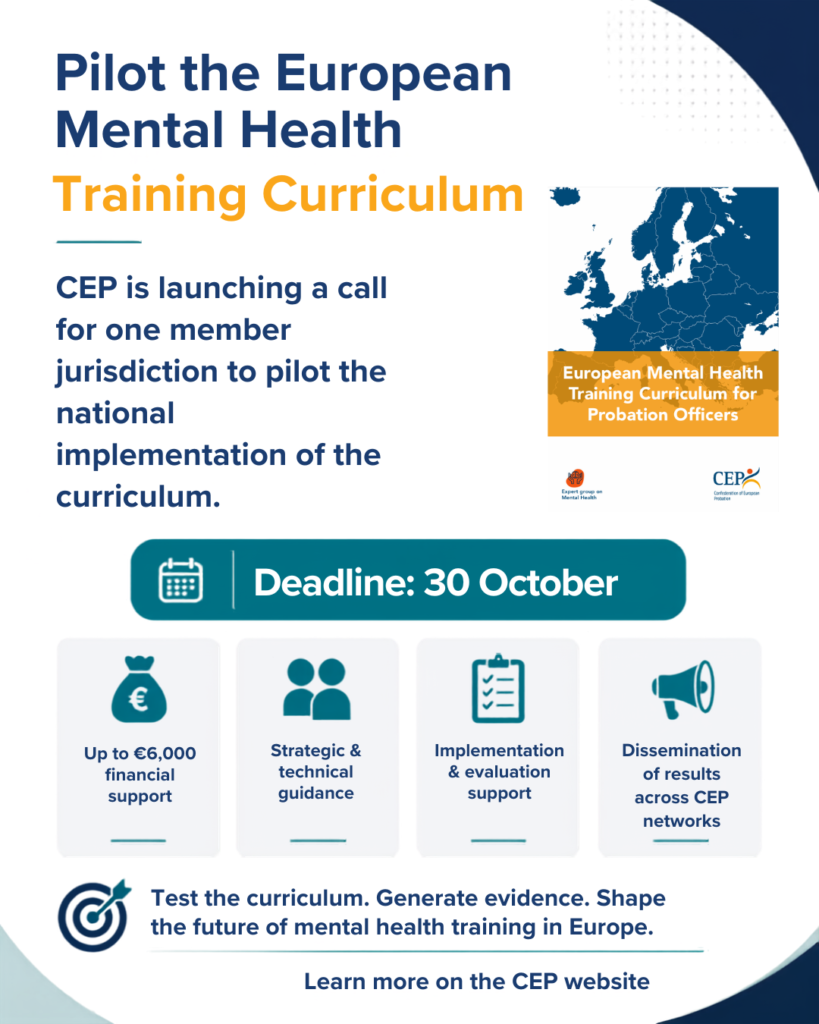
Good news for CEP members! Following requests from our members, CEP has extended the deadline to apply for the pilot implementation of the European Mental Health Training Curriculum for Probation Officers.
Recap

ITSCCS, Technology
6th International Training School opens in Barcelona with a focus on digital probation
28/09/2026
How can probation professionals use new technologies in their interactions while building trust, showing empathy and supporting change? This question is at the heart of the sixth International Training School on Core Correctional Skills, which opened in Barcelona on 28 September 2026.
Subscribe to our bi-monthly email newsletter!
"*" indicates required fields
- Keep up to date with important probation developments and insights.