
Previous Article
News
Exploring Non-Formal Learning for Probation: A Transnational Collaboration
State Probation Service of Latvia (SPS) is close to finishing an important project – the Erasmus+ project “Explore Your Potential”. SPS is implementing it together with the Romanian non-governmental organization Asociatia idei si proiecte pentru tineri activi (IPTA) and the Spanish non-governmental organization RED EUROPEA LOS JOVENES IMPORTAN AHOR. The overall duration of the project was 28 months, and now the collaboration that lasted more than two years is coming to its conclusion.

Context
The focal point of this project is non-formal learning and its integration into working with probation clients aged 21-30. The goals include both a comprehensive manual of approaches and methods for the prevention of substance abuse and violent behavior, as well as specialists trained in the application of these methods. Thus, the transferability and sustainability of project results will be ensured.
One of the primary objectives of this project, which started at the beginning of 2021, was to foster closer ties between Latvian probation services and NGOs operating in the field of criminal justice and social integration. By leveraging the expertise and resources of these organizations, the project aimed to strengthen support mechanisms for youth under probation and promote their successful reintegration into society. Therefore, this project for SPS marks a significant milestone in cross-border collaboration with non-governmental organizations (NGOs) aimed at enhancing probation services in Latvia.
Project results
Over the course of its implementation, the project facilitated knowledge-sharing, capacity-building, and the development of innovative practices within Latvian probation services. This was achieved through a series of workshops, training sessions, and collaborative initiatives designed to enhance the skills of probation officers and equip them with effective tools for working with youth within the criminal justice system. Overall, there were five transnational meetings organized in three countries, and two training courses for probation youth specialists were conducted.
As the project draws to a close on 30th of April, its impact will continue to resonate within Latvian probation services and the broader criminal justice landscape. It will be important to other Latvian organizations working with youth as well. In order to provide dissemination of the project results, on April 12th, SPS organized a seminar for its partners from NGOs and other organizations working with youth. During this event, the handbook of non-formal learning methods was presented and handed over to participants.
Project aftermath
The handbook developed in the “Explore your potential” project will be integrated into probation work to enhance offender rehabilitation strategies and support effective reintegration into society. Looking ahead, the project’s legacy will be sustained through the planning of new initiatives and collaborations aimed at further advancing probation services and community-based interventions. Krista Skara (Head of Probation Programs Department, The State Probation Service of Latvia), acknowledges: This project has been a real adventure for us – offering new ideas and ways to help young people better integrate into society. Our cooperation with NGOs from other countries has expanded our knowledge and skills, helped us to find new collaborators and friends.
>>Learn more about the project.
You can find more about the project on the “Explore Your Potential” Facebook page.
The project is co-financed by the European Union from the funds of the “Erasmus+” program.
This article was written by Jānis Nicmanis (Leading expert of the Performance Analysis and Development Department at State Probation Service of Latvia).

Related News
Keep up to date with the latest developments, stories, and updates on probation from across Europe and beyond. Find relevant news and insights shaping the field today.
Recap
Framework Decisions
Recap: annual meeting of the Expert Network on Framework Decisions 829 and 947
09/11/2026
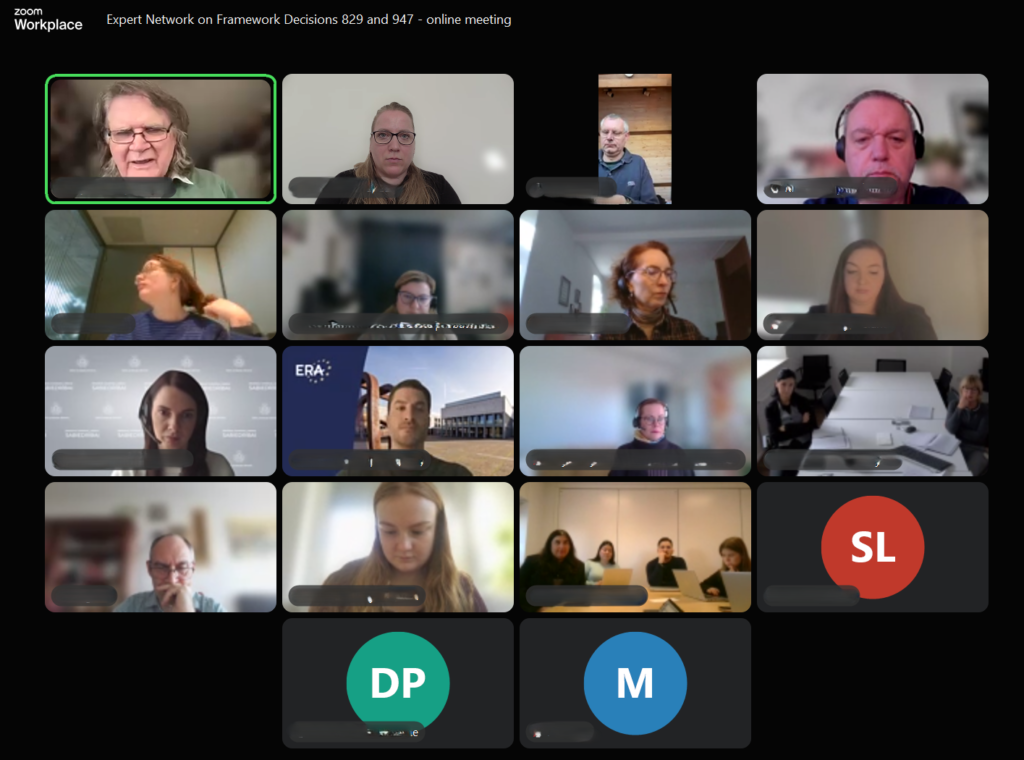
On Thursday 5 November an annual meeting of the Expert Network on Framework Decisions 829 and 947 took place online. Bringing together 20 participants from 12 EU jurisdictions including representatives of the Academy of European Law and European Judicial Network, the meeting provided an opportunity to exchange experiences, discuss current implementation challenges and identify priorities for enhancing cross-border cooperation in the application of the two Framework Decisions.
New
Education and Training, Probation in Europe
Justice programme: the judicial training call is open for applications!
09/11/2026
Are you ready to help address the training needs of justice professionals from different EU countries in the fields of civil law, criminal law and fundamental rights? This call supports cross-border training projects contributing to the effective and consistent application of EU law. In line with the new European Judicial Training Strategy, the call also supports the digitalisation of justice. Don’t miss this opportunity! Apply by 4 March 2027, 17:00 Brussels time.
Recap
CEP Board, Foreign Nationals in Prison and Probation, Probation in Europe
CEP at the 16th Plenary Meeting of the Council for Penological Co-operation
06/11/2026
From 3 to 5 November 2026, representatives of the Confederation of European Probation (CEP) participated in the 16th Plenary Meeting of the Council for Penological Co-operation (PC-CP).
New
CEP
Newsletter October 2026 out now
29/10/2026
CEP’s latest newsletter is out now! It includes:
- Deadline approaching for the Workshop on Technology and Alternatives to Detention
- Recap of the 14th EM and CEP Excellence Leadership Training
- New publications from Expert Groups on Technology and Expert Group on Violent Extremism
- Call for Proposals: Evaluation of CEP Expert Groups
- Engaging with Research – a new section in our newsletter
- and much more!
New
Violent Extremism
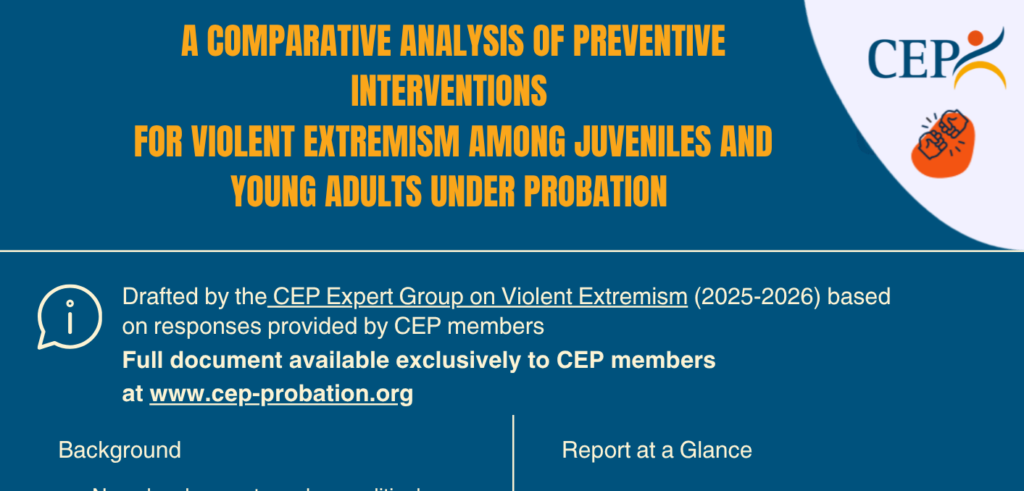
Understanding Youth Radicalisation: What Can Probation Services Do? | New Report from CEP’s Expert Group
27/10/2026
In recent decades, the violent radicalisation of juveniles and young adults has become a pressing concern for policymakers, researchers, practitioners, and communities worldwide. While considerable attention has been devoted to psychological vulnerabilities, socio-economic marginalisation, and community-level influences, the broader context in which violent radicalisation develops is often overlooked. At the same time, the increasing involvement of young people in violent extremist offences highlights the urgent need for effective prevention efforts. Addressing youth radicalisation has become a complex and evolving challenge for families, educators, mental health professionals, law enforcement agencies, probation services, and security authorities.
Recap
Probation in Europe
Reflections on the European Society of Criminology Conference 2026 | From Criminological Research to Probation Practice
26/10/2026
At CEP, we are fascinated by research from across Europe and beyond, and by helping it reach the people who can use it. Ruth Armstrong, CEP Research and Policy Officer, went to the 26th Annual Conference of the European Society of Criminology (EuroCrim 2026 – Working Group on Community Sanctions and Measures) that took place in Warsaw, Poland, from 9–12 September 2026.
Against a backdrop of overcrowded prisons and net-widening (with ever more people drawn into supervision), three questions kept coming up in the research: how time shapes justice, what we mean by success, and how we define harm.
Subscribe to our bi-monthly email newsletter!
"*" indicates required fields
- Keep up to date with important probation developments and insights.