

Previous Article
News
“Health crisis”: Marie-Claude Salignat-Plumasseau, advisor at the French Villepinte prison
Since March 18 our prison has implemented a business continuity plan (BCP) and measures to adapt our practice in order to avoid the spread of COVID-19. The organization of the service has therefore been re-designed to best meet the requirements of the official governmental note of March 16 and 17 of this health crisis.
In the pandemic context that we are in now, our role within the prison administration remains essential and we have changed our working habits as well as adapted ourselves to the new measures.
New arrivals and interviews
When someone new comes in, we must make sure that this person has first been seen by the health unit and that there is no visible risk for the prison personnel. Likewise, during our interviews, we must systematically equip ourselves with a mask and apply all other security protocols. As for the other people under justice care, we only meet them for emergency purposes.
Maintaining family ties
We are listening to families wishing to hear from their imprisoned loved ones, and we relay messages by mail to the inmates when necessary.
Arrangement of sentences and preparation for discharge
Within the framework of the PCA, we focus in particular on detainees identified as vulnerable, those who have been sentenced for acts of domestic or spousal violence and are in the last phase of their sentence, and those who are imprisoned for acts of terrorism or likely to be radicalized.
For vulnerable people, the aim is to use all relevant legal measures to adjust the penalties and to react quickly in the event of infection with COVID 19.
For people who are at the end of their sentence or detained for only a short period, i.e. people who should be released at the end of May 2020, we offer early releases if they have a stable and safe place to go to. A telephone verification with the host of this accommodation place is essential.
For those convicted of acts of domestic and conjugal violence, the aim is to distance the offender from his victim. We know that in a period of confinement, the promiscuity of the closed door can generate tensions and the risks of violence in the family or between the couple can grow… Hence the interest to be very vigilant regarding the exit address and to expressly alert our hierarchy.
For people imprisoned for acts of terrorism or likely to be radicalized, we also remain alert when they get a sentence adjustment, additional sentence reductions or a release. We need to alert our hierarchy quickly.
We must take into account the health emergency but also public security during our interventions for a possible release. Therefore quick assessments are necessary in all cases.
Treatment of emergencies
Thus, since this confinement, our days have been punctuated by the treatment of emergencies, ie by several files combined (for example adjustment of sentence in adversarial debate and outside debate, or early release), new inmates arriving, interviews with people with psychological fragility, handling letters and telephone calls. It’s a fairly stressful time for each of us, but we continue to give our best to meet the official demands of the Justice department.
Faced with the COVID-19 epidemic which also affects prisons, and in this context of restrictions, we remain however committed to our profession and mobilized to ensure the continuity of public service in both face-to-face and teleworking.

Related News
Keep up to date with the latest developments, stories, and updates on probation from across Europe and beyond. Find relevant news and insights shaping the field today.
Recap

Uncategorized
CEP at UNODC: Contributing to the Development of Probation Services Worldwide
19/10/2026
The Confederation of European Probation (CEP) was represented by its Secretary General, Jana Špero Kamenjarin, at the Expert Group Meeting on the Establishment of Probation Services and Probation Practices, organised by the United Nations Office on Drugs and Crime (UNODC) and held at the Vienna International Centre (VIC) from 12 to 14 October 2026.
Recap
Electronic monitoring, Technology
14th Electronic Monitoring Conference, Electronic Monitoring in a Changing World – Perception vs Reality
08/10/2026
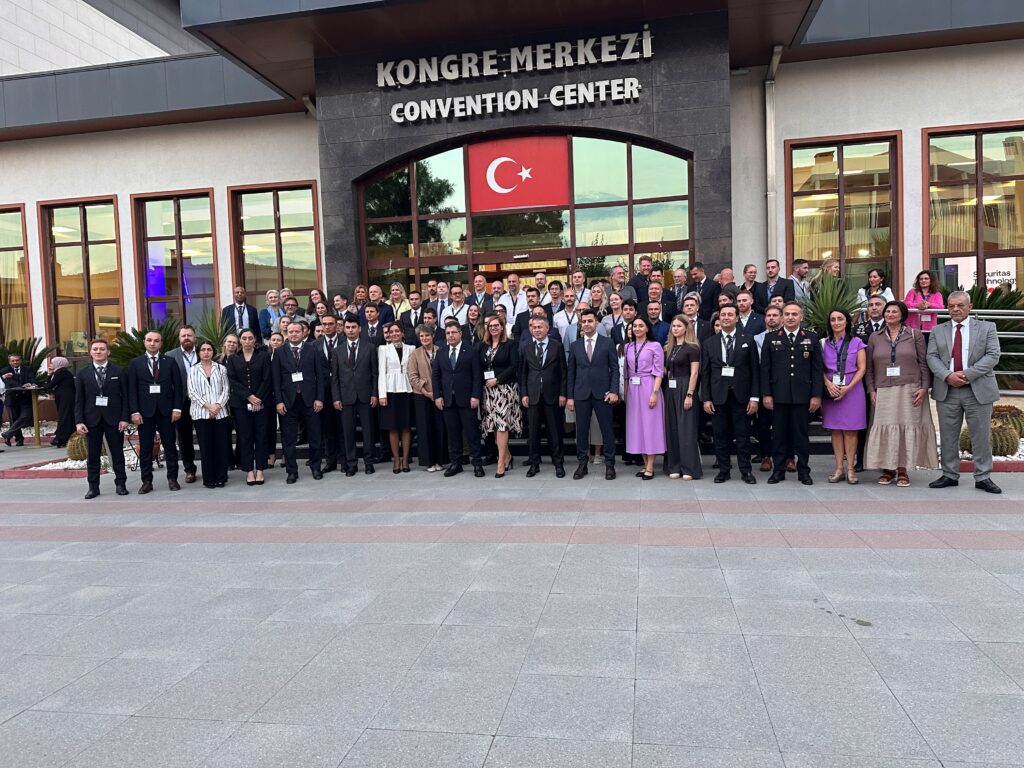
On 6-8 October 2026, Antalya hosted the 14th Electronic Monitoring Conference “Electronic Monitoring in a Changing World – Perception vs Reality”. More than 350 participants coming from 32 countries across Europe and worldwide representing probation services, Ministries of Justice, victims´ services, EM providers, researchers as well as local participants representing the Turkish Prison and Probation Service gathered to discuss how electronic monitoring (EM) is understood by all stakeholders involved including the victims and the public, and how these perceptions compare to the evidence and experiences of those affected. While the gap between perception and reality in electronic monitoring has been recognised for over a decade, the rapid expansion of EM into areas such as victim protection, high-risk supervision and digital innovation has brought new challenges and questions to the forefront.
Recap

ITSCCS
Core Correctional Skills in Digital Probation: highlights from the 6th ITSCCS in Barcelona
05/10/2026
The sixth International Training School on Core Correctional Skills (ITSCCS) took place in Barcelona from 28 September to 2 October 2026, bringing together 26 participants for a week of learning, practical training and international exchange. Organised by the Confederation of European Probation (CEP) and the Centre for Legal Studies and Specialised Training (CEJFE), the programme focused on “Clicks and Empathy: Core Correctional Skills in Digital Probation.”
Recap
Framework Decisions
Recap: ERA workshop on Framework Decisions 829 and 947 in Bucharest
02/10/2026
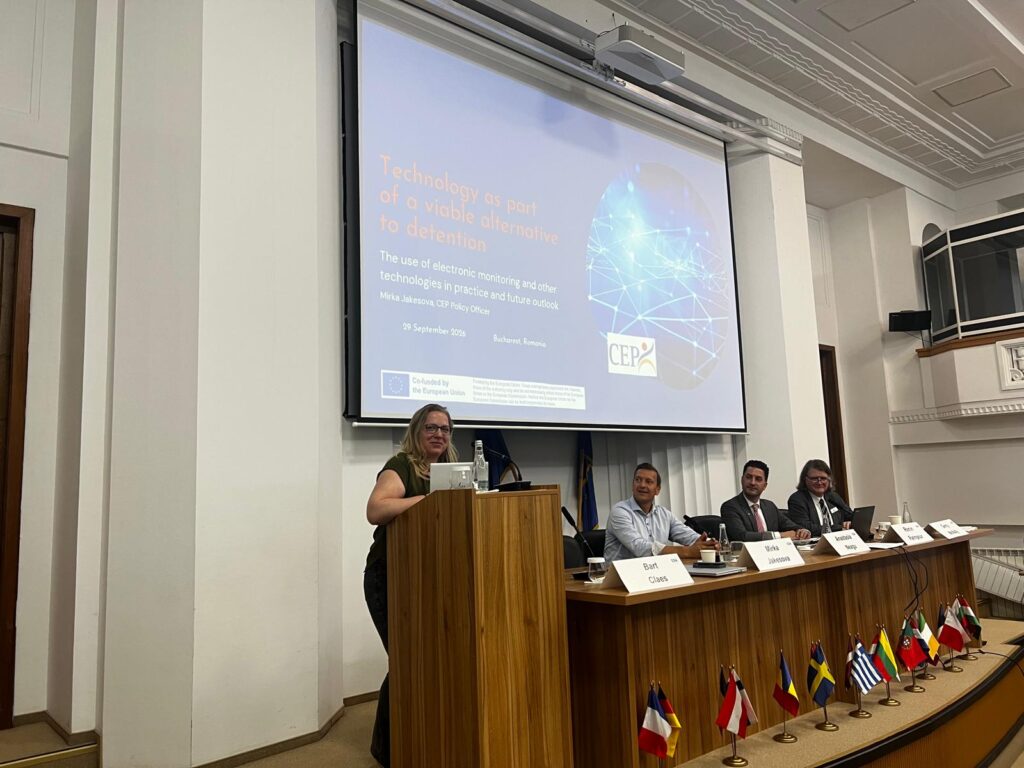
CEP Vice-President Daniel Danglades, Ambassador Gerry McNally and Policy Officer Mirka Jakesova participated in the Seminar on Framework Decisions 829 and 947 and their Impact on Alternatives in the EU organized under the EU project run by the Academy of European Law on 28-29 September in Bucharest, Romania. The seminar brought together judges, prosecutors, probation practitioners, academics, and policy experts to discuss the growing role of alternatives to detention within European criminal justice systems.
New

CEP
CEP and Catalan justice leaders reaffirm longstanding cooperation
29/09/2026
Representatives of the Confederation of European Probation (CEP) met with senior officials from the Catalan Department of Justice and Democratic Quality in Barcelona on 28 September 2026, alongside the opening of the sixth International Training School on Core Correctional Skills. The meeting offered an opportunity to recognise a longstanding partnership and discuss its continued development.
Updated
Mental Health
DEADLINE EXTENDED: Call for Pilot Implementation of the European Mental Health Training Curriculum
29/09/2026
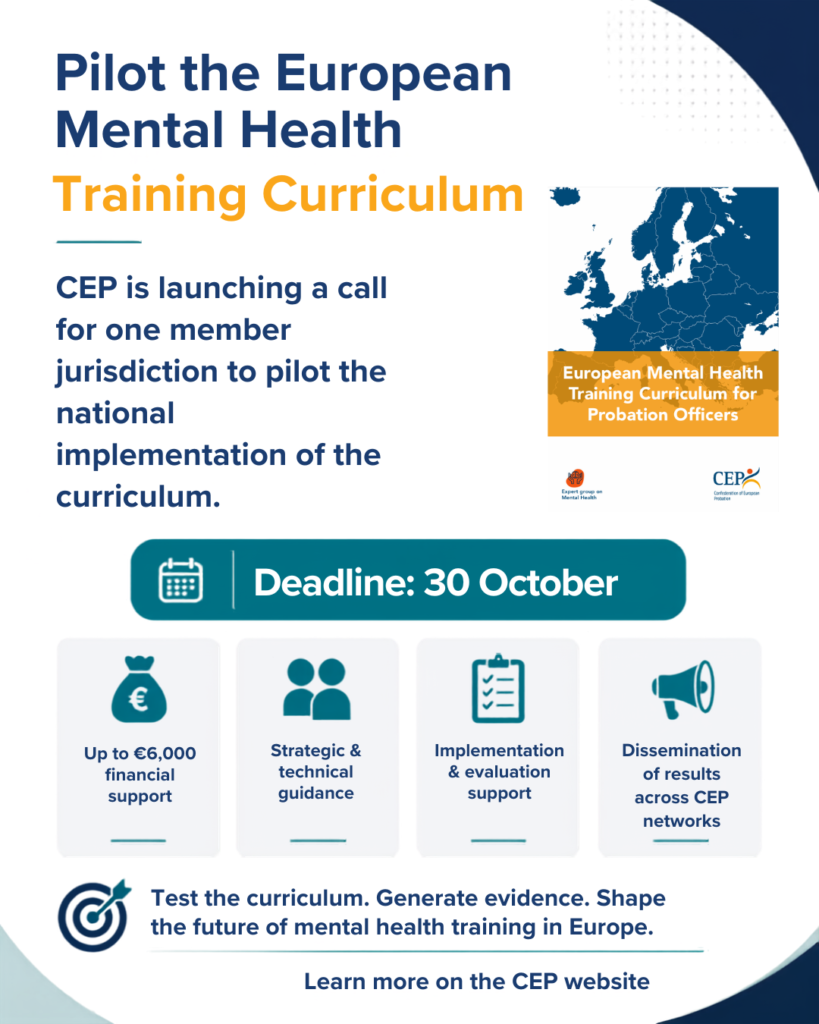
Good news for CEP members! Following requests from our members, CEP has extended the deadline to apply for the pilot implementation of the European Mental Health Training Curriculum for Probation Officers.
Subscribe to our bi-monthly email newsletter!
"*" indicates required fields
- Keep up to date with important probation developments and insights.