

Previous Article
News
Community supervision and COVID-19
An article written by Nicola Carr, community and supervision, for the Probation Journal
Impact
The COVID-19 crisis has impacted on all aspects of society worldwide and has thrown justice systems into sharp focus. Attention has understandably focused on prisons, where overcrowding and ill-equipped estates means that the chance of the spread of the virus is a very real public health concern. In order to try and manage the situation, changes have been announced to the prison regime across the jurisdictions of the United Kingdom. In England and Wales, this means that prisoners will spend more time locked in their cells. Prison visits have been suspended and some measures have been put in place to enable prisoners to maintain contact with their families. All face-to-face Parole Board hearings have been temporarily suspended and parole cases will now be progressed through a combination of remote hearings and paper reviews.
Temporary releases
At the time of writing, the Ministry of Justice had announced that prisoners assessed as low risk and within 2 months of their release date as well as all pregnant prisoners will be temporarily released. It is estimated 4000 prisoners will be released under these measures, providing some relief to a prison service operating at capacity. However, in England and Wales with a prison population of approximately 85,000 and high levels of staff absence due to the Coronavirus, it seems unlikely that these measures alone will be sufficient to manage the public health risk within prisons . The exceptional legislation providing for temporary release (Coronavirus Amendment Rules, 2020) also sets out that released prisoners will be subject to electronic monitoring and licence conditions and some will be accommodated within Approved Premises, meaning that probation services will be responsible for monitoring released prisoners. So far there has been no mention of any measures being put in place to reduce the probation caseload. However, the delivery of probation services has also been impacted by the measure simple mented to contain the spread of the virus. In evidence to the Justice Committee on 24 March 2020, the Lord Chancellor and Secretary of State for Justice, Robert Buckland and Jo Farrar, Chief Executive Officer of HMMPS, outlined the government’s plans to deal with the COVID crisis across the justice system under an ‘exceptional delivery model’.
For probation services, this means applying social distancing measures by suspending Unpaid Work and reducing the requirements for face-to-face contacts with supervising officers, and where possible maintaining contact through technology. Most countries are working to similarly adapt their criminal justice systems to respond to the crisis. The Confederation of European Probation (CEP) provides a useful overview of some of the changes to the delivery of probation services in different countries across Europe.
Use of technology
Like in many aspects of our lives, technology is being deployed to bridge the gap in face-to-face contact. In some instances, this has involved the greater deployment of electronic monitoring and use of videomessaging services to undertake reporting. Although, more analogue approaches such as probation officers driving by someone’s residence to check they are home are also being used. The restriction measures imposed on movement and assembly are changing our relationships with time and space. Some commentators have already begun to reflect upon the extent to which our recourse to technology in this crisis will accelerate trends towards greater digitisation, not only within the criminal justice system, but in all facets of our lives. In a fast-moving situation, we don’t know where the dust will settle after all of this, but it does not seem far-fetched to suggest that aspects of our lives will change profoundly, including the means through which we communicate and maintain contact with people under supervision.
‘Before Corona’ and ‘After Corona’
As the historian Peter Hennessy has suggested we may come to use the terms (BC) ‘Before Corona’ and (AC) ‘After Corona’ to demarcate the times we are living in. It is certainly hard to envisage life continuing on as normal; nonetheless, plans for the future reform of probation services in England and Wales continue apace. A Draft Target Operating Model for the Future of Probation Services in England and Wales was published by HMPPS in March 2020, and it contains further details on planned reforms. These include specification of the services that will be delivered by the National Probation Service (NPS) and those which will be commissioned from ‘Probation Delivery Partners’ and through a dynamic commissioning framework. There is a welcome change in use of language. The word ‘offender’ has been excised from the new lexicon, replaced by ‘individual subject to supervision’, and ‘Probation Practitioner’ replacing the term ‘offender manager’. Further detail is also provided on a ‘Probation Workforce Programme’, which will see increased recruitment across the service, and the provision of continuous professional development opportunities. The vaunted professional recognition of probation will first take the form of an ‘internally administered register, before seeking to enshrine this function in primary legislation’.

Related News
Keep up to date with the latest developments, stories, and updates on probation from across Europe and beyond. Find relevant news and insights shaping the field today.
Recap

Electronic monitoring, Technology
14th Electronic Monitoring Conference, Electronic Monitoring in a Changing World – Perception vs Reality
08/10/2026
On 6-8 October 2026, Antalya hosted the 14th Electronic Monitoring Conference “Electronic Monitoring in a Changing World – Perception vs Reality”. More than 350 participants coming from 30 countries across Europe and worldwide representing probation services, Ministries of Justice, victims´ services, EM providers, researchers as well as local participants representing the Turkish Prison and Probation Service gathered to discuss how electronic monitoring (EM) is understood by all stakeholders involved including the victims and the public, and how these perceptions compare to the evidence and experiences of those affected. While the gap between perception and reality in electronic monitoring has been recognised for over a decade, the rapid expansion of EM into areas such as victim protection, high-risk supervision and digital innovation has brought new challenges and questions to the forefront.
Recap

ITSCCS
Core Correctional Skills in Digital Probation: highlights from the 6th ITSCCS in Barcelona
05/10/2026
The sixth International Training School on Core Correctional Skills (ITSCCS) took place in Barcelona from 28 September to 2 October 2026, bringing together 26 participants for a week of learning, practical training and international exchange. Organised by the Confederation of European Probation (CEP) and the Centre for Legal Studies and Specialised Training (CEJFE), the programme focused on “Clicks and Empathy: Core Correctional Skills in Digital Probation.”
Recap
Framework Decisions
Recap: ERA workshop on Framework Decisions 829 and 947 in Bucharest
02/10/2026
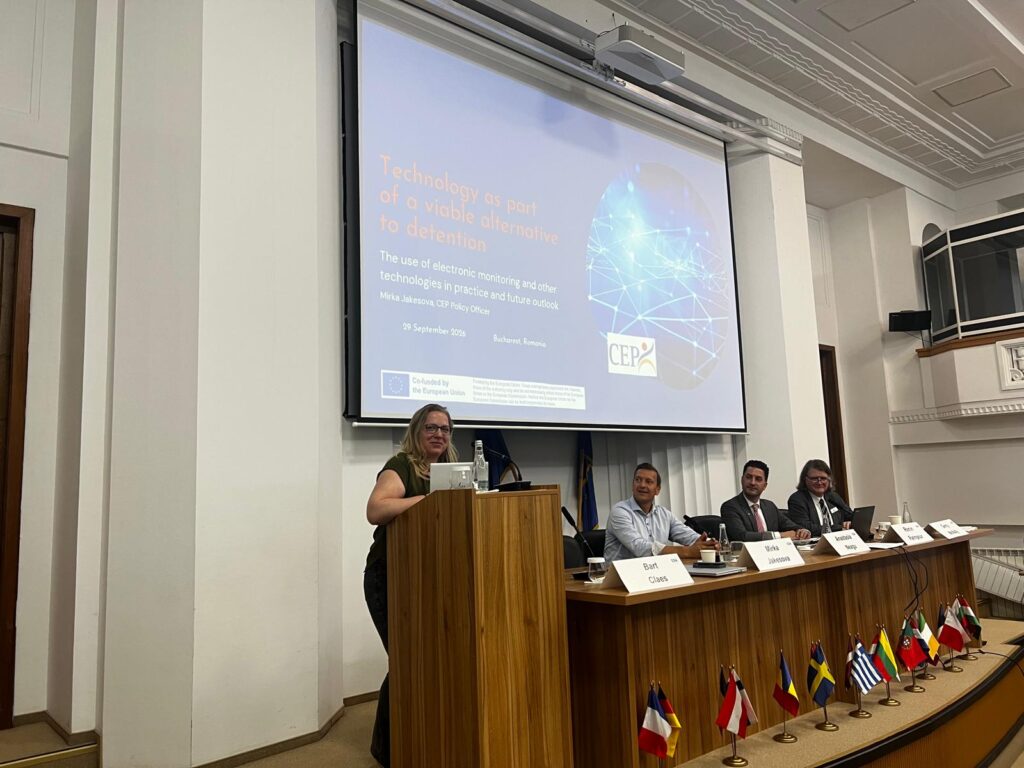
CEP Vice-President Daniel Danglades, Ambassador Gerry McNally and Policy Officer Mirka Jakesova participated in the Seminar on Framework Decisions 829 and 947 and their Impact on Alternatives in the EU organized under the EU project run by the Academy of European Law on 28-29 September in Bucharest, Romania. The seminar brought together judges, prosecutors, probation practitioners, academics, and policy experts to discuss the growing role of alternatives to detention within European criminal justice systems.
New

CEP
CEP and Catalan justice leaders reaffirm longstanding cooperation
29/09/2026
Representatives of the Confederation of European Probation (CEP) met with senior officials from the Catalan Department of Justice and Democratic Quality in Barcelona on 28 September 2026, alongside the opening of the sixth International Training School on Core Correctional Skills. The meeting offered an opportunity to recognise a longstanding partnership and discuss its continued development.
Updated

Mental Health
DEADLINE EXTENDED: Call for Pilot Implementation of the European Mental Health Training Curriculum
29/09/2026
Good news for CEP members! Following requests from our members, CEP has extended the deadline to apply for the pilot implementation of the European Mental Health Training Curriculum for Probation Officers.
Recap
ITSCCS, Technology
6th International Training School opens in Barcelona with a focus on digital probation
28/09/2026
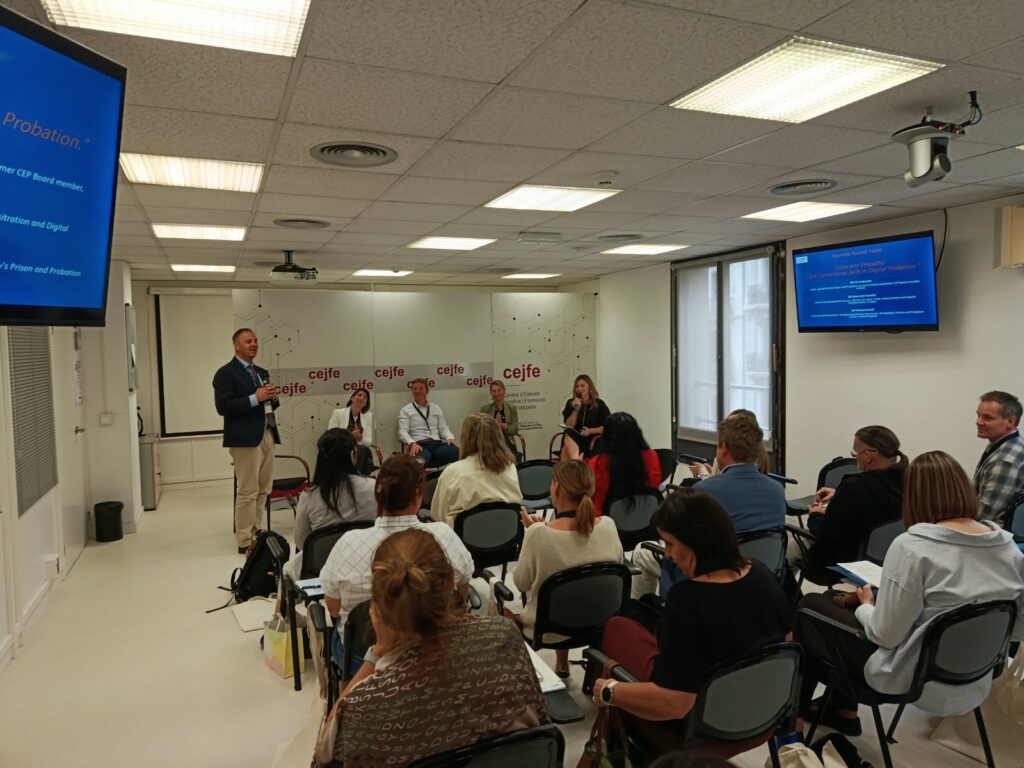
How can probation professionals use new technologies in their interactions while building trust, showing empathy and supporting change? This question is at the heart of the sixth International Training School on Core Correctional Skills, which opened in Barcelona on 28 September 2026.
Subscribe to our bi-monthly email newsletter!
"*" indicates required fields
- Keep up to date with important probation developments and insights.