

Previous Article
News
6th International Training School opens in Barcelona with a focus on digital probation
How can probation professionals use new technologies in their interactions while building trust, showing empathy and supporting change? This question is at the heart of the sixth International Training School on Core Correctional Skills, which opened in Barcelona on 28 September 2026.
Organised by the Confederation of European Probation (CEP) and the Centre for Legal Studies and Specialised Training (CEJFE), the week-long school brings together probation professionals and international experts under the theme “Clicks and Empathy: Core Correctional Skills in Digital Probation.” The opening reflected the strong support of the Catalan Government and CEJFE for CEP and their shared commitment to professional training and international exchange.
Participants were welcomed by Penelope Torres Moreno, Head of the Research and Training Area for Penal Enforcement at CEJFE; Maria-Paz Vallès Creixell, Director General of Probation and Juvenile Justice at the Catalan Department of Justice and Democratic Quality; Domingo Estepa Camacho, Director General of Prison Services at the same Department; and Professor Ioan Durnescu of the University of Bucharest, who is the author of the Core Correctional Skills manual and coordinates the Training School.
The opening was followed by a keynote round table that brought perspectives from Finland, Croatia and the United Kingdom to a high-level discussion of digital probation. Pia Andersson, Senior Specialist at the Finnish Prison and Probation Service and former CEP Board member; Vesna Zelić Ferenčić, Head of the Development Service at Croatia’s Ministry of Justice, Public Administration and Digital Transformation; and Michael Arnold, Head of AI and Innovation at His Majesty’s Prison and Probation Service, explored what technological change means for everyday probation practice. The discussion was chaired by Iuliana Carbunaru, Probation Inspector at Romania’s National Probation Directorate and former CEP Vice-President, together with Professor Durnescu.
The programme then moved from discussion to practice. In a session led by Professor Durnescu, participants examined how to build a working alliance with a person who is required to engage with probation services. A practice lab on the first interview gave them an immediate opportunity to apply and discuss these skills.
The Training School runs until 2 October. Through expert sessions, practice labs and peer exchange, participants will explore how to use core correctional skills, including pro-social modelling, motivational interviewing and problem-solving, in both face-to-face and digital settings. As the ways we communicate change, skilled human relationships remain essential to effective probation work.
Follow CEP on social media for updates and highlights throughout the week.

Related News
Keep up to date with the latest developments, stories, and updates on probation from across Europe and beyond. Find relevant news and insights shaping the field today.
New
CEP Board
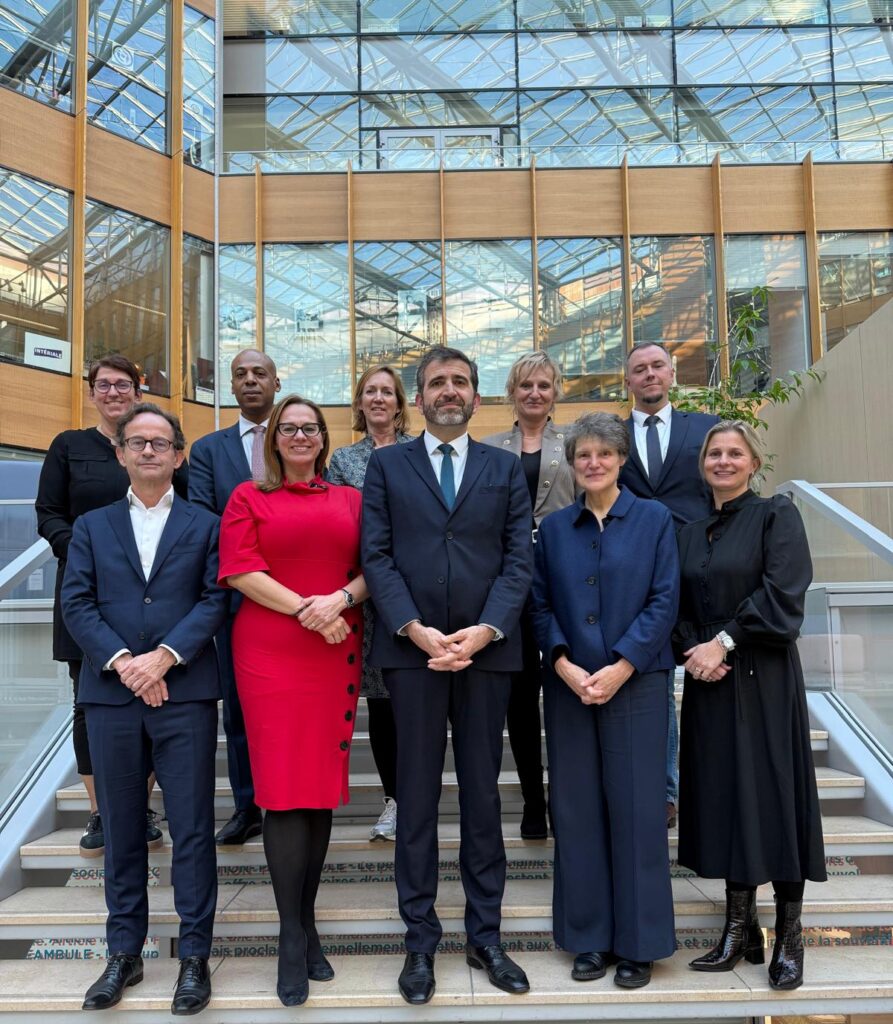
CEP board visit France
16/11/2026
On 13 November 2026, the CEP Board visited its French member organisation, the Direction Générale de l’Administration Pénitentiaire of the French Ministry of Justice. The visit coincided with the final CEP Board meeting of the year, hosted by CEP Vice-President Mr Daniel Danglades, who represents the French institution.
Recap
Framework Decisions
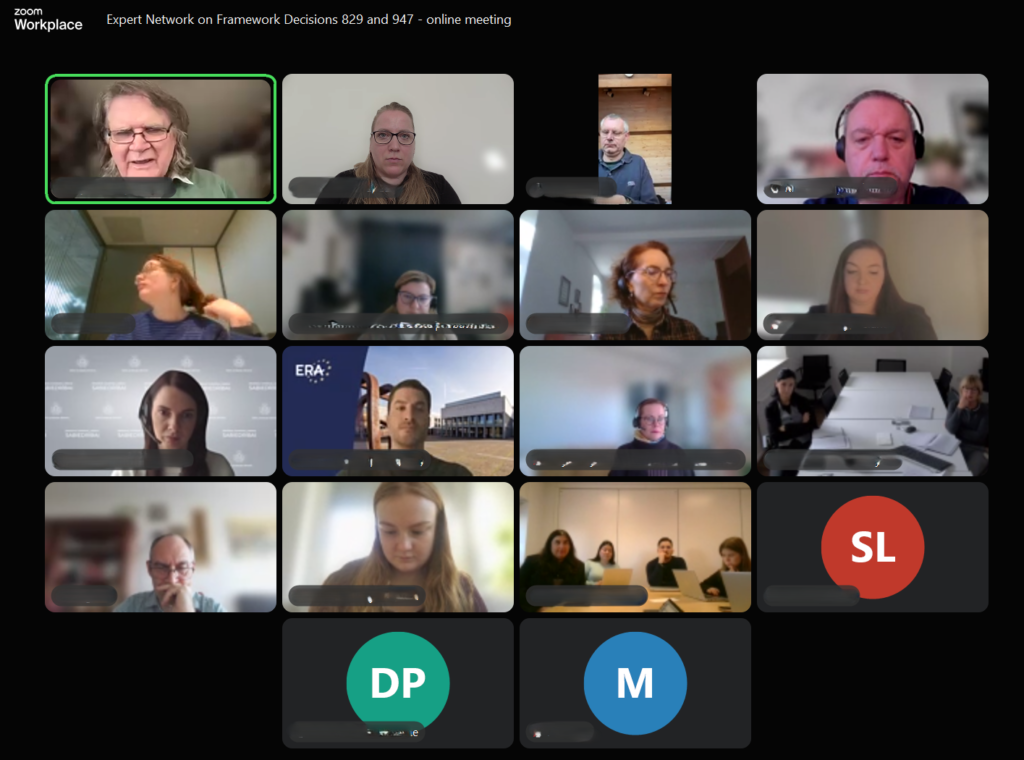
Recap: annual meeting of the Expert Network on Framework Decisions 829 and 947
09/11/2026
On Thursday 5 November an annual meeting of the Expert Network on Framework Decisions 829 and 947 took place online. Bringing together 20 participants from 12 EU jurisdictions including representatives of the Academy of European Law and European Judicial Network, the meeting provided an opportunity to exchange experiences, discuss current implementation challenges and identify priorities for enhancing cross-border cooperation in the application of the two Framework Decisions.
New

Education and Training, Probation in Europe
Justice programme: the judicial training call is open for applications!
09/11/2026
Are you ready to help address the training needs of justice professionals from different EU countries in the fields of civil law, criminal law and fundamental rights? This call supports cross-border training projects contributing to the effective and consistent application of EU law. In line with the new European Judicial Training Strategy, the call also supports the digitalisation of justice. Don’t miss this opportunity! Apply by 4 March 2027, 17:00 Brussels time.
Recap

CEP Board, Foreign Nationals in Prison and Probation, Probation in Europe
CEP at the 16th Plenary Meeting of the Council for Penological Co-operation
06/11/2026
From 3 to 5 November 2026, representatives of the Confederation of European Probation (CEP) participated in the 16th Plenary Meeting of the Council for Penological Co-operation (PC-CP).
New

CEP
Newsletter October 2026 out now
29/10/2026
CEP’s latest newsletter is out now! It includes:
- Deadline approaching for the Workshop on Technology and Alternatives to Detention
- Recap of the 14th EM and CEP Excellence Leadership Training
- New publications from Expert Groups on Technology and Expert Group on Violent Extremism
- Call for Proposals: Evaluation of CEP Expert Groups
- Engaging with Research – a new section in our newsletter
- and much more!
New
Violent Extremism
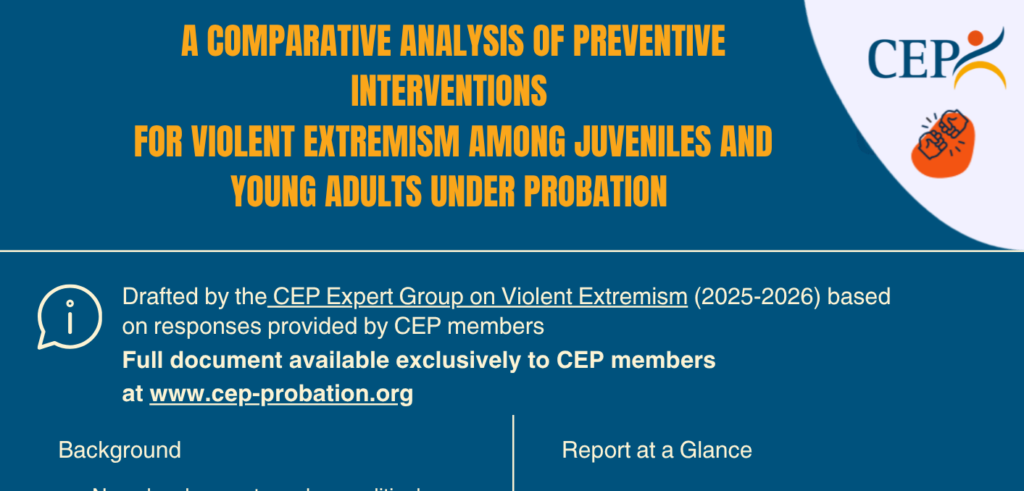
Understanding Youth Radicalisation: What Can Probation Services Do? | New Report from CEP’s Expert Group
27/10/2026
In recent decades, the violent radicalisation of juveniles and young adults has become a pressing concern for policymakers, researchers, practitioners, and communities worldwide. While considerable attention has been devoted to psychological vulnerabilities, socio-economic marginalisation, and community-level influences, the broader context in which violent radicalisation develops is often overlooked. At the same time, the increasing involvement of young people in violent extremist offences highlights the urgent need for effective prevention efforts. Addressing youth radicalisation has become a complex and evolving challenge for families, educators, mental health professionals, law enforcement agencies, probation services, and security authorities.
Subscribe to our bi-monthly email newsletter!
"*" indicates required fields
- Keep up to date with important probation developments and insights.