

Previous Article
News
The European Commission’s mapping criteria for Help Seeker
The European Commission’s mapping criteria for Help Seeker and Perpetrator Prevention Initiatives in Child Sexual Abuse and Exploitation
By Kieran McCartan, Ph.D., and David S. Prescott, LICSW
Earlier this week, the European Commission published a new document titled “Help seeker and Perpetrator Prevention Initiatives – Child Sexual Abuse and Exploitation.” Its aim is to support initiatives for Child Sexual Abuse (CSA) help-seeker and perpetration prevention. The idea is that by creating a common taxonomy of prevention programs for several different stakeholders, we can collectively understand and share best practices around CSA prevention initiatives. The report is a step towards the creation of a European Union (EU) knowledge platform on CSA prevention initiatives, which will support EU Member States to develop and roll out tailor-made prevention policies according to their respective cultural and societal environments and needs.
On May 11, 2022, the European Commission published a proposal to prevent and combat CSA, with a strong emphasis on prevention; but even though preventing and combatting child sexual abuse is a priority of the European Union, there has been no common EU-wide approach or concrete framework to highlight what member states had already accomplished. A plethora of different terminologies and taxonomies exist to describe prevention programmes (a common issue across the EU in general), making the information about such initiatives limited, unclear, and unstructured.
Collectively the JRC, DG HOME, members of the EU Prevention Network, and a number of interviewed practitioners and experts reached a common consensus on the idea that to raise awareness of existing prevention programmes for people at risk of committing sexual offenses it was necessary to categorize and evaluate them. For this purpose, a dedicated working group was established, and the output of this common effort are 14 classification criteria that will support EU Member States to develop, implement and research prevention work in different countries. The 14 agreed classification criteria are:
- TARGET identifies to whom the initiative is addressed, such as people who fear they may offend.
- CONTEXT refers to the environment in which the intervention is given.
- METHODS refers to the tools, treatments, support opportunities and programmes proposed to the targets.
- INITIATIVE PROVIDER refers to the nature and main activities of the entity or initiative provider that is offering the program and/or treatment as well as the one that implemented it.
- FUNDING refers to the money allocated to the program and/or treatment.
- COSTS refers to the costs that would be sustained by the entity proposing/setting up the program
- THE FOUR PREVENTION STAGES (Primary, Secondary, Tertiary, Quaternary, described in previous blog posts and the extant literature).
- EVALUATION aims to capture the outcomes of the initiatives.
- ACCOUNTABILITY of the programmes refers to the processes and mechanisms put in place by the initiative provider to appraise the programme at different stages to ensure that the programme remains accountable, and that it is working towards the goals.
- LEGISLATION refers to the legal national framework under which the specific programme/intervention is being deployed.
- COLLABORATION refers to the synergies and complementarities that can be established with different entities involved in the prevention of CSA.
- DISSEMINATION refers to the actions taken to raise awareness about the prevention initiative among (potential) stakeholders.
- TARGETS’ RIGHTS are explored in terms of privacy, anonymity, and safety to preserve and assure confidentiality, assurance of empathy, etc.
- ACCESSIBILITY refers to several elements of the preventive programme that can be related to: the language of the resources, the availability of complementary tools to the traditional text-based ones, the standardisation of tools provided, and he cultural responsivity factors.
The 14 classification criteria were then applied to five case studies (PedoHelp – France; Parafilik – Czech Republic; Out of the Net – Spain; Sexual Aggression Control – Spain; Circles of Support and Accountability (CoSA) – European union-united kingdom) to see how they aligned. The results indicated that the five case studies did align and that the criteria were useful in the development and implementation of prevention programs. Additionally, the report goes on to discuss a series of international prevention mapping tools (i.e., INHOPE prevention initiative report, Eradicating Child Sexual Abuse (ECSA), PedoHelp, Helplinks (a Europol website as part of the Police2Peer project) and the UNICEF promising programmes to prevent Child Sexual Abuse and Exploitation report. The report finishes off with a series of smaller sections describing relevant information on several programmes for people who fear they may offend, for people going through criminal proceedings and post criminal proceedings, as well as those for minors.
This is an invaluable resource for policy makers, practitioners, and researchers alike. The report demonstrates the development of good practice available in developing interventions for people at risk of committing a sexual offence or those who have. I would strongly recommend looking at it and learning from its findings.

Related News
Keep up to date with the latest developments, stories, and updates on probation from across Europe and beyond. Find relevant news and insights shaping the field today.
New
CEP
CEP annual report
07/04/2026
The Confederation of European Probation (CEP) has published its Annual Report 2025, showcasing a year marked by growth, cooperation, and continued commitment to strengthening probation across Europe.
Bringing together more than 100 member organisations across 42 countries and 59 jurisdictions, CEP continued to serve as a central platform for knowledge exchange, professional development, and collaboration within the European criminal justice field.

Uncategorized
ProtectEU: Commission presents new counterterrorism agenda
07/04/2026
On 26 February 2026, the European Commission presented ProtectEU, a renewed EU counterterrorism agenda aimed at strengthening the Union’s capacity to prevent, detect and respond to evolving terrorist threats.
New
Probation in Europe
New Vodcast Episode: Jana Spero Kamenjarin on the Confederation of European Probation (CEP)
07/04/2026
The 19th episode of Division_Y features Jana Spero Kamenjarin, Secretary General of the Confederation of European Probation (CEP), based in Utrecht, the Netherlands.
New

Electronic monitoring
Electronic Monitoring in Europe: Insights from the 13th Electronic Monitoring conference Questionnaire
30/03/2026
The 13th Electronic Monitoring (EM) conference Questionnaire has now been released, offering a comprehensive overview of how EM is applied across Europe today.ion.
New
CEP members
New CEP member: Guernsey Probation Service
25/03/2026
In recent weeks, CEP has interviewed individual members and representatives of the new member organisations that joined CEP at the beginning of 2026. In these interviews, the new member organisations or individual members will share information on why they decided to become members, how they would like to contribute to the development of CEP and many more.
Enjoy reading!
Recap
Probation outside Europe
Recap: CEP and APPA webinar
25/03/2026
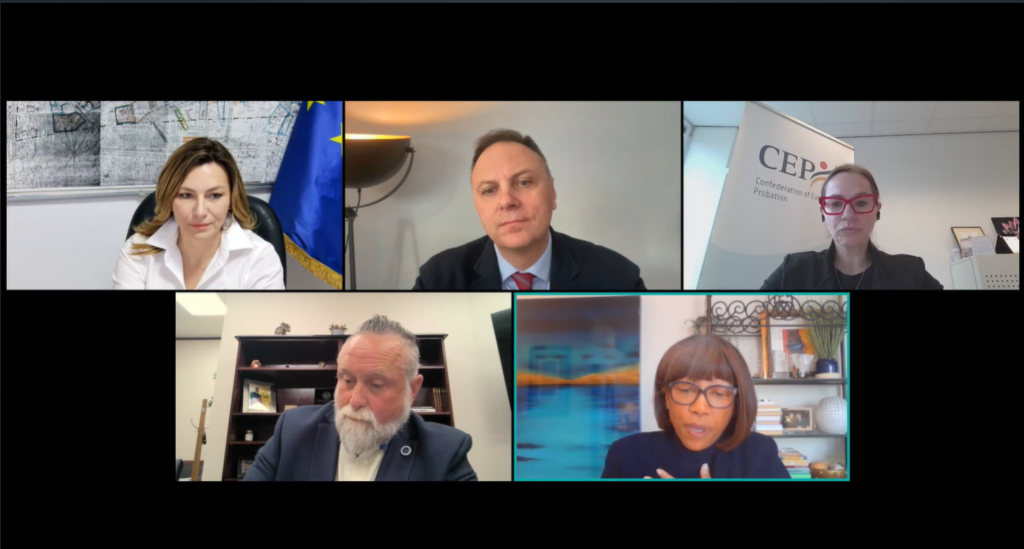
Confederation of European Probation (CEP) and American Probation and Parole Association (APPA) hosted the second joint webinar on 24 March 2026, this time on “Integrity of Performance: Ensuring Meaningful and Ethical Outcomes”.
The overarching theme of integrity of performance was explored through two distinct perspectives on this fundamental concept.
Subscribe to our bi-monthly email newsletter!
"*" indicates required fields
- Keep up to date with important probation developments and insights.