
Skip to content

News

Recap: Webinar om Alternatives to Detention

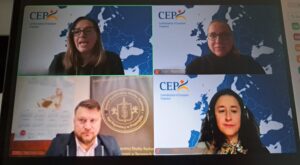
With more than 30 participants present CEP started its first webinar of 2025 on Thursday 23 January. This session explored penalties and alternative punitive measures to imprisonment within the Polish justice system, offering valuable insights and practical examples to participants from across Europe.


Since its very beginning, the probation system in Poland has been organizationally linked to the courts. The system which is of a dual character gather over 5 000 professional probation officers and 15 000 community probation officers working within it. Currently, the prevailing model is a professional-community one, with professional probation officers (both family and criminal probation) being supported by community probation officers.

Poland has the highest probation population rates in Europe managing a significant number of cases involving electronic monitoring (around 7 000 active cases) as well as the highest number of juveniles (around 25 000) under probation supervision. As of 2022 the Institution of probation centers in Poland operates under the framework established by the Act on Supporting and Resocializing Juveniles. Probation centers are designed to provide educational and rehabilitative support to juveniles exhibiting signs of demoralization or those who have committed punishable acts.
Within the Lower Silesian Region, the WrocÅ‚aw Restorative Justice Center (WCSN) and the Association of Court Probation Officers “Frontis” are the main initiators behind the promotion and application of restorative justice and its principles.

The presentation can be found here.

The video will be published soon.

Related News

Keep up to date with the latest developments, stories, and updates on probation from across Europe and beyond. Find relevant news and insights shaping the field today.

New

Domestic violence, Gender-based violence

Practitioner guidance for supporting neurodivergent clients in domestic abuse work

23/12/2025

A new practitioner guide is currently being piloted across the UK that aims to support professionals working with neurodivergent clients for more inclusive domestic abuse perpetrator interventions. The guide has been co developed for domestic abuse perpetrator intervention practitioners who work with neurodivergent clients, translating research findings into practical guidance for day to day practice.

New

Probation in Europe

New Vodcast Episode: Christoph Koss on Probation and Parole in Austria

22/12/2025

The 17th episode of Division_Y features Christoph Koss, Director of the NEUSTART Association for Probation and Parole, Restorative Justice, and Social Work in Austria.

New

Uncategorized

Newsletter December 2025 out now, featuring the 2026 CEP Activity calendar

18/12/2025

CEP’s latest newsletter is out now! Articles on the CoPPer Final Project Conference, New CEP report: The European Survey of Probation Staff’s Stress and Morale, and more.>> Read here

Check out the CEP Activity Calendar 2026

>>Read previous newsletters

Reading corner

Criminal Justice

Bridging Research and Practice in Forensic Social Work: An interview with the editors of Forensic Social Work – Supporting Desistance

17/12/2025

Supporting desistance while managing risk is at the heart of criminal justice social work across Europe. In Forensic Social Work – Supporting Desistance, editors Jacqueline Bosker, Anneke Menger and Vivienne de Vogel bring together scientific insights and everyday professional practice to support those working with justice-involved individuals. In this interview, they reflect on the motivation behind the English edition of the book, its core themes, and how professionals can use its tools and approaches in their daily work.

New

Mental Health

Why some court-ordered psychiatric patients remain in prison in Europe

15/12/2025

There is an urgent yet insufficiently recognised human-rights and public-health crisis unfolding across Europe: the systematic imprisonment of mentally ill individuals who have already been assessed by courts or psychiatric professionals as requiring treatment in secure psychiatric hospitals rather than confinement in correctional facilities. Evidence indicates that structural failings—including bed shortages, procedural delays, and fragmented legal and administrative frameworks—have produced a situation in which thousands of vulnerable individuals remain in prison in direct contravention of judicial orders, clinical assessments, and international human-rights obligations. This constitutes a largely invisible mental-health scandal, obscured by inconsistent data collection, political sensitivities, and the general invisibility of people in custody.

New

Partners

Memorandum of Understanding Signed Between CEP and RESCALED

11/12/2025

On 10 December 2025, at the CEP Headquarters in Utrecht, CEP and RESCALED signed a Memorandum of Understanding (MoU) aimed at strengthening cooperation in areas of mutual interest. The MoU was signed by Rogier Elshout, Chair of Rescaled and Jana Å pero Kamenjarin, CEP Secretary General, with the signing ceremony attended by Helen De Vos, Rescaled Executive Director and Daniel Danglades, CEP Vice-President.

Through this partnership, both organizations will work together to develop joint activities, exchange expertise, and support initiatives that advance their shared objectives.

This MoU reflects a commitment to transparent communication and the creation of new opportunities for joint projects and broader community impact.

Subscribe to our bi-monthly email newsletter!