
Previous Article
The Basque Country is a political community integrated into Spain with autonomy and extensive authority of its own. This authority includes those relating to the execution of penitentiary legislation and the organisation, regime and operation of penitentiary institutions.
The effective transfer of penitentiary competencies took place on 1 October 2021. The basic criminal and penitentiary legislation is common throughout Spain, but this does not prevent the Basque Country from orienting and planning a model with its own characteristics, integrated and coordinated with the state penitentiary system.
A strategic document of bases for the implementation of the prison model in the Basque Country has been approved, the final objectives of which are:
- To promote the use of community sentences and measures;
- To increase the serving of sentences in semi-liberty;
- To improve the situation of prisoners and their social inclusion;
- To protect the rights and interests of victims more adequately; and
- To obtain, through insertion and inclusion, greater public safety.
The Directorate of Justice of the Department of Equality, Justice and Social Policies of the Basque Government is responsible for organising penal and penitentiary execution services. It is responsible for penitentiary centres, community sentences and measures services, victim assistance services, restorative justice services and juvenile justice services.
Why did your organisation decide to join CEP?
The Basque Government assumed competence for the management of the penal execution and penitentiary system on 1 October 2021. Although it previously managed penalties and alternative measures and care services for victims of crime.
One of the strategic lines of the bases for a Basque penitentiary and penal execution model is to promote sentences and measures in an open environment or in the community, as well as restorative justice, mediation and conciliation.
This aligns with CEP’s strategic vision of “contributing to safer communities by rehabilitating and reintegrating offenders and providing the best possible interventions to reduce crime and the impact of crime”.
In that context joining CEP means for us participating in a unique network of expertise on positive ways of working with offenders in the community, which is valuable to learn from the best practices in Europe in this field and to be able to develop our own model of penal enforcement.
How would you like to contribute to the development of CEP, its project, actions and work programme?
We are happy to participate in the CEP project and we will try to participate in all its initiatives to the extent of our possibilities.
We are a relatively small country and organisation compared to other countries. However, we do have experience in the promotion of serving prison sentences in an open environment (with a higher percentage than in our environment) and in the development of alternative sanctions and measures, as well as highly developed victim assistance, mediation and restorative justice services.
As far as we can, we will try to contribute our experiences, listen to those of other countries and dialogue with each other in order to achieve individual and common objectives in the improvement of the Probation system throughout the world.
What are the main priorities, topics, or themes you would like CEP to open/address more frequently? And how would you like to use your knowledge to support and participate in developing its actions and work programme?
The main issues for us now are the following:
- The reorganisation of the services for alternative sanctions and measures after the assumption of penitentiary competence.
- The sizing of services to cope with the increase in alternative sanctions and measures and the management of workloads;
- The digitalisation of information systems and their integration with those of the Administration of Justice.
- The implementation of new treatment programmes to meet new or growing demands (sexual aggression, gender violence, etc.).
- The promotion of social cooperation mechanisms for the development of programmes and services for the benefit of the community.
- The evaluation of the effectiveness of the individualised programmes for the execution of the sanction or measure.
- The integration of the work of the alternative sanctions and measures services with that of the services for victims and restorative justice.
We would be willing to share our experience in these and other areas during face-to-face and online meetings or create agendas on these issues.
Why do you think it is so important to promote alternative sanctions and measures and what is the state of play in your country in this regard?
Promoting alternative sanctions and measures is important because it avoids the overcrowding of the prison system and its high cost. But also is important because it avoids the negative effects of imprisonment for the convicted person and his family; it satisfies the principle of proportionality; it avoids penalising minor anti-social behaviour that could be resolved in the community; it allows the needs of the offender and the factors linked to the deterrence of the offence to be addressed.
And it can contribute to adequate reparation for the victims and is suitable for protecting the community.
In our country there is a catalogue of alternative penalties and measures; a consensus that they help to reduce recidivism and a propensity of judges to suspend prison sentences when the sentence is less than 2 years.
However, although alternative sentences and measures have increased in number, they have not led to a decrease in prison admissions and such alternative measures are mainly applied in certain crimes such as gender violence or road safety offences, taking into account the offence rather than the criminogenic characteristics of the specific person.
There is a lack of pre-sentence reports on the possibilities of imposing a sanction or measure in an open environment that could facilitate the judicial work, by assessing the existing needs and risks and, subsequently, through close and personal intervention to overcome social, family, psychological or physical obstacles. This would enable the alternative sentence to be individualised, taking into account the needs of the person concerned.

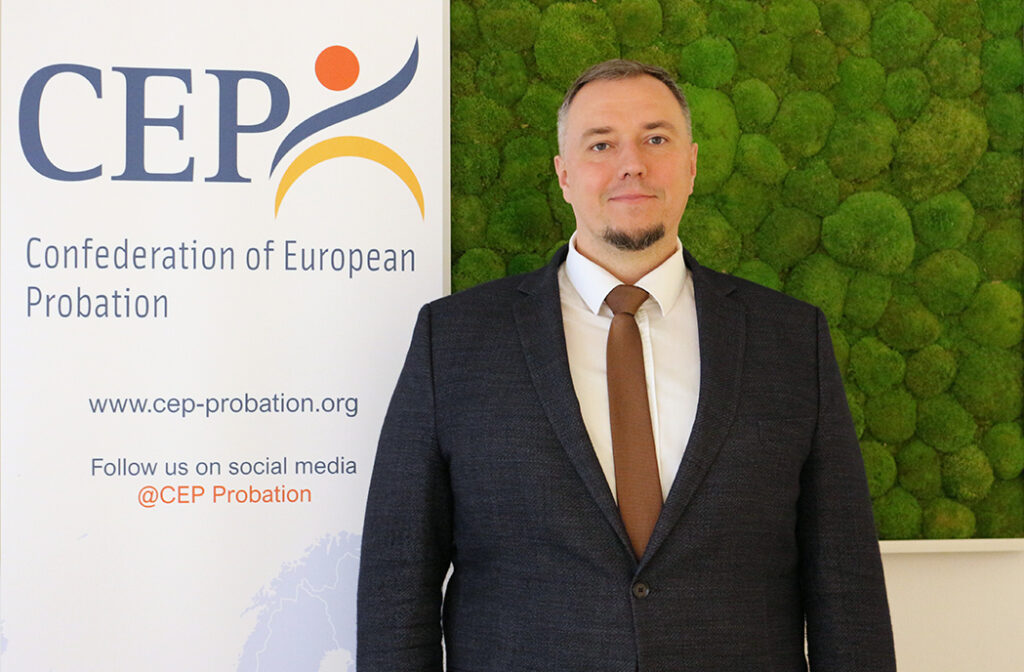
Eugenio Artetxe Palomar, Justice General Director.
Department of Equality, Justice and Social Policies
Basque Country.