

Previous Article
News
Interview with Corinne Clarenne, probation officer in Neufchâteau (Belgium)
How did you experience your work during the COVID-19 pandemic?
The work period during the COVID-19 pandemic was a time of discovery of new technologies (videoconferencing, etc.) and use of these technologies. We had to get organised and manage to keep the relationship established with the person concerned as lively, motivating and enriching as during face-to-face interviews. It should be noted that in the province of Luxembourg, it is not always easy to connect through mobile phone or computer in all areas. There are sometimes problems when connecting to the network. The population we meet may also not own a computer, a smartphone or simply an internet connection. The people in question do not always have the financial means to afford an internet connection. This situation can also make it difficult to maintain a good relationship with the people subject to trial. A good follow-up is based on respect, trust and on the way the person views the measure.
As far as I am concerned, I have continued to follow up on my cases by contacting the offenders by phone. Whenever materially possible for them, I made a video call. Up to now, relations with offenders have been maintained. For some cases, it was not possible but they were already causing slight problems before the pandemic. For some offenders, the situation suited them. They did not have to take time off work to come to a meeting and they were more available after work for a phone or video-call. It was also possible to conduct phone interviews from 7:00 am or after 5:00 pm. Some are even more regular in the delivery of certificates, others are not, but it was already the case before the pandemic. A small number of offenders have taken advantage of the situation.
In the second wave, I have found that people who were being tried had more financial difficulties. Some offenders no longer had a phone because they could no longer afford to pay a subscription. For some, it was difficult for them to come to an appointment, not enough money to take the bus. This pandemic has sometimes accentuated the precariousness of some of our citizens. Having discussed it with my colleagues, I also think that the second lock-down was more difficult to live with, for both the offenders and for probation officers. I noticed that some probation officers were no longer able to juggle family life and teleworking. We have had to renew ourselves in terms of organisation and work and this situation does not suit everyone. Some manage it well and others do not.
What would you have done differently?
Nothing I think. Guidance has continued. Thinking about it, I think I would have liked to be able to go to some of the offenders’, respecting the sanitary measures. Those who have no means of transport or with difficulties getting around would have taken advantage of my visit to have a social connection. Throughout the guidance process, connections are forged between the offender, the probation officer, and sometimes the family.
What challenges do you face today?
Keeping to follow up and maintaining the relationship established with each offender. We will probably have to continue this type of follow-up for some time. Our approach to follow-up will change. We may have to consider a follow-up that combines an appointment at the probation office, when it is really necessary, and follow up with telephone calls and video conferences. Find the best method to apply with people who no longer have enough financial means to have a mobile phone, possibly an internet connection, or the ability to move around. It involves working together with the police services and the public prosecutor’s office, so that we are informed directly of any breaches. At this point, it will be important to see the person concerned again in the court house. It will then be necessary to re-establish the basis of the work, to rebuild trust with the offender.
How do probation procedures take place during this period?
It is going well. For those who are currently under guidance, it follows its course, either by telephone or by videoconference. The participants hand in the certificates to prove that the conditions have been met. When a problem arises (new fine or else), I contact the person concerned and suggest an appointment at the law courts to contextualise the problem and see what can be done to prevent it from happening again. The offenders send me the certificates by e-mail or by post. For the new evidential measures, contact is made by phone. The measure is discussed with the person concerned. They are the conditions that the person concerned must respect. Some conditions require less face-to-face follow-up.
It is important to maintain regular contact with the parties involved in cases of vice or assault and battery cases, especially at the beginning of the guidance process. They must know that you are present and available when a problem arises.
Some offenders contacted me to find out whether the pandemic would have an impact on the follow-up of their case, they were worried about the outcome. By talking with them, the caused nervous tension was eased. Most of them were relieved to know that the follow-up was continuing even if no appointments were held at the probation office.

Related News
Keep up to date with the latest developments, stories, and updates on probation from across Europe and beyond. Find relevant news and insights shaping the field today.
Recap
Electronic monitoring, Technology
14th Electronic Monitoring Conference, Electronic Monitoring in a Changing World – Perception vs Reality
08/10/2026
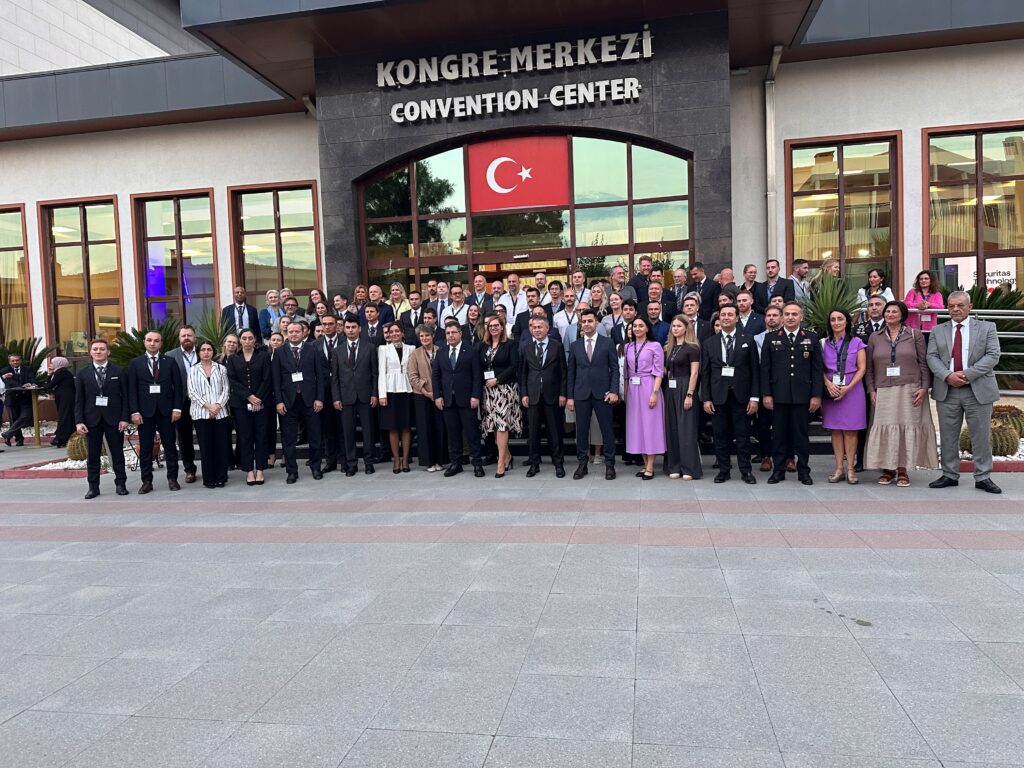
On 6-8 October 2026, Antalya hosted the 14th Electronic Monitoring Conference “Electronic Monitoring in a Changing World – Perception vs Reality”. More than 350 participants coming from 30 countries across Europe and worldwide representing probation services, Ministries of Justice, victims´ services, EM providers, researchers as well as local participants representing the Turkish Prison and Probation Service gathered to discuss how electronic monitoring (EM) is understood by all stakeholders involved including the victims and the public, and how these perceptions compare to the evidence and experiences of those affected. While the gap between perception and reality in electronic monitoring has been recognised for over a decade, the rapid expansion of EM into areas such as victim protection, high-risk supervision and digital innovation has brought new challenges and questions to the forefront.
Recap
ITSCCS
Core Correctional Skills in Digital Probation: highlights from the 6th ITSCCS in Barcelona
05/10/2026
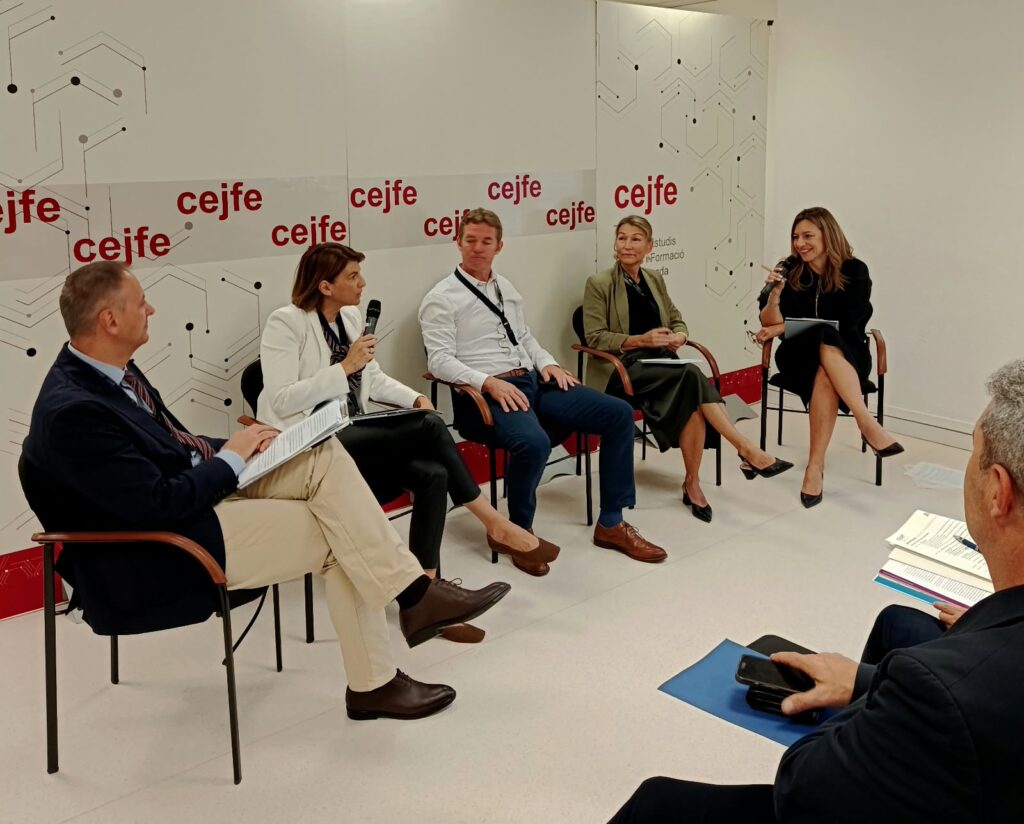
The sixth International Training School on Core Correctional Skills (ITSCCS) took place in Barcelona from 28 September to 2 October 2026, bringing together 26 participants for a week of learning, practical training and international exchange. Organised by the Confederation of European Probation (CEP) and the Centre for Legal Studies and Specialised Training (CEJFE), the programme focused on “Clicks and Empathy: Core Correctional Skills in Digital Probation.”
Recap
Framework Decisions
Recap: ERA workshop on Framework Decisions 829 and 947 in Bucharest
02/10/2026
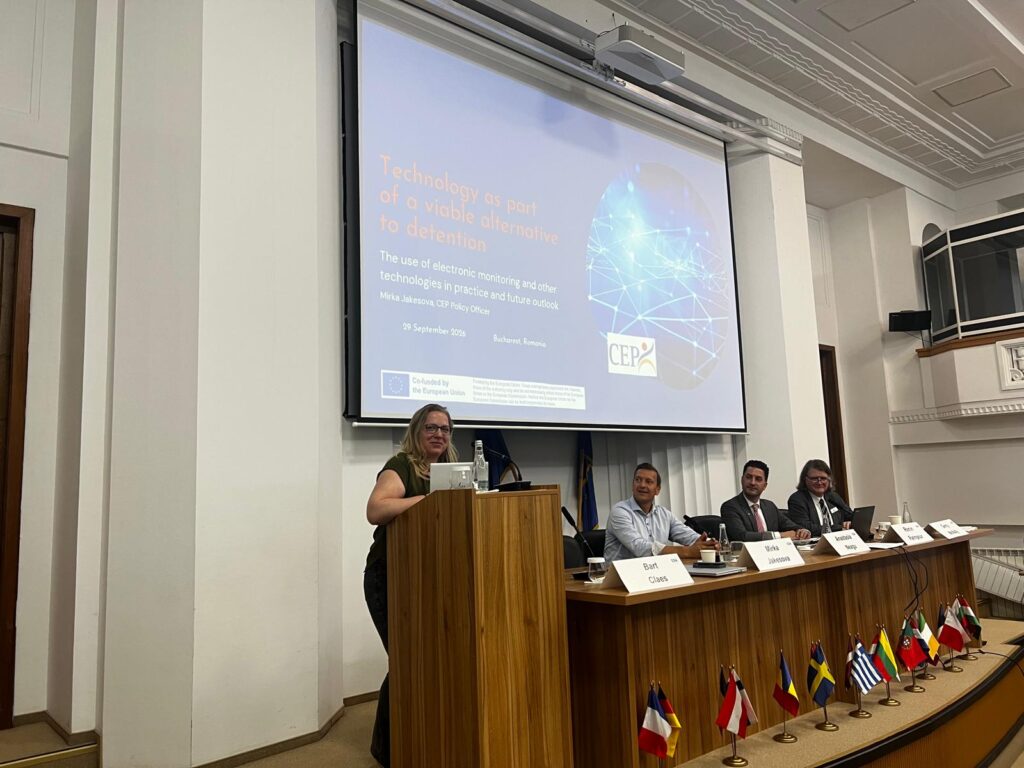
CEP Vice-President Daniel Danglades, Ambassador Gerry McNally and Policy Officer Mirka Jakesova participated in the Seminar on Framework Decisions 829 and 947 and their Impact on Alternatives in the EU organized under the EU project run by the Academy of European Law on 28-29 September in Bucharest, Romania. The seminar brought together judges, prosecutors, probation practitioners, academics, and policy experts to discuss the growing role of alternatives to detention within European criminal justice systems.
New
CEP
CEP and Catalan justice leaders reaffirm longstanding cooperation
29/09/2026
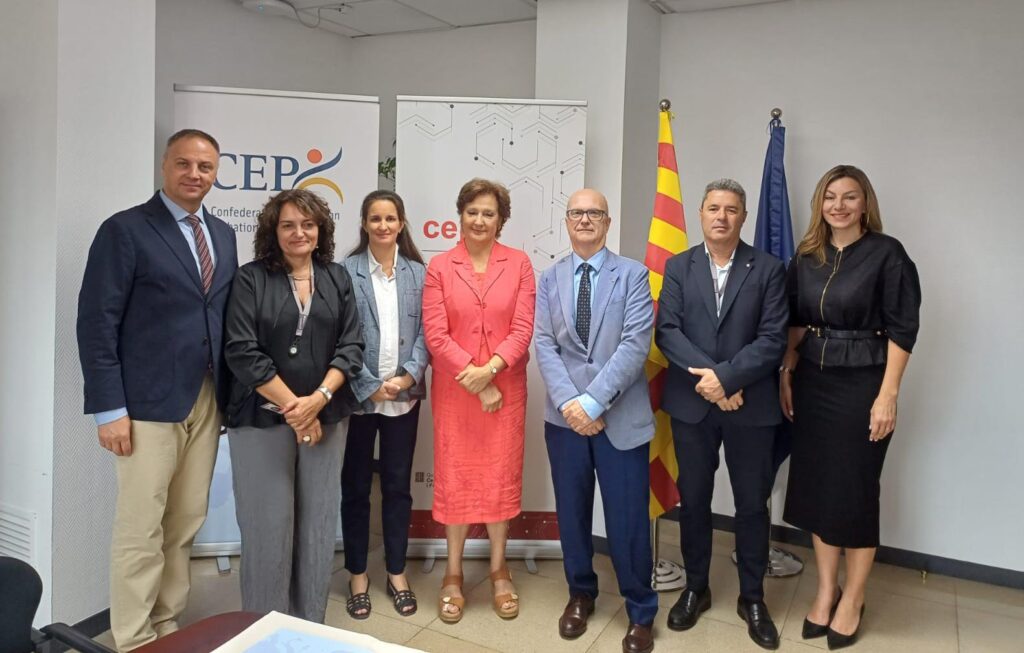
Representatives of the Confederation of European Probation (CEP) met with senior officials from the Catalan Department of Justice and Democratic Quality in Barcelona on 28 September 2026, alongside the opening of the sixth International Training School on Core Correctional Skills. The meeting offered an opportunity to recognise a longstanding partnership and discuss its continued development.
Updated
Mental Health
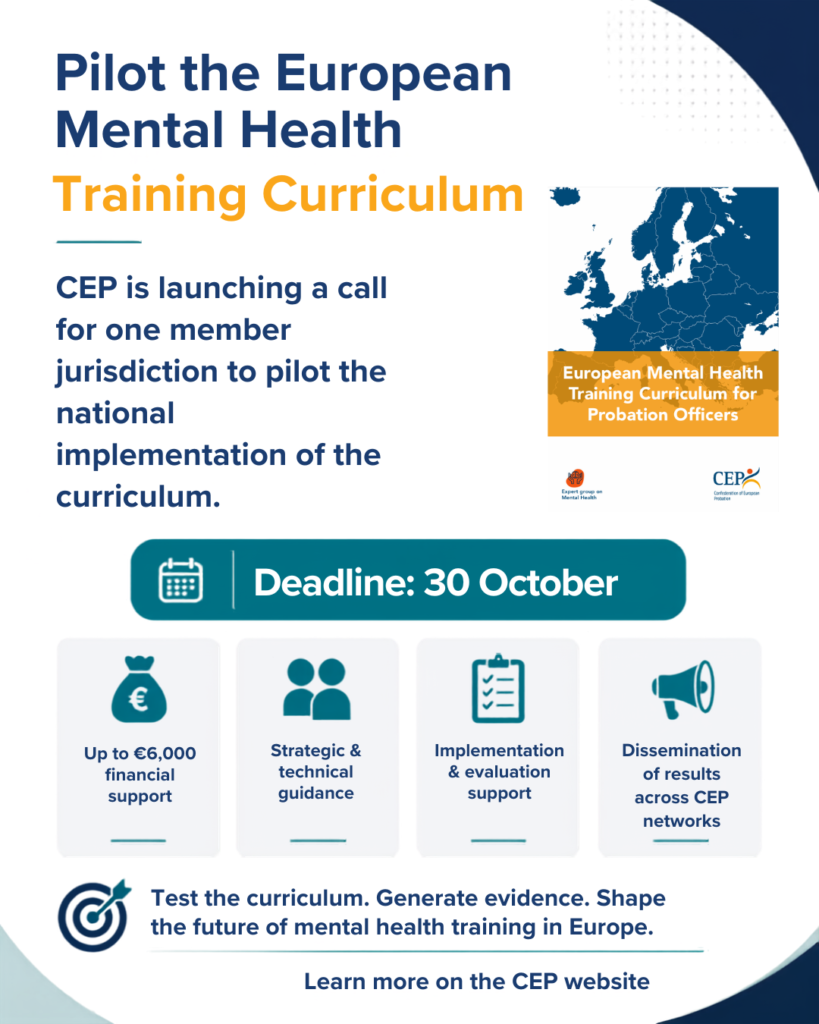
DEADLINE EXTENDED: Call for Pilot Implementation of the European Mental Health Training Curriculum
29/09/2026
Good news for CEP members! Following requests from our members, CEP has extended the deadline to apply for the pilot implementation of the European Mental Health Training Curriculum for Probation Officers.
Recap
ITSCCS, Technology
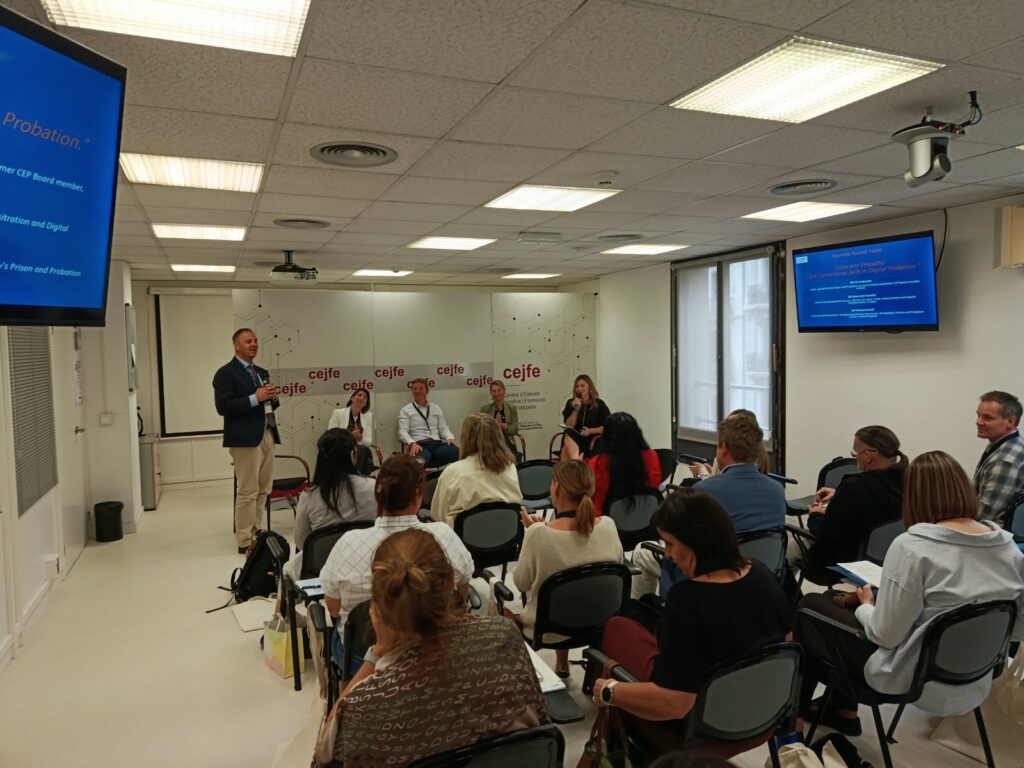
6th International Training School opens in Barcelona with a focus on digital probation
28/09/2026
How can probation professionals use new technologies in their interactions while building trust, showing empathy and supporting change? This question is at the heart of the sixth International Training School on Core Correctional Skills, which opened in Barcelona on 28 September 2026.
Subscribe to our bi-monthly email newsletter!
"*" indicates required fields
- Keep up to date with important probation developments and insights.