

Previous Article
News
Interagency working and three initiatives for improved outcomes
Ireland’s prison population increased by 400% between 1970 and 2011. Between 1997 and 2011 Ireland’s prison population doubled. In its 1997 election manifesto the Fianna Fáil political party declared war on crime, pledging to “adopt a zero tolerance policy on all crime” and to create 2,000 more prison places. On the 22 of July 2011, a total of 5,479 prisoners were in the prison system, with a further 612 on temporary release (TR).
An article by Jane Mulcahy, an Irish Research Council funded PhD scholar in Law at University College Cork, co-funded by the Probation Service. Her employment partner is the Cork Alliance Centre, a desistance project in Cork City. The views expressed in this piece are those of the author, and do not represent those of the Irish Research Council, the Probation Service, or the Cork Alliance Centre.
On 16 February 2017, there were 4,142 prisoners in the system, including 263 on TR. Of the number on TR, 43 people were on the Community Support Scheme, 61 were on Community Return under Probation Supervision and 58 were on “Other temporary release including under probation supervision”.
According to the IPS Annual Report 2016, 90.4% of all committals under sentence were for less than twelve months in 2016. Those serving long sentences face greater rupture to their familial and other relationships than short sentence prisoners. On the other hand, more can arguably be done with long sentence prisoners as regards constructive sentence planning and providing opportunities for personal development in prison.
In recent years the Irish Prison Service (IPS), in partnership with the Department of Justice and Equality, third sector organisations and other Criminal Justice Agencies (CJAs), namely the Probation Service and An Garda Síochána, has developed three welcome initiatives to engage with different cohorts of prisoners. All of the initiatives have a post-release supervision or support component, as well as a strong focus on interagency working.
The Community Support Scheme (CSS) provides post-release support to people serving sentences under twelve months. Under the Community Return Scheme (CRS) suitable longer sentence prisoners swap prison time for unpaid Community Service. The Joint Agency Response to Crime, involves the intensive case management of carefully selected prolific offenders by the CJAs, using a carrot and stick approach.
The Community Support Scheme
CSS is an early release program for prisoners serving sentences of less than twelve months in prison. Prior to its development as an IPS pilot project with Cork prison and the Cork Alliance Centre in April 2013 and subsequent roll-out to other prisons, many short sentence prisoners were released with little or no warning on TR, often at the weekend, with no community supports and perhaps no money or safe place to stay.
The third sector plays a crucial role in the operation of CSS. Before release, a support worker from a community based organisation meets with prisoners serving less than a year in prison to see if they may wish to engage with the programme and avail of structured support upon release. Prisoners may, of course, decline the offer of support. For instance, they may view participation in CSS as too onerous on them if they live in the countryside and would be reliant on public transport to sign on daily at a specified police station. If prisoners opt out of CSS, they will stay in prison until their remission date.
Prisoners who avail of the scheme, develop a post-release plan with their support worker. Following a pre-release consultation regarding their suitability, willingness to participate and risks/needs analysis (homelessness, addiction, psychosocial disorder etc.), they can be released at any point in their sentence. The primary aim of CSS is to provide practical support and structure in the difficult days and weeks after release.
The TR conditions specify that CSS participants must attend weekly meetings with their support worker in community for a period of time. CSS participants will be returned to custody if they breach the terms of their TR. When they return to the prison to sign on each week, they may be refused a further period of TR and held at the prison. This could happen if they are no longer welcome at the family home in order to meet the residence requirement in their release conditions or have relapsed on drugs and are considered to be a danger to themselves.
The Community Return Scheme
The Community Return Scheme (CRS) won a runner up award for innovation at the Confederation of European Probation Awards 2016, for outstanding contribution to rehabilitation.
In April 2011, following a commitment in the Government Programme for National Recovery about the planned super prison (the Thornton Hall Prison Project) on a green field site in Dublin, the then Minister for Justice, Equality and Defence, Alan Shatter set up the Thornton Hall Review Group to review the plans, and to make recommendations on the twin problems of overcrowding and poor physical conditions. In July 2011, the Review Group recommended that “the Minister for Justice and Equality should introduce an incentivised scheme for earned temporary release coupled with a requirement to do community service under supervision.”
A pilot CRS was launched in October 2012 and commenced in November 2012 in line with the recommendations of the Thornton Hall Project Review Group. Prisoners who are serving sentences of between one and eight years’ imprisonment, may be released at the half-way point of their sentence instead of getting normal remission at the three-quarter point. Under the scheme, people do a week of community service in exchange for extra remission of one month. Essentially, they “swap prison time for time in the community paying back through unpaid work”, such as graffiti removal, landscaping or breaking pallets for kindling. Reportedly, 90% of CRS participants successfully complete the scheme.
The Joint Agency Response to Crime
The Joint Agency Response to Crime (J-ARC) was launched in November 2015 and is the Irish adaptation of IOM. The three Dublin-based J-ARC pilot projects were established to provide for “co-ordinated and enhanced levels of co-operation and co-ordination between An Garda Síochána [the Irish Police Service], the Probation Service and the Irish Prison Service”. They work with different groups of prolific offenders, namely:
- STRIVE operates in the Ballymun area of Dublin, focussing on “quality of life” offences, such as issues relating to drugs consumption, public order and criminal damage and in the locality.
- The ACER 3 project works intensively with burglars in certain postal codes who were identified by the police Analyst as being the most prolific burglars in the area.
- The “Change Works” programme run by the Bridge Project intervenes with high risk violent offenders and adopts a strengths-based, integrated case management approach.
In September 2016, several new J-ARC projects targeting prolific offenders in Waterford, Dundalk and Limerick were announced. In June 2017, the Youth Agency Response to Crime (Y-JARC) was launched for problematic young offenders in Cork and Dublin. According to the CJAs, there are palpable benefits to interagency working and swift, systematic data sharing about breach of release conditions, risks relating to drugs relapse or the acquisition of fresh charges in terms of prompt decision-making and immediate consequences.
Conclusion
Prior to 2011, the IPS was constantly in fire-fighting mode, struggling to cope with chronic overcrowding and poor physical conditions. At this time there was no real, sustained effort on the part of the CJAs to adopt either an intelligible, evidence informed penal policy, or a “whole of Justice” approach to dealing with offending behaviour, barriers to successful reentry and recidivism. The three schemes discussed above are, therefore, remarkably innovative if only because the CJAs now place greater emphasis on, and see real value in, working together towards achieving common goals.

Related News
Keep up to date with the latest developments, stories, and updates on probation from across Europe and beyond. Find relevant news and insights shaping the field today.
New
CEP
CEP annual report
07/04/2026
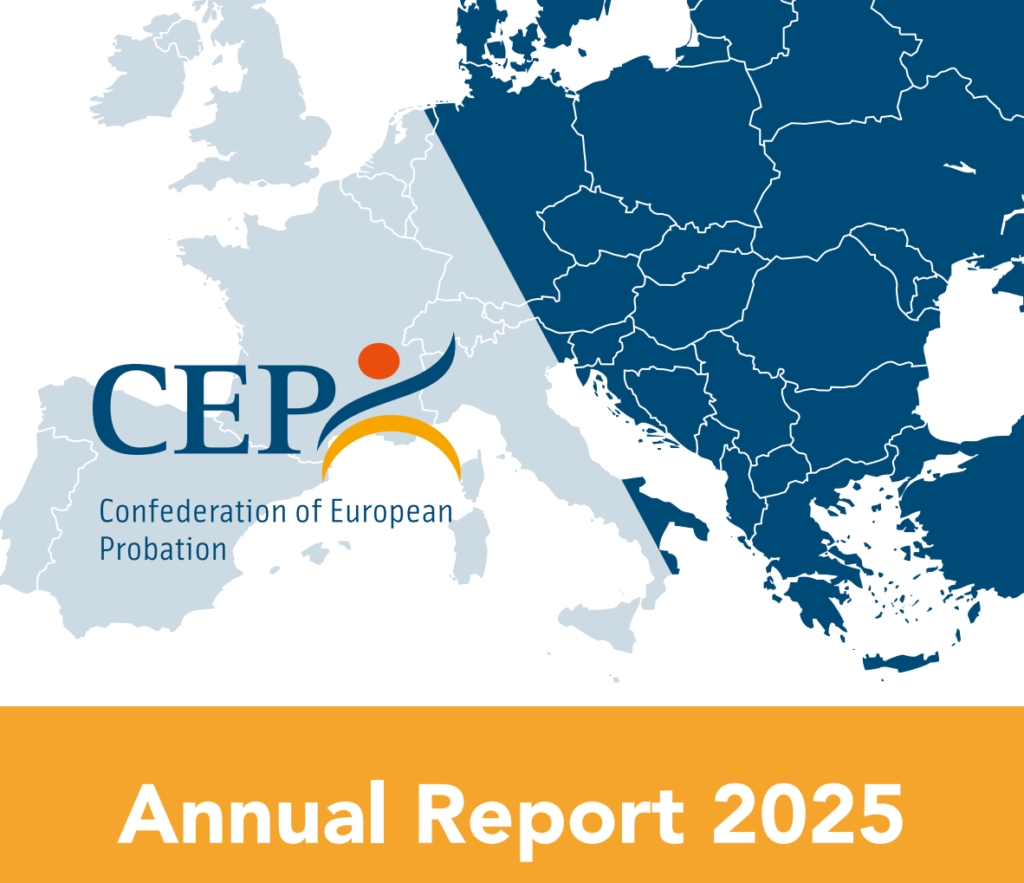
The Confederation of European Probation (CEP) has published its Annual Report 2025, showcasing a year marked by growth, cooperation, and continued commitment to strengthening probation across Europe.
Bringing together more than 100 member organisations across 42 countries and 59 jurisdictions, CEP continued to serve as a central platform for knowledge exchange, professional development, and collaboration within the European criminal justice field.

Uncategorized
ProtectEU: Commission presents new counterterrorism agenda
07/04/2026
On 26 February 2026, the European Commission presented ProtectEU, a renewed EU counterterrorism agenda aimed at strengthening the Union’s capacity to prevent, detect and respond to evolving terrorist threats.
New
Probation in Europe
New Vodcast Episode: Jana Spero Kamenjarin on the Confederation of European Probation (CEP)
07/04/2026
The 19th episode of Division_Y features Jana Spero Kamenjarin, Secretary General of the Confederation of European Probation (CEP), based in Utrecht, the Netherlands.
New

Electronic monitoring
Electronic Monitoring in Europe: Insights from the 13th Electronic Monitoring conference Questionnaire
30/03/2026
The 13th Electronic Monitoring (EM) conference Questionnaire has now been released, offering a comprehensive overview of how EM is applied across Europe today.ion.
New
CEP members
New CEP member: Guernsey Probation Service
25/03/2026
In recent weeks, CEP has interviewed individual members and representatives of the new member organisations that joined CEP at the beginning of 2026. In these interviews, the new member organisations or individual members will share information on why they decided to become members, how they would like to contribute to the development of CEP and many more.
Enjoy reading!
Recap

Probation outside Europe
Recap: CEP and APPA webinar
25/03/2026
Confederation of European Probation (CEP) and American Probation and Parole Association (APPA) hosted the second joint webinar on 24 March 2026, this time on “Integrity of Performance: Ensuring Meaningful and Ethical Outcomes”.
The overarching theme of integrity of performance was explored through two distinct perspectives on this fundamental concept.
Subscribe to our bi-monthly email newsletter!
"*" indicates required fields
- Keep up to date with important probation developments and insights.