
Skip to content

News

The Judicial Training Team | CJEU traning videos Available in All EU Languages

Have you ever wondered what’s really behind the doors of the Court of Justice of the EU?

 >>Join our virtual tour through the Court of Justice of the European Union through a set of 6 practical learning videos, NOW AVAILABLE IN ALL EU LANGUAGES.

Course details

The Commission, in collaboration with the CJEU, has produced a series of 6 training videos. They provide concrete knowledge and hands-on advice to help you prepare your next encounter.

Target audience

Judiciary, lawyers, and other justice professionals. Judiciary, lawyers, and other justice professionals, as well as agents acting before the CJEU. Primary lawyers, other legal practitioners and agents acting before the CJEU, judiciary, as well as all justice professionals. Judiciary, lawyers, and other justice professionals, specifically those involved in direct actions to the General Court. Primary judges, members of national courts and tribunals (within the meaning of Article 267 TFEU), as well as all justice professionals. Primary lawyers, other legal practitioners and agents acting before the CJEU, as well as all justice professionals.

Learning objectives

  • The CJEU jurisdiction, composition, and types of actions handled
  • The main tasks of the Court of Justice and of the General Court
  • Case-law establishing some of the basic structural principles governing the EU institutional and judicial system
  • The role on national courts in judicial dialogue, building multi-levelled constitutionalism in Europe
  • The essence of the cooperation between the Court of Justice and the national courts and tribunals
  • Procedural rules regarding the written part of the procedure
  • Various proce
  • dural matters concerning submissions, the language regime, etc
  • Skills to present legal arguments during the written and the oral phases of the proceedings
  • Ability to use the e-Curia application

To access the videos,

  1. Click here and log in to the EU Academy through your EU Login. If you don’t have one yet, you can register here.
  2. To enrol to the course click on the yellow item, titled “enrol” below the video on the top right side of the page.
  3. Open the first section “Welcome” and Click on this link to answer the short survey. Once you have responded to the three simple questions in the survey, the course will be open for you to learn everything you have been wondering about the CJEU.

We encourage you to use this free and high-quality learning material, financed by the European Commission and created in cooperation with the CJEU.

Offered by

This content is offered by the European Commission. The European Commission is the European Union’s politically independent executive arm. It is alone responsible for drawing up proposals for new European legislation, and it implements the decisions of the European Parliament and the Council of the European Union.

Related News

Keep up to date with the latest developments, stories, and updates on probation from across Europe and beyond. Find relevant news and insights shaping the field today.

Recap

Framework Decisions

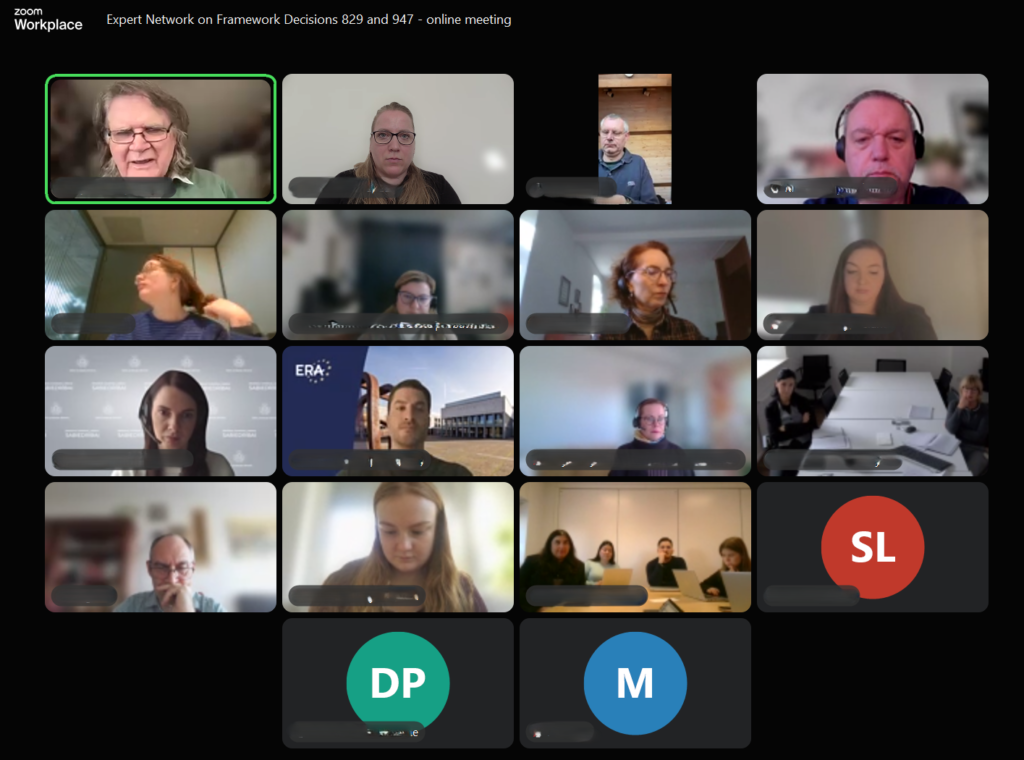
Recap: annual meeting of the Expert Network on Framework Decisions 829 and 947

09/11/2026

On Thursday 5 November an annual meeting of the Expert Network on Framework Decisions 829 and 947 took place online. Bringing together 20 participants from 12 EU jurisdictions including representatives of the Academy of European Law and European Judicial Network, the meeting provided an opportunity to exchange experiences, discuss current implementation challenges and identify priorities for enhancing cross-border cooperation in the application of the two Framework Decisions. 

New

Education and Training, Probation in Europe

Justice programme: the judicial training call is open for applications!

09/11/2026

Are you ready to help address the training needs of justice professionals from different EU countries in the fields of civil law, criminal law and fundamental rights? This call supports cross-border training projects contributing to the effective and consistent application of EU law. In line with the new European Judicial Training Strategy, the call also supports the digitalisation of justice. Don’t miss this opportunity! Apply by 4 March 2027, 17:00 Brussels time.

More info


Recap

CEP Board, Foreign Nationals in Prison and Probation, Probation in Europe

CEP at the 16th Plenary Meeting of the Council for Penological Co-operation

06/11/2026

From 3 to 5 November 2026, representatives of the Confederation of European Probation (CEP) participated in the 16th Plenary Meeting of the Council for Penological Co-operation (PC-CP).

New

CEP

Newsletter October 2026 out now

29/10/2026

New

Violent Extremism

Understanding Youth Radicalisation: What Can Probation Services Do? | New Report from CEP’s Expert Group

27/10/2026

In recent decades, the violent radicalisation of juveniles and young adults has become a pressing concern for policymakers, researchers, practitioners, and communities worldwide. While considerable attention has been devoted to psychological vulnerabilities, socio-economic marginalisation, and community-level influences, the broader context in which violent radicalisation develops is often overlooked. At the same time, the increasing involvement of young people in violent extremist offences highlights the urgent need for effective prevention efforts. Addressing youth radicalisation has become a complex and evolving challenge for families, educators, mental health professionals, law enforcement agencies, probation services, and security authorities.

Recap

Probation in Europe

Reflections on the European Society of Criminology Conference 2026 | From Criminological Research to Probation Practice

26/10/2026

At CEP, we are fascinated by research from across Europe and beyond, and by helping it reach the people who can use it. Ruth Armstrong, CEP Research and Policy Officer, went to the 26th Annual Conference of the European Society of Criminology (EuroCrim 2026 – Working Group on Community Sanctions and Measures) that took place in Warsaw, Poland, from 9–12 September 2026.

Against a backdrop of overcrowded prisons and net-widening (with ever more people drawn into supervision), three questions kept coming up in the research: how time shapes justice, what we mean by success, and how we define harm.

Subscribe to our bi-monthly email newsletter!