Skip to content

News

Criminal Justice Social Work Project kick-off: The Latvian perspective

In Europe, probation services are professionalising and education is distinct component of this development. The project ‘Criminal Justice Social Work’ (CJSW) is a response to the need for teaching materials for probation workers. The Latvian Probation Service is a partner in the project, together with a number of European partners. Anvars Zavackis, senior researcher of its Training & Research Unit, comments on the motivation for Latvia to participate.

Anvars Zavackis
Working on education
The kick-off meeting of the CJSW project took place on the 9-10 February in Den Bosch, The Netherlands. At this meeting, the partners met for the first time in the project setting. Anvars Zavackis of the Probation Service and Aija Zobena of the University of Latvia represented their country at the meeting. “I am enthusiastic about our participation,” says Anvars Zavackis. “The demand for educational material is great.” The Probation Service has about 350 probation officers and turnover rate is quite high. “About 14-20% of the officers changes every year. In 2010 only 48 of the probation workers had a background in social work and we would like to increase this number. The others usually had an education in law (90 persons) or pedagogy (100 persons).”

Cooperation with the University of Latvia
To work together on the CJSW project with the University of Latvia proves to be an excellent opportunity for the Probation Service. “We had been in touch with the University but these initiatives stranded around 2006. Other developments in the Service proved to be more urgent at the time,” continues Anvars Zavackis. “The CJSW project provides us, however, an opportunity to cooperate again. Students of the University will be able to choose an education in social work with a specialisation, instead of a short on-the-job course for workers. We will develop teaching modules and test & try them. In this process we will help each other in a practical way, and learn from the other partners in the CJSW project.”

Networking in Europe
Developments in Europe make cooperation with European partners a logical step. The Probation Rules and greater mobility requires the sector of probation to connect. For Latvia, however, the cooperation is a relatively new development. “Strangely enough, in the beginning Canada was our example.. Our officers visited Canada and the Canadian system was a model for our Probation Service programmes. It was only in 2011 that a European programme was introduced: A UK sex offender treatment programme. I would like to see that the development of the past 3-4 years is continued and I know it will be an important topic for the Service in the upcoming 5 years.”

Work in probation is challenging, particularly in the context of the European laws. “The CJSW project will offer a practical solution by providing educational material of high quality,” hopes Anvars Zavackis. “This is what we need in Europe.”

Project:
CJSW logo

Partners:

AvansEACEA
Funding:

Logo

This project has been funded with support from the European Commission.

Disclaimer:
This publication [communication] reflects the views only of the author, and the
Commission cannot be held responsible for any use which may be made of the
information contained therein.

Related News

Keep up to date with the latest developments, stories, and updates on probation from across Europe and beyond. Find relevant news and insights shaping the field today.

Recap

CJPE summer course, Gender-based violence

She Matters: Advancing Gender-Responsive Criminal Justice Through Cross-Sector Learning in Barcelona.

13/07/2026

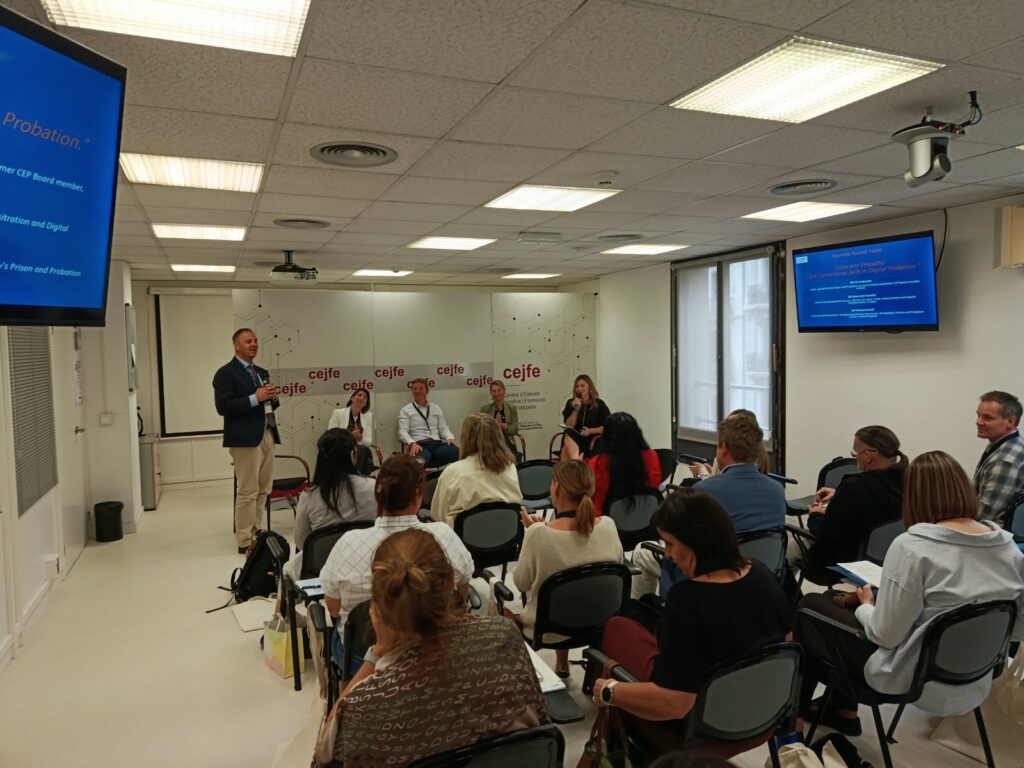
From 7 to 10 July 2026, more than 60 criminal justice professionals from across Europe and beyond gathered in Barcelona for the 8th Criminal Justice Platform Europe (CJPE) Summer Course, hosted by the Centre for Legal Studies and Specialised Training (CEJFE) of the Government of Catalonia. Bringing together professionals from probation, restorative justice and prisons, the Summer Course once again demonstrated the unique value of cross-sector learning, international cooperation and professional exchange.

Reading corner

Probation in Europe

Dohľad

08/07/2026

The authentic world of probation and mediation, in which professional work intersects with human destinies, is brought to you by the publication through case studies revealing the diverse life stories of convicts and the dynamics of their relationship with probation and mediation officers.

Probation Journal

CEP

New Publication: CEP, Probation and the Digital Future

02/07/2026

The latest issue of the Journal of Offender Monitoring features an English version of Gerry McNally’s chapter, CEP, Probation and the Digital Future, first published in 2023 as part of the Portuguese book Execução das Penas e Medidas na Comunidade no Futuro Digital, edited by Nuno Caiado.

New

Calls and funding oppertunities

European Commission | Call for proposals to support transnational projects in the fields of e-Justice, victims’ rights, and procedural rights.

02/07/2026

The European Commission has launched a new call for proposals to support transnational projects in the fields of e-Justice, victims’ rights, and procedural rights.

With a total budget of €9.4 million, the call aims to fund projects that contribute to the digitalisation and effectiveness of justice systems, strengthen the protection of victims, and promote access to justice and judicial cooperation across Europe.


New

Education and Training

Launch of 40 e-Capsules: Training on EU Law for Justice Professionals

29/06/2026

The European Judicial Training Team of the European Commission is pleased to announce the launch of 40 e-capsules (each available in all EU languages) within civil law, criminal law and fundamental rights.


New

CEP

Delegation from Azerbaijan visits CEP Office in Utrecht

25/06/2026

On 23 June, a delegation from Azerbaijan visited the CEP office in Utrecht, the Netherlands. The delegation included representatives of the Probation Service, Ministry of Justice of the Republic of Azerbaijan, a judge of the Supreme Court of the Republic of Azerbaijan and representatives of the Embassy of the Republic of Azerbaijan in the Netherlands. The visit to the CEP office was part of a broader learning programme with Reclassering Nederland.

Subscribe to our bi-monthly email newsletter!