

Previous Article
News
CEP Probation Awards 2016: a celebration of outstanding contributions to probation
The Confederation of European Probation is establishing a Probation Awards Scheme to celebrate outstanding contributions to Probation. Awards will be presented at each General Assembly, beginning with the General Assembly to be held in Bucharest in October 2016.
Objectives
The awards scheme reflects CEP’s vision: To contribute to safer communities by rehabilitating and reintegrating offenders and providing the best possible interventions to reduce re-offending and the impact of crime.
The Award Scheme aims to:
- Celebrate and recognise outstanding achievement in a range of probation settings
- Promote professionalism and excellence
- Foster good practice through dissemination of information about award winners
- Improve awareness of probation and stimulate publicity
- Encourage leadership and partnership
- Promote research and the sharing of professional knowledge
- Promote CEP values, and a commitment to diversity and human rights
Award winners will receive an engraved plaque and a framed photograph of them receiving their award at the General Assembly. Opportunities would be found for their work to be showcased in the media, on the website – either at the conference or at future events.
CEP will cover the cost for one person to attend the conference for each of the 4 awards.
Process
The nomination process has now closed.
Recipients of the Award will be contacted and invited to attend and present the CEP Conference by Friday 2 September.
Any questions about the Awards Programme should be sent to the CEP office: secr@cep-probation.org
Awards
There are four categories of award. A winner and runner-up from each category will be selected.
- Rehabilitation in the community – an award for work which is effective in rehabilitating probation clients and reducing reoffending.
- Social inclusion – an award for work which has made a significant contribution to integrating probation clients into the community.
Examples could include work which enables clients to make amends to the community (restorative justice); or which tackles discrimination; or which involves volunteers in actively supporting ex-offenders (e.g. mentoring).
- Public protection – an award for making a significant contribution to reducing risk of harm to potential victims.
Examples of this would include work which focuses in specific risks (e.g. violence, sex offending, domestic violence, radicalisation). It would also include an approach to managing individuals who pose a serious public protection risk.
- Research – an award for research which has had a major impact on probation practice.
The research must have been published in the last 5 years (2011 or later). Examples include the evaluation of a specific intervention; desistance research; research which improves the training or development of practitioners.
Eligibility
Rehabilitation, Social Inclusion and Public Protection awards
- The competition is open to all organisations working to provide probation or community justice services in the community.
- The work nominated must be based in the community (i.e. not in a prison or correctional institution).
- It must have been operating for a minimum of 12 months at the point of nomination and be able to provide information about the type of services provided and number of people receiving these.
- The work must be able to show that it has clear objectives and provide evidence about its success in meeting these.
In making their decisions the Awards Committee will take into account
- How long has the project/service has been operating successfully
- Innovation
- Level of impact
Research award
The research nominated must have been published in the last 5 years. If the research has not been published in English, a summary in English must be provided.
The nomination must show how the research has been used to develop or support probation practice.
Supporting evidence
The nomination for the rehabilitation, social inclusion and public protection awards must be supported by
- a reference from a senior manager from the agency (normally the Director of Chief Executive) who can endorse the nomination and confirm that the information provided is accurate;
- a reference an individual who is not a member of the agency who can confirm the impact of the work.
The nomination for the research award must be supported by:
- a reference from an academic in relation to the quality of the research
- a senior member of a probation / community justice organisation who can confirm the impact of the research on probation practice.
Nominations must be submitted in English using the on-line proforma. Additional evidence may also be submitted electronically as an attachment.

Related News
Keep up to date with the latest developments, stories, and updates on probation from across Europe and beyond. Find relevant news and insights shaping the field today.
Recap
Electronic monitoring, Technology
14th Electronic Monitoring Conference, Electronic Monitoring in a Changing World – Perception vs Reality
08/10/2026
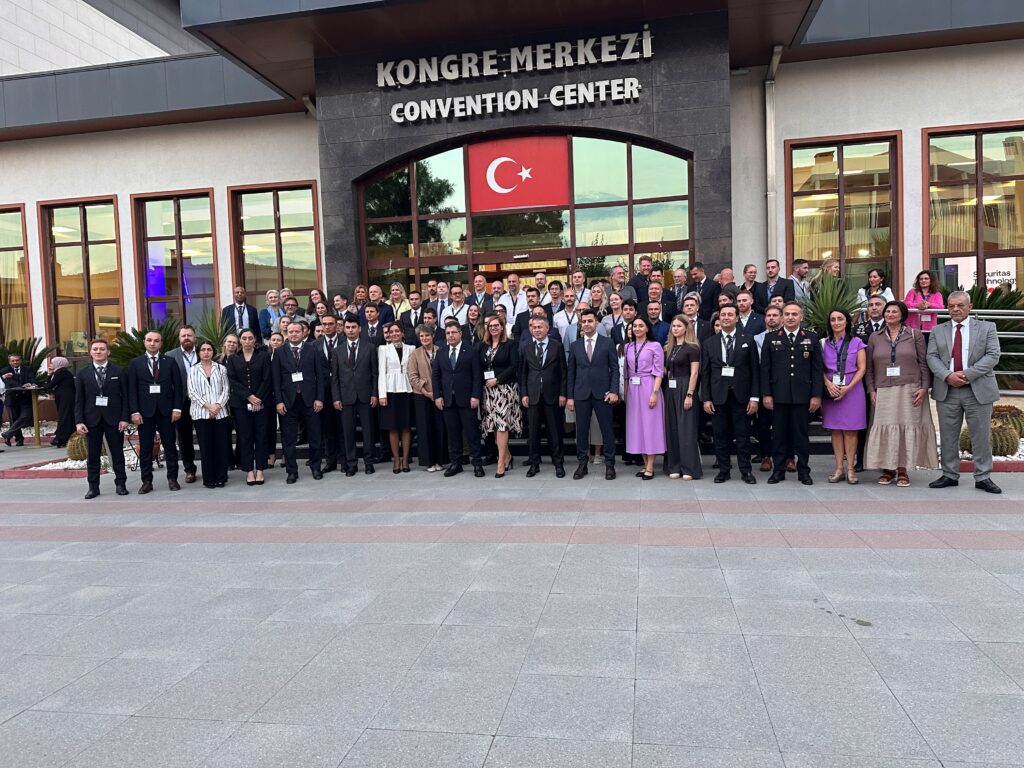
On 6-8 October 2026, Antalya hosted the 14th Electronic Monitoring Conference “Electronic Monitoring in a Changing World – Perception vs Reality”. More than 350 participants coming from 30 countries across Europe and worldwide representing probation services, Ministries of Justice, victims´ services, EM providers, researchers as well as local participants representing the Turkish Prison and Probation Service gathered to discuss how electronic monitoring (EM) is understood by all stakeholders involved including the victims and the public, and how these perceptions compare to the evidence and experiences of those affected. While the gap between perception and reality in electronic monitoring has been recognised for over a decade, the rapid expansion of EM into areas such as victim protection, high-risk supervision and digital innovation has brought new challenges and questions to the forefront.
Recap

ITSCCS
Core Correctional Skills in Digital Probation: highlights from the 6th ITSCCS in Barcelona
05/10/2026
The sixth International Training School on Core Correctional Skills (ITSCCS) took place in Barcelona from 28 September to 2 October 2026, bringing together 26 participants for a week of learning, practical training and international exchange. Organised by the Confederation of European Probation (CEP) and the Centre for Legal Studies and Specialised Training (CEJFE), the programme focused on “Clicks and Empathy: Core Correctional Skills in Digital Probation.”
Recap
Framework Decisions
Recap: ERA workshop on Framework Decisions 829 and 947 in Bucharest
02/10/2026
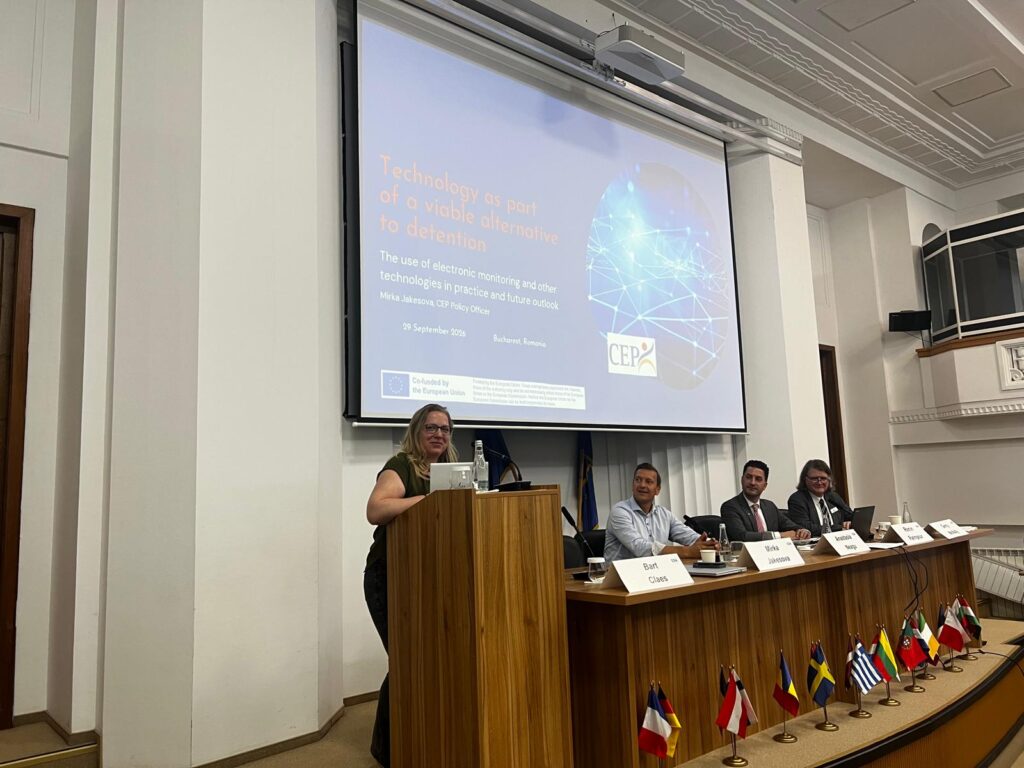
CEP Vice-President Daniel Danglades, Ambassador Gerry McNally and Policy Officer Mirka Jakesova participated in the Seminar on Framework Decisions 829 and 947 and their Impact on Alternatives in the EU organized under the EU project run by the Academy of European Law on 28-29 September in Bucharest, Romania. The seminar brought together judges, prosecutors, probation practitioners, academics, and policy experts to discuss the growing role of alternatives to detention within European criminal justice systems.
New

CEP
CEP and Catalan justice leaders reaffirm longstanding cooperation
29/09/2026
Representatives of the Confederation of European Probation (CEP) met with senior officials from the Catalan Department of Justice and Democratic Quality in Barcelona on 28 September 2026, alongside the opening of the sixth International Training School on Core Correctional Skills. The meeting offered an opportunity to recognise a longstanding partnership and discuss its continued development.
Updated
Mental Health
DEADLINE EXTENDED: Call for Pilot Implementation of the European Mental Health Training Curriculum
29/09/2026
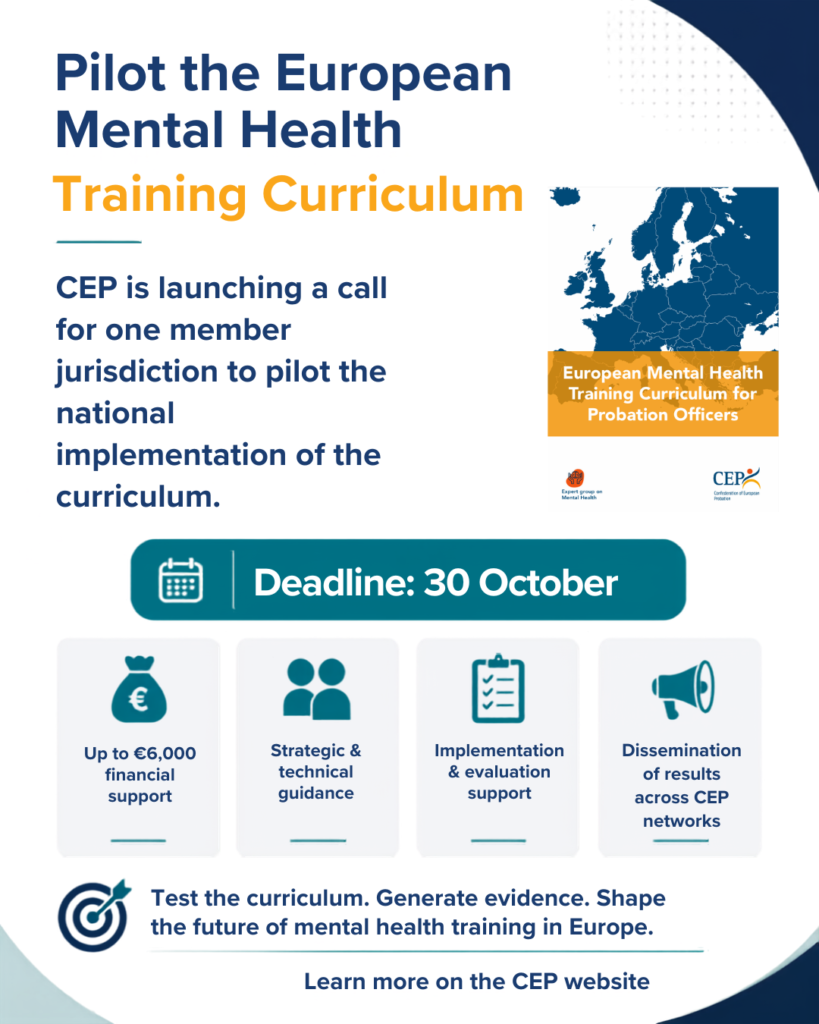
Good news for CEP members! Following requests from our members, CEP has extended the deadline to apply for the pilot implementation of the European Mental Health Training Curriculum for Probation Officers.
Recap

ITSCCS, Technology
6th International Training School opens in Barcelona with a focus on digital probation
28/09/2026
How can probation professionals use new technologies in their interactions while building trust, showing empathy and supporting change? This question is at the heart of the sixth International Training School on Core Correctional Skills, which opened in Barcelona on 28 September 2026.
Subscribe to our bi-monthly email newsletter!
"*" indicates required fields
- Keep up to date with important probation developments and insights.