Previous Article
News
CEP Expert Network on Education and Training Publishes Technical Recommendations on Mentoring in Probation Training
The Confederation of European Probation (CEP) is pleased to present the Technical Recommendations on Mentoring in the Context of Probation Training, developed through the work of the CEP Expert Network on Education and Training.
This publication is the result of extensive collaborative exchange among 30 experts from 15 European jurisdictions, who convened in March 2025 in Agen, France, at the École Nationale d’Administration Pénitentiaire (ENAP). Bringing together probation directors, middle managers, practitioners, and representatives from training institutions, the network worked collectively to identify shared challenges, exchange practices, and formulate practical recommendations to strengthen mentoring within probation services across Europe.
The resulting document represents an important achievement for the CEP Education and Training Expert Network and reflects CEP’s ongoing commitment to supporting the professional development of probation staff, fostering cross-jurisdictional cooperation, and promoting high standards in probation practice.
The recommendations provide a structured framework addressing three key areas:
- The professional role, responsibilities, and ethical foundations of mentors;
- The integration of mentoring within Core Correctional Skills training;
- The responsible and effective use of digital technologies in mentoring environments.
By addressing these areas, the recommendations contribute to strengthening organisational capacity, supporting workforce development, and enhancing the quality and consistency of probation training systems throughout Europe.
The publication underlines the importance of mentoring as a strategic tool for knowledge transfer, professional socialisation, reflective practice, and the reinforcement of evidence-based approaches within probation services. It also highlights the growing relevance of digitalisation, while emphasising the need to maintain ethical safeguards, professional values, and human-centred approaches.
This work demonstrates the added value of European cooperation in the probation field and supports broader objectives related to justice modernisation, professionalisation, and capacity-building.
 Availability for CEP Members
The full Technical Recommendations on Mentoring in the Context of Probation Training is available to CEP members through the CEP Members page.
How to access the member page?
Once logged in, click on the avatar in the top-right corner of the CEP website to access the Members page. ![]()

Related News
Keep up to date with the latest developments, stories, and updates on probation from across Europe and beyond. Find relevant news and insights shaping the field today.
New
CEP
Newsletter August 2026 out now
27/08/2026
CEP’s latest newsletter is out now! It includes:
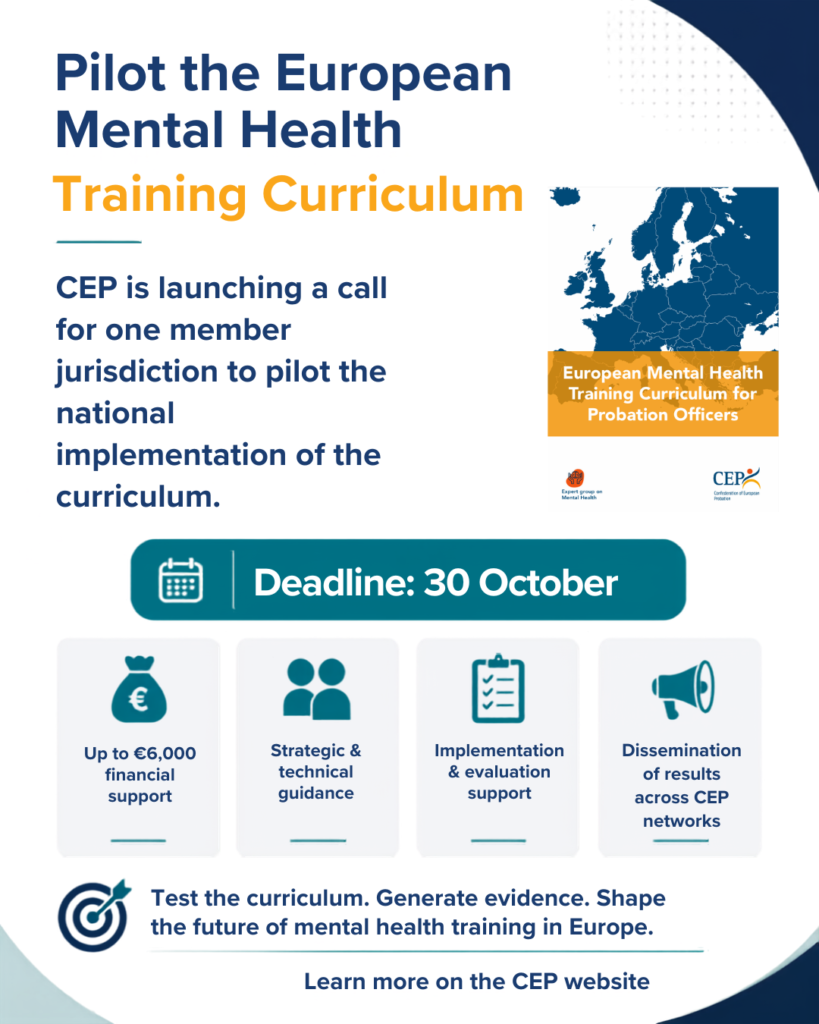
- Approaching deadlines for upcoming events (ITSCCS26, 14th EM and DG leadership training) and the Mental Health curriculum pilot)
- Call for European Probation Journal on the topic of Workload in Probation
- EU documents like SPACE II, revised Victims’ Rights directive and so on
- and much more!
New
Caseload and workload
Do you work in probation? We need your voice!
24/08/2026
As part of its long-standing cooperation with research, CEP invites its members to contribute to a special edition of the European Probation Journal on the topic of Workload in Probation.
New
Alternatives to pre-trial detention, Foreign Nationals in Prison and Probation, Gender Equality, Probation in Europe
SPACE II report is now available
24/08/2026
The use of community sanctions and measures that allow individuals to remain in the community – also known as alternatives to imprisonment – continues to grow overall in Europe, although at a moderate pace, according to the latest Council of Europe annual penal statistics on persons under the supervision of probation agencies (2025 SPACE II survey).
New
Victims rights
Adoption of the revised Victims’ Rights Directive and call for evidence on EU strategy on victims’ rights
05/08/2026
The Council of the European Union has formally approved a new directive strengthening the rights of victims of crime across the EU. The updated law improves access to information, support, and protection by introducing an EU-wide victim support helpline (116 006), making it easier to report crimes through digital tools, strengthening safeguards for victims’ personal data, expanding child-friendly support services, improving access to legal aid, and helping ensure that victims receive compensation more quickly.
This directive updates the 2012 EU Victims’ Rights Directive and aims to ensure that victims receive more consistent and effective support across all Member States. Following its publication in the Official Journal, Member States will have 24 months to transpose the new rules into national law. For more information, see the Council of the European Union’s press release: Council greenlights law reinforcing protection of victims’ rights and check out the revised Victims’ Rights.
Probation Journal
juvenile offenders, Probation in Europe
Overview of Probation Procedures for Juveniles and Adults in Albania
22/07/2026
The Albanian Probation Service plays an important role in the implementation of alternative sanctions and measures for both juveniles and adults. Through supervision, assessment, and rehabilitation-oriented interventions, the Service aims to support compliance with court decisions, reduce the risk of reoffending, and promote the successful reintegration of individuals into society.
Community Sanctions and Measures
Nelson Mandela day
18/07/2026
Nelson Mandela Day reminds us that justice is not only about accountability – it is also about hope. Mandela believed in the dignity of every person and in the possibility of change. These principles are at the heart of probation.
Across Europe, probation professionals work every day to support people in taking responsibility for their actions, rebuilding their lives and successfully reintegrating into their communities. By promoting rehabilitation, social inclusion and human dignity, probation helps reduce reoffending and contributes to safer, more resilient societies.
Subscribe to our bi-monthly email newsletter!
"*" indicates required fields
- Keep up to date with important probation developments and insights.