
Previous Article
 The development of the Turkish probation services was seen in the light of Turkey’s wish to join the EU and was therefore funded within the EU Instrument for Pre-Accession Assistance (IPA). In 2005, the UK had assisted Turkey properly establishing probation services in a separate project. Subsequently, from January 2009 until October 2010, the goal was to develop working, training and other materials for the probation workers and staff. Mary Anne McFarlane focused on two work streams, one in relation to juvenile offenders and one regarding victim support. 60 European experts from– and research trips to England, Northern Ireland, Austria, The Netherlands, France, Germany, Hungary, Czech Republic and Catalonia became valuable sources of information.
Intended outcomes
The project was centred around the two themes of youth offending and victim support. Mary Anne McFarlane sets out the outcomes: “For each work stream we developed national standards, policy, inter-agency working processes, hand books, four intervention programs and a range of manuals to train staff in running the intervention programs. Additionally, we divided it up in four levels ranging from the basics of approaching case management to more intensive aggression replacement therapy for juveniles and counselling to victims of sexual violence.* We also produced quite a lot of materials for communication such as brochures, power-points, roll-ups and posters to reach victims and promote the new juveniles services.” The nature of the project demanded that each step built upon the previous step, resulting in a comprehensive two-year programme that covered many of the 134 branch offices, 30 pilot projects and 22 manuals.
The receivers of all these materials are not just the probation workers, but also their managers, other involved agencies and the courts, explains Mary Anne McFarlane. “We visited nearly 30 branches and really got the discussion going on how we were going to get all these people to work together. I was in constant contact with different agencies who dealt with labour, education, social services, health, police and so on and I reported to a steering committee with EU representatives. My task was very interesting because it combines project management with government advisory skills, ranging from witnessing daily practice to managerial strategic thinking.”
End of project conference
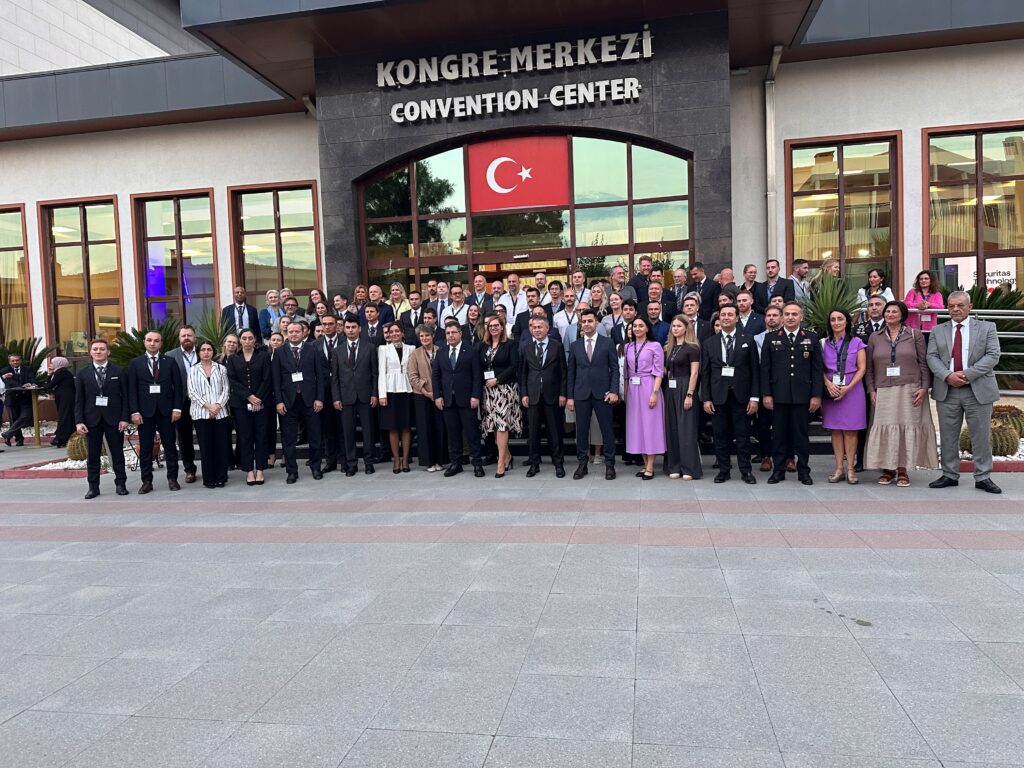
The end result was presented at the closing conference held in Ankara, Turkey, that was at the same time the launch of the work that the twinning project has initiated. “I think it was wonderful to have both Ministers of Justice present,” recalls Mary Anne McFarlane, “their appearance gave our work some extra strength.” The day of the conference consisted of two parts, starting with formal speeches. In the afternoon, the work streams and the use of the materials in the future were discussed in greater detail. There was also an award ceremony that honoured important probation staff. “It was wonderful to see that staff trainers and program developers received extra attention and see them all on the stage.”
“It was also very useful that Leo Tigges (ed. CEP Secretary General) could attend,” adds Mary Anne McFarlane about the contribution of the CEP. “Because informally we could discuss the option of Turkey becoming a member of the CEP. Not only what might help in achieving that but also what Turkey can bring to the CEP network and vice versa. I think it would be great to have the Turkish MoJ on board, we welcome their contribution.”
Over all, Mary Anne McFarlane is very hopeful that the twinning project has created substantial and lasting results. “I had no doubt that the juveniles work would be successful because it was not a new field for the Turks. But the victims work was new and very ambitious. In the end I am very pleased with what we have done and the intervention projects that the Turkish probation services are rolling out at the moment. We are already beginning to help some victims of crime.”

CEP Secretary General Leo Tigges with the assistants to Mary Anne McFarlane Asli and Ergin.
* Four levels in each work stream:
Juvenile offenders:
Basic approaches to case management
Juveniles with drug problems
General offending behaviour programme
Art – Aggression Replacement Therapy
Victim support:
Basic approaches to case management
Victims who need additional counselling
Victims of domestic violence
Victims of sexual violence