
Previous Article
News
A day in the Life of Probation Officer from Malta during Covid 19
Nothing can alter my perception that working as a Probation Officer makes a person unique and interesting but it also brings a lot of stress. This job is very various which at times can take its toll on us. Our main task is to deal with offenders who are given another opportunity in the community to change their lives. Some of them do, others progress is slow, and some is nothing at all.
written by Marry Ann Zammit
And going day by day with all these activities, did we really need a pandemic? No, but it still came. Going back in time. It is the year 2020 and like other colleagues, I am planning to keep the daily routine, compiling Pre Sentence Reports, Parole Reports, attending at the Court of Justice and Supervision of clients. Till one day dawned and it changed everything.
In February 2020 the world woke up to a new reality ,that of a new virus, to covid-19. Suddenly it spread all over the world, attacking rapidly, infecting people and even leading to deaths. In a short period of time, covid-19 has frightened us and made us uncertain. The number of covid cases increased and to prevent widespread contamination we went into lockdown. For the Department of Probation and Parole in Malta, it meant working remotely from home. Nevertheless, this was going to be a new challenge and a new experience for Probation Officers.
Reality of remote working
This was going to be my first time working from home and I was used to the conventional method of working. Many questions came to mind; how I was going to deal with the clients and their supervision? It seemed like a journey into the unknown, without the slightest idea how things were going to turn out. Or worse what if I got infected with covid?
I call to mind that warm Spring day in March, when I found myself packing all the files and the necessary documents for this new journey. But before I left I looked at the desk and thought. When will I return? It was a odd period with a lot of emotions, but I picked up my courage and left.
Adjusting at home
The journey has started and I noticed I had to be creative. Working from at home required discipline and I needed a new strategy. There was also the technical part which included the transfer of files from the work computer to the notebook at home and getting accustomed to all the systems.
First day at home went well. Communication with clients involved telephone calls, video calls and skype calls while I used zoom for communicating with other professionals. I noticed that my clients were getting used to this new way of communicating. One of the issues I came across was taking urine testing from my clients. Although it was impossible to take the test I found out that my clients were being open about their drug use. Yet, still the covid cases kept going higher and we kept living day after day in this new scenario. And week after week I found myself adapting to this new lifestyle and even after work hours I was finding time to organize myself with my artistic life, which is writing and painting.
What did I learn?
This new work scenario helped me to develop more skills personally and as a probation officer. For sure it was an exercise for flexibility and adaptation, but most of all it was an opportunity to adapt to the technology. I believe this applies also for our clients.
To conclude, our work as probation officer is already a journey for growth and self development. Every case brings new insights but the pandemic has been a big lesson for growth. It had taught me that nothing in life is static and what’s meant to happen, will happen. And that is that we need to be ready for the unexpected and to use skills of adaptation. We need to be there for our clients. For sure it will remain a mile stone in my story as a probation officer.

Related News
Keep up to date with the latest developments, stories, and updates on probation from across Europe and beyond. Find relevant news and insights shaping the field today.
Recap
Framework Decisions
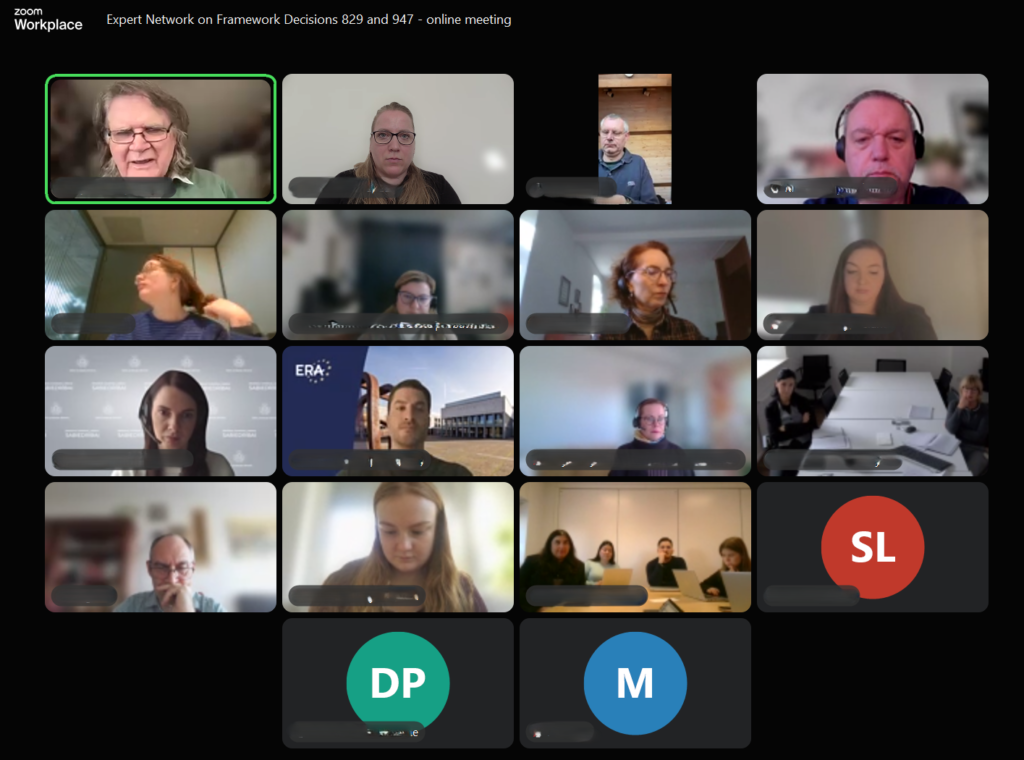
Recap: annual meeting of the Expert Network on Framework Decisions 829 and 947
09/11/2026
On Thursday 5 November an annual meeting of the Expert Network on Framework Decisions 829 and 947 took place online. Bringing together 20 participants from 12 EU jurisdictions including representatives of the Academy of European Law and European Judicial Network, the meeting provided an opportunity to exchange experiences, discuss current implementation challenges and identify priorities for enhancing cross-border cooperation in the application of the two Framework Decisions.
New
Education and Training, Probation in Europe
Justice programme: the judicial training call is open for applications!
09/11/2026
Are you ready to help address the training needs of justice professionals from different EU countries in the fields of civil law, criminal law and fundamental rights? This call supports cross-border training projects contributing to the effective and consistent application of EU law. In line with the new European Judicial Training Strategy, the call also supports the digitalisation of justice. Don’t miss this opportunity! Apply by 4 March 2027, 17:00 Brussels time.
Recap
CEP Board, Foreign Nationals in Prison and Probation, Probation in Europe
CEP at the 16th Plenary Meeting of the Council for Penological Co-operation
06/11/2026
From 3 to 5 November 2026, representatives of the Confederation of European Probation (CEP) participated in the 16th Plenary Meeting of the Council for Penological Co-operation (PC-CP).
New
CEP
Newsletter October 2026 out now
29/10/2026
CEP’s latest newsletter is out now! It includes:
- Deadline approaching for the Workshop on Technology and Alternatives to Detention
- Recap of the 14th EM and CEP Excellence Leadership Training
- New publications from Expert Groups on Technology and Expert Group on Violent Extremism
- Call for Proposals: Evaluation of CEP Expert Groups
- Engaging with Research – a new section in our newsletter
- and much more!
New
Violent Extremism
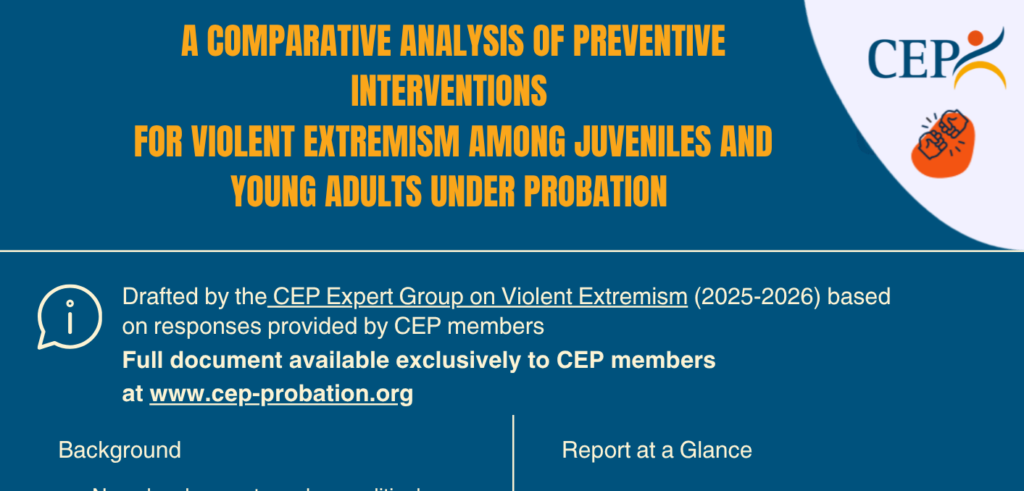
Understanding Youth Radicalisation: What Can Probation Services Do? | New Report from CEP’s Expert Group
27/10/2026
In recent decades, the violent radicalisation of juveniles and young adults has become a pressing concern for policymakers, researchers, practitioners, and communities worldwide. While considerable attention has been devoted to psychological vulnerabilities, socio-economic marginalisation, and community-level influences, the broader context in which violent radicalisation develops is often overlooked. At the same time, the increasing involvement of young people in violent extremist offences highlights the urgent need for effective prevention efforts. Addressing youth radicalisation has become a complex and evolving challenge for families, educators, mental health professionals, law enforcement agencies, probation services, and security authorities.
Recap
Probation in Europe
Reflections on the European Society of Criminology Conference 2026 | From Criminological Research to Probation Practice
26/10/2026
At CEP, we are fascinated by research from across Europe and beyond, and by helping it reach the people who can use it. Ruth Armstrong, CEP Research and Policy Officer, went to the 26th Annual Conference of the European Society of Criminology (EuroCrim 2026 – Working Group on Community Sanctions and Measures) that took place in Warsaw, Poland, from 9–12 September 2026.
Against a backdrop of overcrowded prisons and net-widening (with ever more people drawn into supervision), three questions kept coming up in the research: how time shapes justice, what we mean by success, and how we define harm.
Subscribe to our bi-monthly email newsletter!
"*" indicates required fields
- Keep up to date with important probation developments and insights.