

Previous Article
News
Mental health among persons subject to Probation Service Supervision in Ireland
Internationally, the prevalence of mental health problems and mental illness among people subject to Probation Service supervision is significantly higher than in the general population. The internal studies conducted in 2019 in the Irish Probation Service, which are outlined in this report, show that Ireland is no exception.
Mental health among persons subject to Probation Service Supervision in Ireland
By Dr. Christina L. Power, Irish Probation Service
Until recently in Ireland there has been a paucity of data and research on mental health problems among persons subject to Probation Service supervision. A number of small scale practitioner studies (Griffin, 2008; Cotter, 2015; Foley, 2016) highlighted concerns regarding the incidence of mental health problems among the population. The studies were limited in their focus but were instrumental in drawing attention to the field by identifying significant gaps in knowledge and the need for further evaluation and action.
The 2019 studies, go much further and focus specifically on examining the nature and extent of mental health problems among persons subject to Probation Service supervision. The studies examine existing data based on initial assessment, development and pilot of a measure specially developed for the studies in one team and a third study which replicated the methodology study on a larger representative population of those subject to a Probation Supervision Order in Ireland. Probation Officers completed two measures for each client on their caseload based on their knowledge, observation and any available collateral information.
The three studies are consistent in identifying that, at least 40% of adults on a Probation Supervision Order, compared to 18.5% of the general population in Ireland, present with symptoms indicative of one or more mental health problem. Furthermore, approximately 50% of all people supervised by the Probation Service in the community that present with mental health problems also present with one or more of the following issues as well: alcohol and drug misuse, difficult family relationships, and accommodation instability.
The third and the largest study based on a population of 500 clients highlights several key findings which are outlined in detail in the report, but for the purpose of this short introduction the following are notable.
- 43% experience Active Symptoms of Mental Health Problems; 10% experience symptoms indicative of serious and/or severe and enduring mental health problems; 1 in 10 people expressed suicidal thoughts or ideas at the time of completion.
- 30% are engaged with a service for Mental Health Assessment and/or Intervention currently (49% women; 28% men), mostly through their GP/medication; less than 1.4% engaged with Primary or Secondary Care Psychology Services.
- 56% have had some form of Mental Health Assessment and/or Intervention in the Past (70% women; 52% men); 11% of persons have had In-Patient Psychiatric Care in the Past.
- 41% are identified as having a known Mental Health Diagnosis provided by a qualified clinician (52% women; 38% men), most often an anxiety disorder or Mood disorder; however, 8% have a formal diagnosis of Schizophrenia/Primary Psychotic Disorder.
It is clear that there are significant and unmet psychological and psychiatric needs among those persons subject to Probation Supervision and there is limited access and engagement with mental health services. To address this, it is recommended that The Probation Service:
- Strengthen knowledge and develop skills-based training in mental health for Probation Service staff to aid recognition of mental health problems and where identified, ensuring that the appropriate services are involved at assessment and/or intervention.
- Improve and strengthen Probation Service engagement with mainstream primary care and forensic and community mental health service providers and the development of joined-up strategies and interventions.
- Have improved access and engagement routes to mental health services; there is a need for cross agency working and a focused government approach to ensure this can happen.
The full report ‘MOVING FORWARD TOGETHER: MENTAL HEALTH AMONG PERSONS SUPERVISED BY THE PROBATION SERVICE’ Probation Service Research Report 7 March 2021 can be downloaded here:

Related News
Keep up to date with the latest developments, stories, and updates on probation from across Europe and beyond. Find relevant news and insights shaping the field today.
Recap

Electronic monitoring, Technology
14th Electronic Monitoring Conference, Electronic Monitoring in a Changing World – Perception vs Reality
08/10/2026
On 6-8 October 2026, Antalya hosted the 14th Electronic Monitoring Conference “Electronic Monitoring in a Changing World – Perception vs Reality”. More than 350 participants coming from 30 countries across Europe and worldwide representing probation services, Ministries of Justice, victims´ services, EM providers, researchers as well as local participants representing the Turkish Prison and Probation Service gathered to discuss how electronic monitoring (EM) is understood by all stakeholders involved including the victims and the public, and how these perceptions compare to the evidence and experiences of those affected. While the gap between perception and reality in electronic monitoring has been recognised for over a decade, the rapid expansion of EM into areas such as victim protection, high-risk supervision and digital innovation has brought new challenges and questions to the forefront.
Recap

ITSCCS
Core Correctional Skills in Digital Probation: highlights from the 6th ITSCCS in Barcelona
05/10/2026
The sixth International Training School on Core Correctional Skills (ITSCCS) took place in Barcelona from 28 September to 2 October 2026, bringing together 26 participants for a week of learning, practical training and international exchange. Organised by the Confederation of European Probation (CEP) and the Centre for Legal Studies and Specialised Training (CEJFE), the programme focused on “Clicks and Empathy: Core Correctional Skills in Digital Probation.”
Recap

Framework Decisions
Recap: ERA workshop on Framework Decisions 829 and 947 in Bucharest
02/10/2026
CEP Vice-President Daniel Danglades, Ambassador Gerry McNally and Policy Officer Mirka Jakesova participated in the Seminar on Framework Decisions 829 and 947 and their Impact on Alternatives in the EU organized under the EU project run by the Academy of European Law on 28-29 September in Bucharest, Romania. The seminar brought together judges, prosecutors, probation practitioners, academics, and policy experts to discuss the growing role of alternatives to detention within European criminal justice systems.
New

CEP
CEP and Catalan justice leaders reaffirm longstanding cooperation
29/09/2026
Representatives of the Confederation of European Probation (CEP) met with senior officials from the Catalan Department of Justice and Democratic Quality in Barcelona on 28 September 2026, alongside the opening of the sixth International Training School on Core Correctional Skills. The meeting offered an opportunity to recognise a longstanding partnership and discuss its continued development.
Updated

Mental Health
DEADLINE EXTENDED: Call for Pilot Implementation of the European Mental Health Training Curriculum
29/09/2026
Good news for CEP members! Following requests from our members, CEP has extended the deadline to apply for the pilot implementation of the European Mental Health Training Curriculum for Probation Officers.
Recap
ITSCCS, Technology
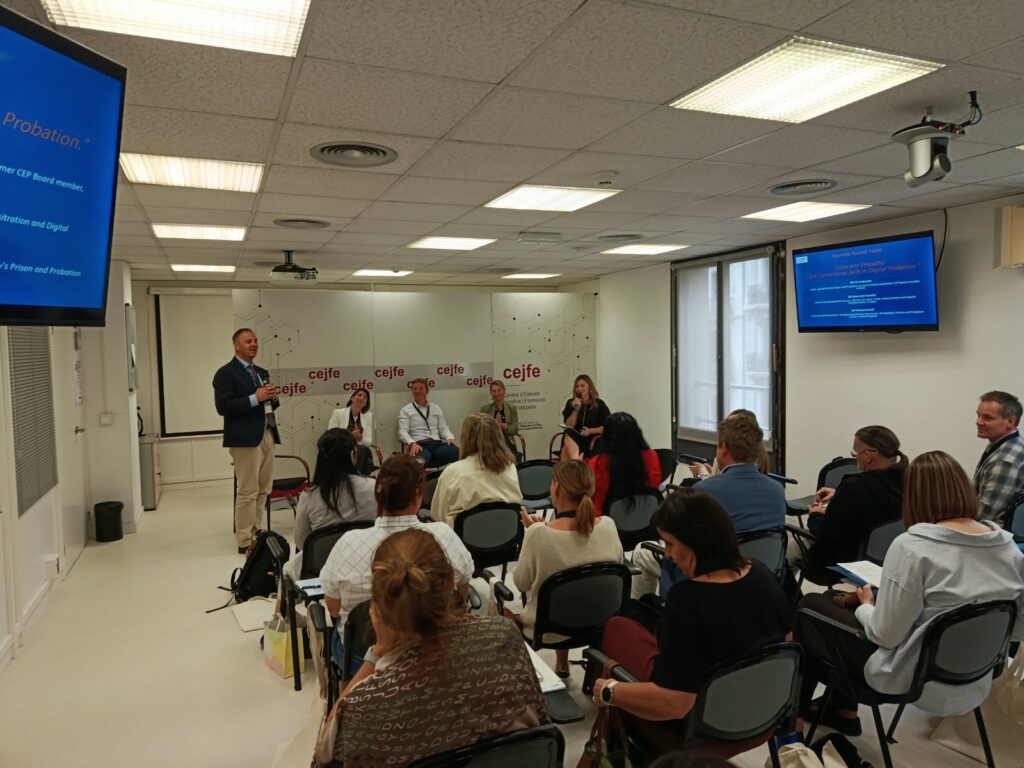
6th International Training School opens in Barcelona with a focus on digital probation
28/09/2026
How can probation professionals use new technologies in their interactions while building trust, showing empathy and supporting change? This question is at the heart of the sixth International Training School on Core Correctional Skills, which opened in Barcelona on 28 September 2026.
Subscribe to our bi-monthly email newsletter!
"*" indicates required fields
- Keep up to date with important probation developments and insights.