

Previous Article
News
Drink&Drive programme in Moldova
The Dutch Probation services and the Romanian Probation Directorate succesfully implemented project Drink&Drive Programme Moldova, financed by the Dutch Embassy in Romania. The project equipped the National Probation Inspectorate from Moldova with a new rehabilitation programme that can be used in working with offenders. The programme is available in seven probation services in Moldova.
The goal of the project was the development of a Drink&Drive programme in Moldova in order to support the rehabilitation of the offenders registered within the Moldovan probation system. The programme aims to diminish recidivism behavior, to reduce the numbers of injures and victims caused by driving under influence and to increase the road safety.
As well, within the project was envisaged the best practice exchange in order to support the strengthening of the Moldovan probation system. The Dutch and Romanian experts attended four workshops and conducted two training sessions for the probation staff in order to design and to disseminate the Drink&Drive programme.
Development of the programme
In 2016, led by the Netherlands Probation and the Romanian Probation, four working meetings were held with representatives of the Moldovan probation, organized by the Institute for Penal Reform Moldova. In the first stage of the project, an analysis report of the current situation related to the drink driving offences in Moldova was developed and a report of evaluation was completed by the experts. The report represents an analysis of all aspects in Moldova around drink driving such as the prevalence and risks of driving under the influence, legal framework, detection and enforcement campaigns about traffic safety, security measures, etc. In addition, the report describes the cooperation between the partners and the draft structure and content of the Drink&Drive programme.
In a second phase of the project, the Drink&Drive programme was created and designed in order to meet the needs of the Moldovan probation system. The content of the programme is based on motivational interviewing and on cognitive behavioral approaches. The Drink&Drive programme has eight sessions (four individual sessions and four group sessions). The programme includes topics such as improving knowledge about relevant items, raising awareness, attitude change and the development of strategies to prevent driving under influence. The guidelines of the programme are drafted in a manual for the probation staff usage.
Improvement required
The Dutch and Romanian experts mentioned the need of a further implementation of the programmme, which must be applied and piloted by the probation staff. In this manner, after the pilot implementation, the programme could be revised and adjusted according to the results of the application. The above mentioned issues could be addressed within the framework of a new project taking into consideration that the Dutch and Romanian experts are willing to continue the cooperation and the support of the Moldovan probation system.

Related News
Keep up to date with the latest developments, stories, and updates on probation from across Europe and beyond. Find relevant news and insights shaping the field today.
Recap
Framework Decisions
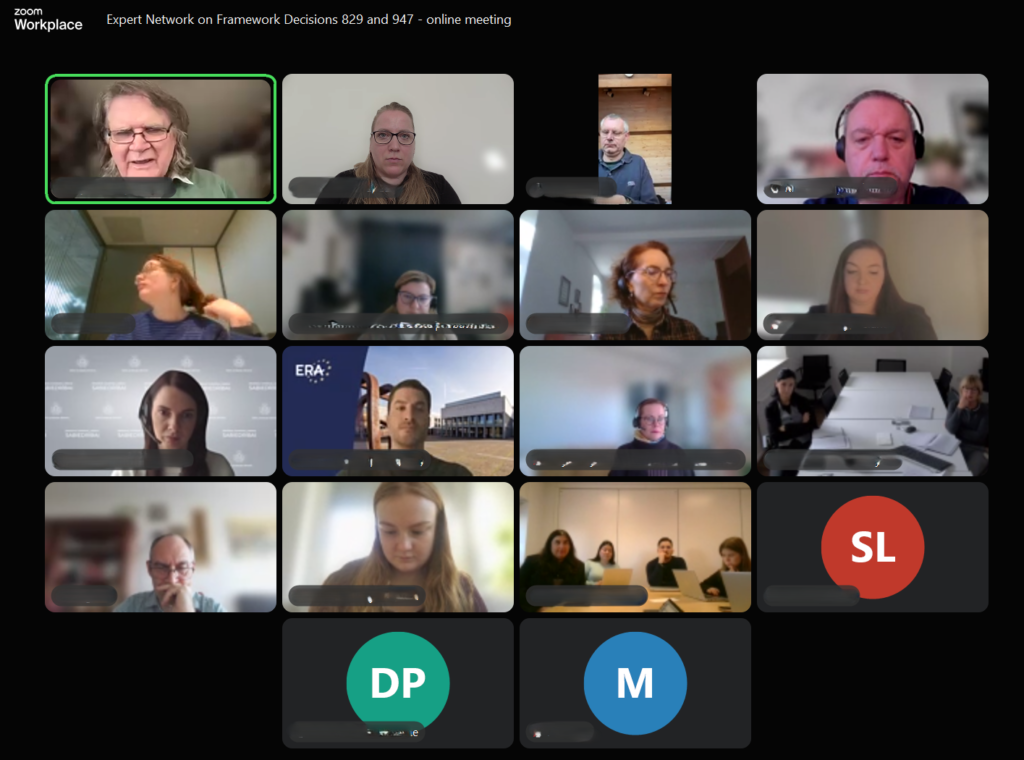
Recap: annual meeting of the Expert Network on Framework Decisions 829 and 947
09/11/2026
On Thursday 5 November an annual meeting of the Expert Network on Framework Decisions 829 and 947 took place online. Bringing together 20 participants from 12 EU jurisdictions including representatives of the Academy of European Law and European Judicial Network, the meeting provided an opportunity to exchange experiences, discuss current implementation challenges and identify priorities for enhancing cross-border cooperation in the application of the two Framework Decisions.
New

Education and Training, Probation in Europe
Justice programme: the judicial training call is open for applications!
09/11/2026
Are you ready to help address the training needs of justice professionals from different EU countries in the fields of civil law, criminal law and fundamental rights? This call supports cross-border training projects contributing to the effective and consistent application of EU law. In line with the new European Judicial Training Strategy, the call also supports the digitalisation of justice. Don’t miss this opportunity! Apply by 4 March 2027, 17:00 Brussels time.
Recap

CEP Board, Foreign Nationals in Prison and Probation, Probation in Europe
CEP at the 16th Plenary Meeting of the Council for Penological Co-operation
06/11/2026
From 3 to 5 November 2026, representatives of the Confederation of European Probation (CEP) participated in the 16th Plenary Meeting of the Council for Penological Co-operation (PC-CP).
New

CEP
Newsletter October 2026 out now
29/10/2026
CEP’s latest newsletter is out now! It includes:
- Deadline approaching for the Workshop on Technology and Alternatives to Detention
- Recap of the 14th EM and CEP Excellence Leadership Training
- New publications from Expert Groups on Technology and Expert Group on Violent Extremism
- Call for Proposals: Evaluation of CEP Expert Groups
- Engaging with Research – a new section in our newsletter
- and much more!
New
Violent Extremism
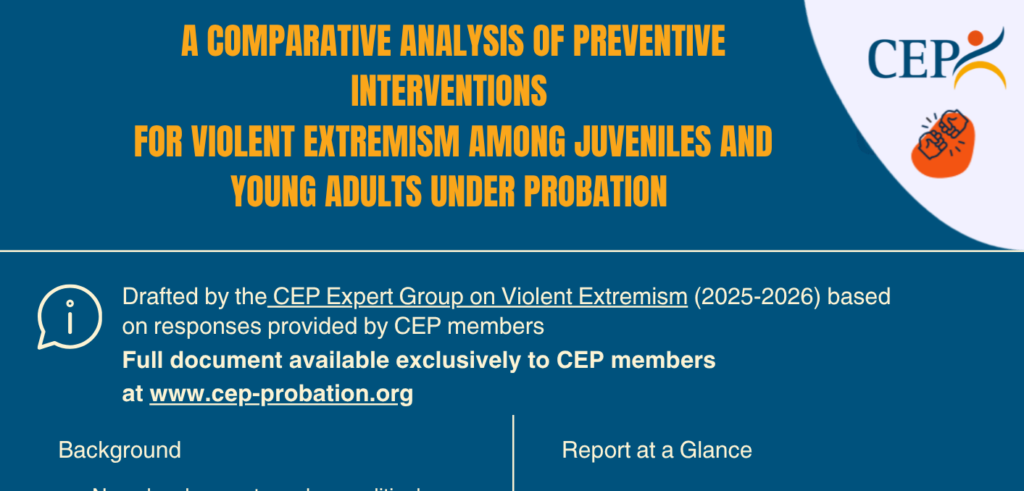
Understanding Youth Radicalisation: What Can Probation Services Do? | New Report from CEP’s Expert Group
27/10/2026
In recent decades, the violent radicalisation of juveniles and young adults has become a pressing concern for policymakers, researchers, practitioners, and communities worldwide. While considerable attention has been devoted to psychological vulnerabilities, socio-economic marginalisation, and community-level influences, the broader context in which violent radicalisation develops is often overlooked. At the same time, the increasing involvement of young people in violent extremist offences highlights the urgent need for effective prevention efforts. Addressing youth radicalisation has become a complex and evolving challenge for families, educators, mental health professionals, law enforcement agencies, probation services, and security authorities.
Recap
Probation in Europe
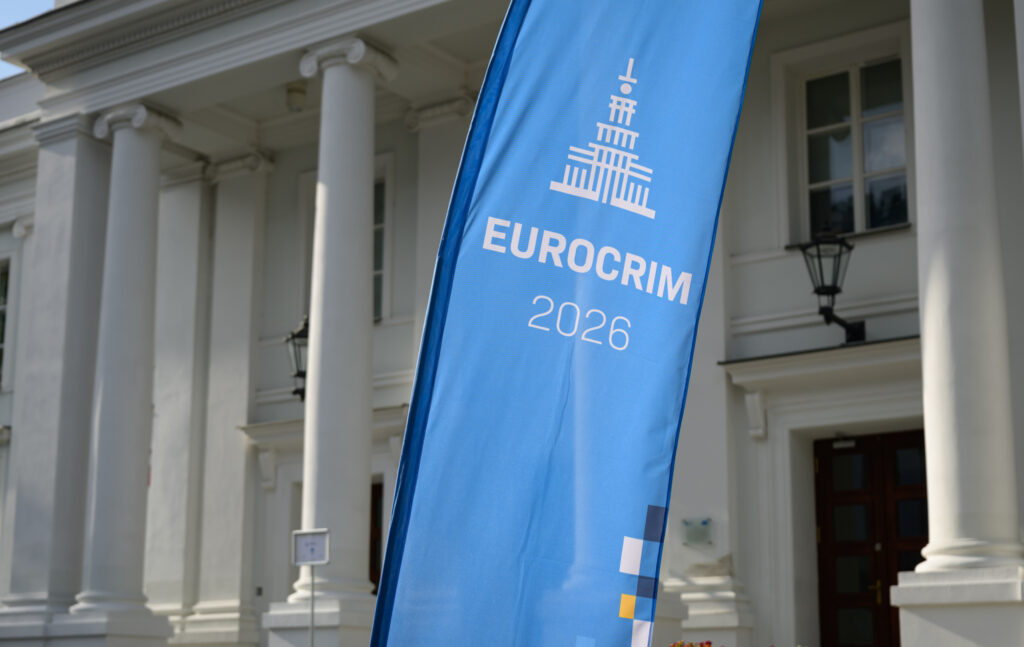
Reflections on the European Society of Criminology Conference 2026 | From Criminological Research to Probation Practice
26/10/2026
At CEP, we are fascinated by research from across Europe and beyond, and by helping it reach the people who can use it. Ruth Armstrong, CEP Research and Policy Officer, went to the 26th Annual Conference of the European Society of Criminology (EuroCrim 2026 – Working Group on Community Sanctions and Measures) that took place in Warsaw, Poland, from 9–12 September 2026.
Against a backdrop of overcrowded prisons and net-widening (with ever more people drawn into supervision), three questions kept coming up in the research: how time shapes justice, what we mean by success, and how we define harm.
Subscribe to our bi-monthly email newsletter!
"*" indicates required fields
- Keep up to date with important probation developments and insights.