

A reflection from the 7th World Congress on Probation and Parole (Bali, April 2026): immersive technology can support Core Correctional Skills, but only when it is embedded in a wider pedagogical architecture.
At the 7th World Congress on Probation and Parole in Bali this April, we had the chance to present findings from the VR‑TooL pilot programme — an Erasmus+ partnership that has spent the last two years asking a deceptively simple question: does virtual reality (VR) deserve a place in the probation officer’s training toolkit? The short answer, on the evidence we now have, is yes — but with conditions that matter rather more than the technology itself.
The empirical base for immersive training is uneven, but no longer trivial. Across roughly eighty controlled studies conducted before 2024, the mean effect size of VR‑based training compared with traditional formats sits at around d = 0.52 — a moderate effect (Merchant et al., 2014). Radianti et al. (2020) report up to fourfold gains in the speed of skill acquisition in simulation contexts, and Parong and Mayer (2021) document a knowledge retention rate of 76% at one‑month follow‑up. The caveat, however, is that most of this evidence comes from medicine and military aviation, where the procedures being trained are highly codified. Probation work, with its relational unpredictability and ethical density, is a harder case.
Two mechanisms in the wider literature seem especially relevant for our field. The first is empathy and perspective‑taking: a VR homelessness simulation developed at Stanford’s Virtual Human Interaction Lab produced higher empathy scores than a narrative‑only condition, with the effect persisting at one‑month follow‑up (Herrera et al., 2018). Barbosa’s (2020) work on officers placed in offender‑role VR scenarios documents a measurable reduction in implicit biases. The second mechanism is decision‑making under pressure: Skinner et al. (2021) found that VR‑trained officers performed better in real‑world de‑escalation at a three‑month follow‑up. Effect sizes here remain small to moderate (d = 0.3–0.6), and there is a recurring warning across this body of work — without structured debriefing, the skills observed in the headset may not transfer into the casework conversation.
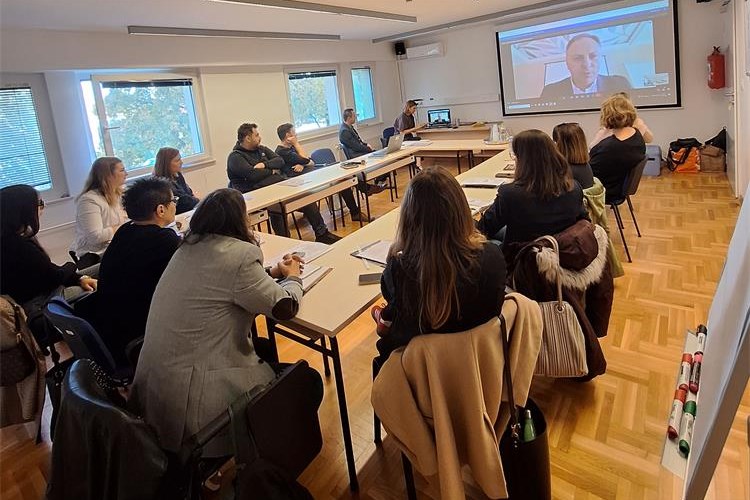
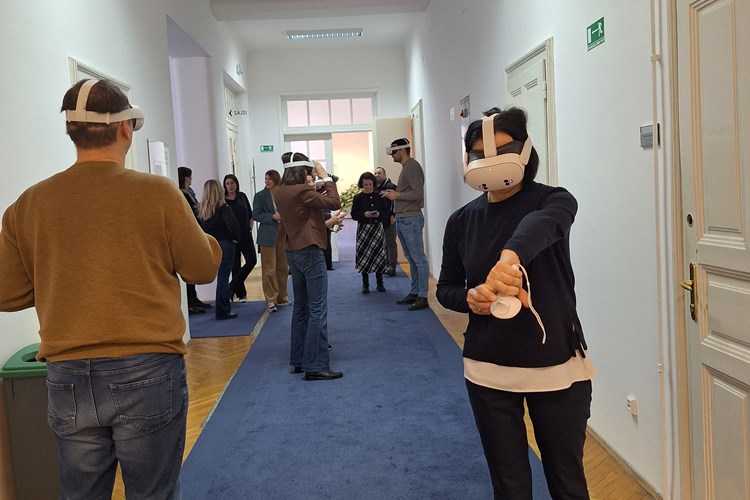
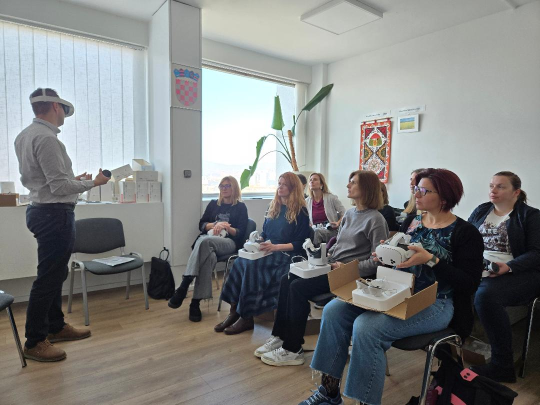
Between 23 and 27 March 2026, twenty‑four probation practitioners from Romania and Croatia took part in a five‑day intensive training in Bucharest that combined Core Correctional Skills instruction with VR scenarios developed by BeCure GmbH. The post‑training evaluation used eleven Likert items on a 1–5 scale, complemented by open‑ended responses.
Training quality scored near the ceiling. Two items achieved perfect unanimity (M = 5.00), and 100% of participants indicated that they intend to apply the methods learned in their daily casework. VR‑specific perceptions were somewhat more dispersed, with means ranging from 4.42 to 4.75. Realism, and effectiveness for practice attracted the most cautious ratings — a finding that, to our reading, signals not scepticism about VR as such, but a clear‑eyed sense of where the technology currently sits in its development curve.
The participant voices added a layer that the numbers alone cannot capture. One officer noted that “it was great to learn in a safe environment, that you are not on the spot and you can make mistakes.” Another reflected on “the connection between theoretical knowledge and practical exercises, a new way of learning that enables a different perspective.” A third reminded us, helpfully, that “trainees should also be trained using pen and paper” — a useful corrective against the seduction of the new.
What seems to be emerging from the pilot is not a case for replacement, but for integration. Drawing loosely on implementation science (Fixsen et al., 2005), we are testing a four‑phase learning cycle. The first phase, which we call Prepare, anchors the trainee in theory of change, in the Risk‑Need‑Responsivity framework, and in the ethical questions VR itself cannot answer. The second, Simulate, places the trainee in immersive scenarios — hostile client, risk disclosure, family confrontation — with enough repetitions for real practice rather than demonstration. The third phase, Debrief, may matter most: one of our participants put it bluntly that “the VR without the debrief is half the training.” Facilitated group reflection is where skills become meaningful. The fourth phase, Transfer, returns the officer to live casework under mentorship, with booster VR sessions at three and six months.
Moreover, the architecture suggests that the value of VR lies precisely in the joints between these phases — in what the technology makes possible for the human trainer, rather than in the headset itself. Linked to this, the participants were emphatic that the human relationship between trainer and trainee, between officer and supervisee, remains the irreducible centre of probation work.
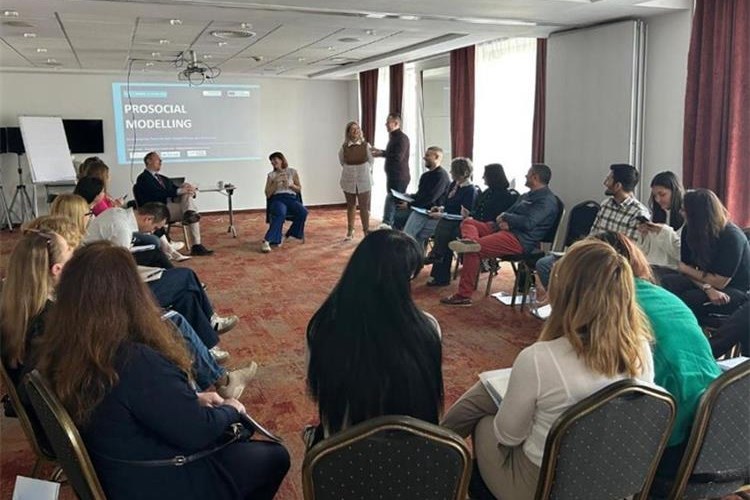
VR‑TooL — Virtual Reality: A Tool in the Treatment of Offenders and Education of Probation Officers — is a 24‑month Erasmus+ KA220‑ADU cooperation partnership (2024–2026), co‑funded by the European Union. It is led by the Ministry of Justice and Public Administration of Croatia (Probation Sector), with European Strategies Consulting (Romania) and BeCure GmbH (Germany) as partners. The project addresses two parallel work streams: VR for offenders, through a problem‑solving module piloted with more than seventy participants; and VR for officers, through four Core Correctional Skills modules — Motivational Interviewing, Cognitive‑Behavioural Interventions, Prosocial Modelling, and Problem‑Solving.
The temptation, when something new arrives, is to overclaim. VR is not a revolution in probation training. It is, on the present evidence, a carefully designed tool whose value lies in what it makes possible within a wider pedagogical architecture. The Bali presentation closed on this note, and our work in the remaining months of the project is, in essence, an attempt to put that conviction into practice. We will continue to share the lessons — the encouraging ones and the awkward ones — with the CEP community as the pilot scales.
Barbosa, A. (2020). Virtual reality and bias reduction in correctional staff training. Journal of Experimental Criminology, 16(3), 415–432.
Fixsen, D. L., Naoom, S. F., Blase, K. A., Friedman, R. M., & Wallace, F. (2005). Implementation research: A synthesis of the literature. University of South Florida, National Implementation Research Network.
Herrera, F., Bailenson, J., Weisz, E., Ogle, E., & Zaki, J. (2018). Building long‑term empathy: A large‑scale comparison of traditional and virtual reality perspective‑taking. PLOS ONE, 13(10), e0204494.
Merchant, Z., Goetz, E. T., Cifuentes, L., Keeney‑Kennicutt, W., & Davis, T. J. (2014). Effectiveness of virtual reality‑based instruction on students’ learning outcomes in K–12 and higher education: A meta‑analysis. Computers & Education, 70, 29–40.
Parong, J., & Mayer, R. E. (2021). Cognitive and affective processes for learning science in immersive virtual reality. Journal of Computer Assisted Learning, 37(1), 226–241.
Radianti, J., Majchrzak, T. A., Fromm, J., & Wohlgenannt, I. (2020). A systematic review of immersive virtual reality applications for higher education: Design elements, lessons learned, and research agenda. Computers & Education, 147, 103778.
Skinner, A. L., Stevenson, M. C., & Camillus, J. C. (2021). Virtual reality training for de‑escalation: Evaluating skill transfer in policing contexts. Police Practice and Research, 22(4), 1572–1589.