

Previous Article
News
Towards a European standard for statistics in probation
Everywhere in Europe, statistics play an important part in showing the effectiveness of probation. However, what is measured is different in every country. In order to develop a European standard for statistics, CEP is designing a project which it hopes to have financed by the EU. “Such a standard would help to create a more common understanding of the role of community penalties and how they might be developed”, explains Steve Murphy, who is leading the project for CEP.
Whilst the CoE has taken an initiative to gather data on probation the majority of countries didn’t return the questionnaire, limiting its usefulness. They seemed to struggle with it as the questions weren’t all fully applicable to the situation in their own countries. “The necessity for common statistics is getting more and more urgent as the probation sector in Europe is moving towards common policy frameworks on which the European Union and the Council of Europe are currently working”, Steve Murphy comments. “For effective implementation of these frameworks, we need a common understanding of judicial systems and sanctions in Europe. So in many regards, it would be helpful if the whole of Europe would use the same definitions or the same standard in statistics.” This may involve grouping types of sanctions rather than identifying them individually nation by nation.
In order to promote a European standard in statistics, CEP commissioned Steve Murphy, a former Director General of the National Probation Service for England & Wales who retired earlier this year from the Ministry of Justice in London, to initiate a project on the basis of the ideas of CEP. “The first step in the plan for the project was to get in touch with key players in European criminal statistics and get their support for the project”, he says.
“That would raise our chances of obtaining funding from the European Union.” One these players is the European Sourcebook Group (ESG), which has published a series of compendiums of crime and criminal justice data for its member states over the years, but not yet on Community Sanctions and Measures (CSMs) a term increasingly used to cover the work of probation and related agencies. Another important player is the European Institute for Crime Prevention and Control, which has extensive experience of research in this field and which also is a member organization of the ESG.
Discussions have begun to identify project partners and a project plan will be written for the next application round of EU funding programs, which is expected to close by the end of February 2009. The project is likely to pilot a common statistical framework in a small group of countries which are to be identified with the help of the European Sourcebook Group. It is envisaged that technical experts from probation services in the pilot countries will work together with statistical experts that other project partners such as the European Sourcebook Group will provide. CEP will help to coordinate and supervise the process.
Steve Murphy: ” Although we plan to start with a small pilot group, we hope to keep a lot of nations who are interested alongside us as we go. In that way they may start to make early judgments about how they could amend their own statistical data capture, so that they can become part of the process in due course. The outcome then should be a true standard for statistics on probation which can be used anywhere in Europe.”
The first results of the project literally are still years away. Nevertheless, Steve Murphy has a clear idea of the desired outcomes. ” By the time a project of this nature was concluded, I would like to think that two particular things would have happened: one is that governments throughout the EU are making better informed policy decisions about developments in corrections in general and community sanctions in particular – after all, they would be operating on the basis of better data; the second is that more nations would be stepping up their funding for community alternatives, because they have a reliable set of data which makes clear where effective investments can be made. In short, better policy making by governments and better development of community alternatives as a result of quality data.”

Related News
Keep up to date with the latest developments, stories, and updates on probation from across Europe and beyond. Find relevant news and insights shaping the field today.
New
CEP
CEP annual report
07/04/2026
The Confederation of European Probation (CEP) has published its Annual Report 2025, showcasing a year marked by growth, cooperation, and continued commitment to strengthening probation across Europe.
Bringing together more than 100 member organisations across 42 countries and 59 jurisdictions, CEP continued to serve as a central platform for knowledge exchange, professional development, and collaboration within the European criminal justice field.

Uncategorized
ProtectEU: Commission presents new counterterrorism agenda
07/04/2026
On 26 February 2026, the European Commission presented ProtectEU, a renewed EU counterterrorism agenda aimed at strengthening the Union’s capacity to prevent, detect and respond to evolving terrorist threats.
New
Probation in Europe
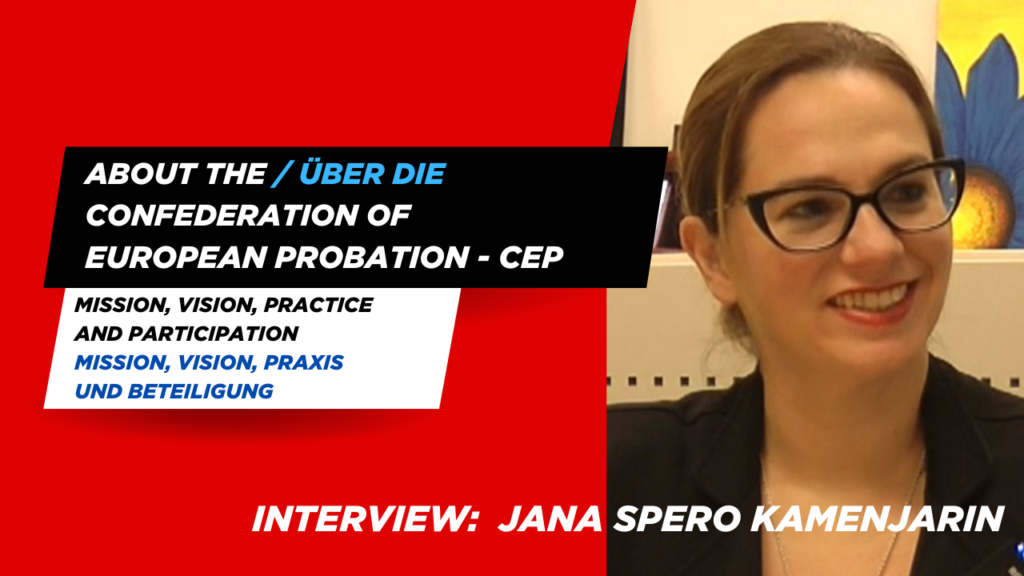
New Vodcast Episode: Jana Spero Kamenjarin on the Confederation of European Probation (CEP)
07/04/2026
The 19th episode of Division_Y features Jana Spero Kamenjarin, Secretary General of the Confederation of European Probation (CEP), based in Utrecht, the Netherlands.
New

Electronic monitoring
Electronic Monitoring in Europe: Insights from the 13th Electronic Monitoring conference Questionnaire
30/03/2026
The 13th Electronic Monitoring (EM) conference Questionnaire has now been released, offering a comprehensive overview of how EM is applied across Europe today.ion.
New
CEP members
New CEP member: Guernsey Probation Service
25/03/2026
In recent weeks, CEP has interviewed individual members and representatives of the new member organisations that joined CEP at the beginning of 2026. In these interviews, the new member organisations or individual members will share information on why they decided to become members, how they would like to contribute to the development of CEP and many more.
Enjoy reading!
Recap

Probation outside Europe
Recap: CEP and APPA webinar
25/03/2026
Confederation of European Probation (CEP) and American Probation and Parole Association (APPA) hosted the second joint webinar on 24 March 2026, this time on “Integrity of Performance: Ensuring Meaningful and Ethical Outcomes”.
The overarching theme of integrity of performance was explored through two distinct perspectives on this fundamental concept.
Subscribe to our bi-monthly email newsletter!
"*" indicates required fields
- Keep up to date with important probation developments and insights.