
Skip to content

News

The Complex Pathways to Violence in the Home – Final report now available!

Last year the UK Home Office commissioned Interventions Alliance to conduct research on better understanding male domestic abuse perpetration, this week we have finally been given permission to publish this research.

“Violence against women and girls (VAWG) has been a focus of the Government for some time, more recently through the Ending Violence Against Women and Girls Strategy 2016 – 2020. It is recognised by the Government and its justice, health and social care agencies that domestic abuse (DA) disproportionately affects women and girls, with disabled individuals being particularly at risk of harm. It is estimated that in the year ending March 2020, an estimated 2.3 million adults were experiencing DA. The above picture has more recently been compounded by the ongoing COVID-19 pandemic. In very recent developments, the new Domestic Abuse Act 2021 has been introduced. Responses to the above issues have been presented by Government over recent years. Identifying perpetrators of DA is challenging. Most do not come into contact with the Criminal Justice System (CJS), and many will not have had the opportunity to be referred onto perpetrator programmes. The following research project, therefore, explores the life-stories of adult males who are known to the CJS as perpetrators of DA.”

To read the full report click here.


Related News

Keep up to date with the latest developments, stories, and updates on probation from across Europe and beyond. Find relevant news and insights shaping the field today.

New

CEP Board

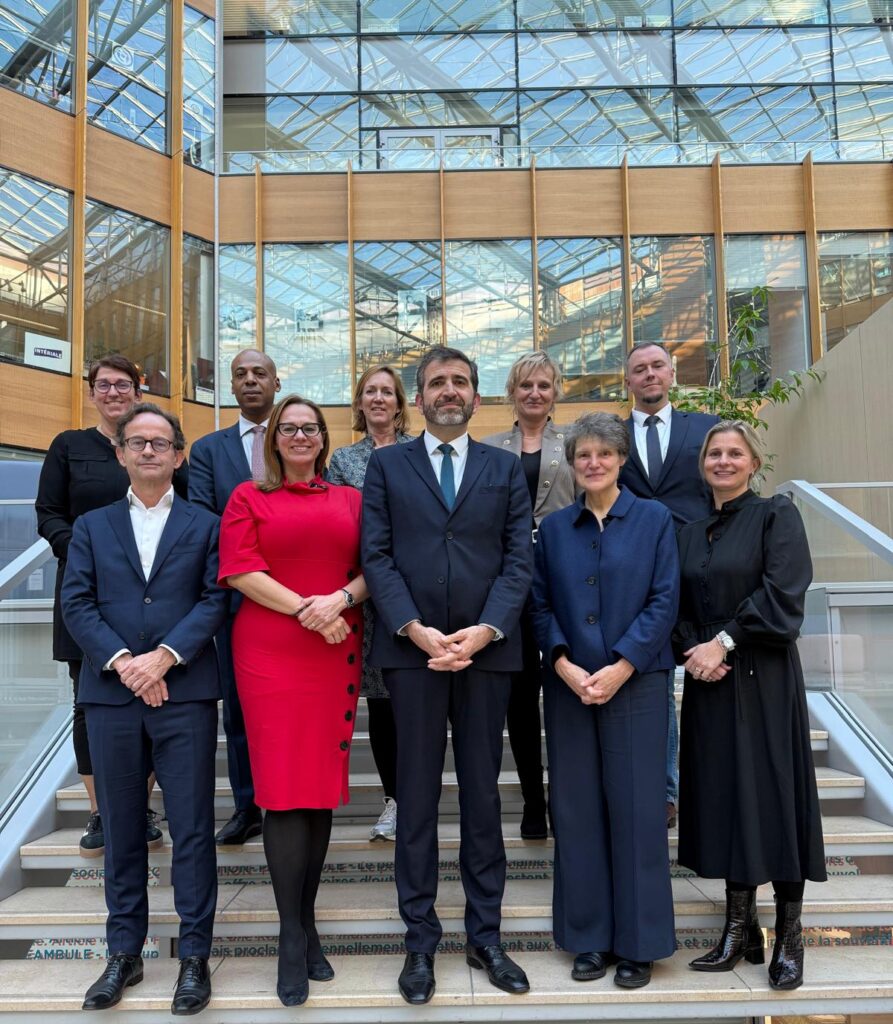
CEP board visit France

16/11/2026

On 13 November 2026, the CEP Board visited its French member organisation, the Direction Générale de l’Administration Pénitentiaire of the French Ministry of Justice. The visit coincided with the final CEP Board meeting of the year, hosted by CEP Vice-President Mr Daniel Danglades, who represents the French institution.

Recap

Framework Decisions

Recap: annual meeting of the Expert Network on Framework Decisions 829 and 947

09/11/2026

On Thursday 5 November an annual meeting of the Expert Network on Framework Decisions 829 and 947 took place online. Bringing together 20 participants from 12 EU jurisdictions including representatives of the Academy of European Law and European Judicial Network, the meeting provided an opportunity to exchange experiences, discuss current implementation challenges and identify priorities for enhancing cross-border cooperation in the application of the two Framework Decisions. 

New

Education and Training, Probation in Europe

Justice programme: the judicial training call is open for applications!

09/11/2026

Are you ready to help address the training needs of justice professionals from different EU countries in the fields of civil law, criminal law and fundamental rights? This call supports cross-border training projects contributing to the effective and consistent application of EU law. In line with the new European Judicial Training Strategy, the call also supports the digitalisation of justice. Don’t miss this opportunity! Apply by 4 March 2027, 17:00 Brussels time.

More info


Recap

CEP Board, Foreign Nationals in Prison and Probation, Probation in Europe

CEP at the 16th Plenary Meeting of the Council for Penological Co-operation

06/11/2026

From 3 to 5 November 2026, representatives of the Confederation of European Probation (CEP) participated in the 16th Plenary Meeting of the Council for Penological Co-operation (PC-CP).

New

CEP

Newsletter October 2026 out now

29/10/2026

New

Violent Extremism

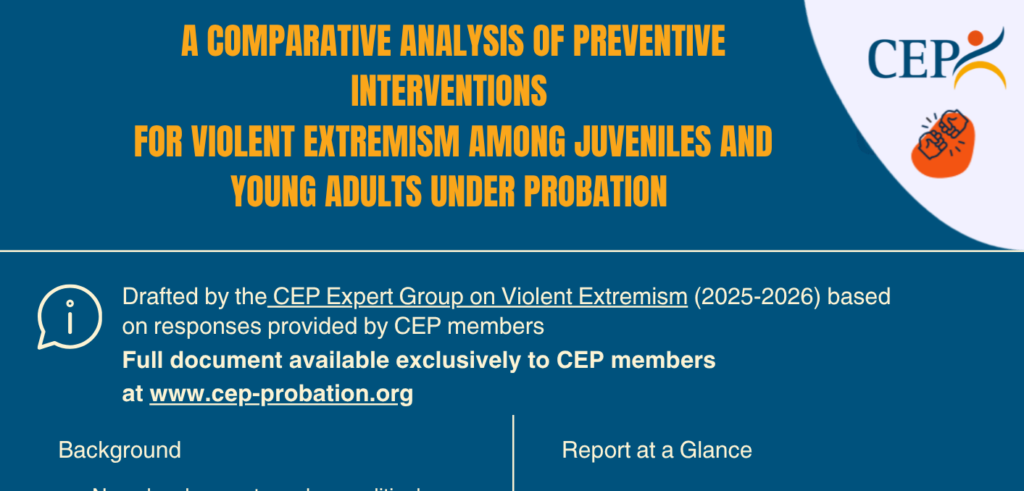
Understanding Youth Radicalisation: What Can Probation Services Do? | New Report from CEP’s Expert Group

27/10/2026

In recent decades, the violent radicalisation of juveniles and young adults has become a pressing concern for policymakers, researchers, practitioners, and communities worldwide. While considerable attention has been devoted to psychological vulnerabilities, socio-economic marginalisation, and community-level influences, the broader context in which violent radicalisation develops is often overlooked. At the same time, the increasing involvement of young people in violent extremist offences highlights the urgent need for effective prevention efforts. Addressing youth radicalisation has become a complex and evolving challenge for families, educators, mental health professionals, law enforcement agencies, probation services, and security authorities.

Subscribe to our bi-monthly email newsletter!