

Previous Article
Probation library
Linking Theory and Practice in Probation
In 2010, the Dutch Probation Service introduced a digital decision support system for case management plans, a so called fourth generation risk/needs assessment instrument. Does this system help probation officers in determining the appropriate interventions that should prevent recidivism for each individual client? And to what extent are the case management plans based on existing theories on desistance from crime? These are the central questions in the thesis of Jacqueline Bosker of the University of Applied Sciences Utrecht: ‘Linking Theory and Practice in Probation – Structured decision support for case management plans’. “Further development is still needed, but we can conclude that the use of digital decision support helps improve the quality of case management plans.”
Bosker concluded in her research that this form of decision support enhances the quality of the case management plans. “In the most practical sense, it helps a probation officer not to overlook certain measures that might be applicable for the client considering the risks and needs. The plans also correspond better to the offenders’ goals and focus more on strengthening social bonds. Over the years, desistance from crime has been studied and researched. This knowledge should be used in practice. A decision support system helps linking theory and practice.”
Not all probation officers seem to be entirely positive about the instrument. A large proportion of them believe it takes to much of their time and that they do not need the instrument for making good decisions. This can partly be ascribed to components of the instrument, which require improvement. However, a resistance to introducing more protocols into their work and a lack of insight into their own potential biases in decision-making probably play a role as well. Bosker emphasizes that a system could never be a substitute for human work. “Probation is all about people. It takes a person to help another person. At the end, it’s always the probation officer who makes an assessment of the client’s needs, risks, chances and pitfalls and composes the case management plan. The decision support system helps to take all things into account that might not be on the probation officer’s radar. Either because he/she is very experienced and relies mostly on lessons learnt over the years, or he/she is a starter and still needs a complete scope.”
Decisions about case management plans are fundamental in the probation process, and can have a significant impact on the effectiveness of probation and on the life of offenders. Bosker’s thesis offers relevant insights in the quality of these decisions and in means to improve decision making in probation.
If you’re interested in reading more on this subject, you can download the thesis Linking Theory and Practice in Probation – Structured Decision Support for Case Management Plans here.

Probation library
Probation Journal

Women, youth
Understanding the needs of girls and young women in youth justice
10/03/2026
New research highlights the underlying needs that influence girls’ and young women’s contact with youth justice systems and calls for more gender responsive approaches in policy and practice. Drawing on a review of recent studies, the authors identify several factors shaping girls’ pathways into the justice system, including persistent abuse, trauma, gendered expectations, and systemic failures. Girls involved in youth justice are often affected by multiple forms of victimisation, such as sexual abuse, neglect, and domestic violence, with experiences frequently beginning in early childhood.
Reading corner

Probation in Europe
The Routledge Handbook of European Penology
05/01/2026
The Routledge Handbook of European Penology, published by Routledge. This comprehensive volume has been edited by Sonja Snacken, Gaëtan Cliquennois, Ioan Durnescu, Diete Humblet and Elena Larrauri.
Reading corner

Criminal Justice
Bridging Research and Practice in Forensic Social Work: An interview with the editors of Forensic Social Work – Supporting Desistance
17/12/2025
Supporting desistance while managing risk is at the heart of criminal justice social work across Europe. In Forensic Social Work – Supporting Desistance, editors Jacqueline Bosker, Anneke Menger and Vivienne de Vogel bring together scientific insights and everyday professional practice to support those working with justice-involved individuals. In this interview, they reflect on the motivation behind the English edition of the book, its core themes, and how professionals can use its tools and approaches in their daily work.
Probation Journal

Domestic violence, Gender-based violence
New evaluation on whole family approach to domestic abuse
26/11/2025
Interventions Alliance has published a new evaluation of a Hub coordinated on behalf of police forces in the south of England, focused on tackling violence against women and children through a whole family approach. The Hub supports victims and perpetrators of domestic abuse and works across policing, health and social services.
Reading corner
Probation in Europe
New Release: Forensic Social Work – Supporting Desistance
13/11/2025
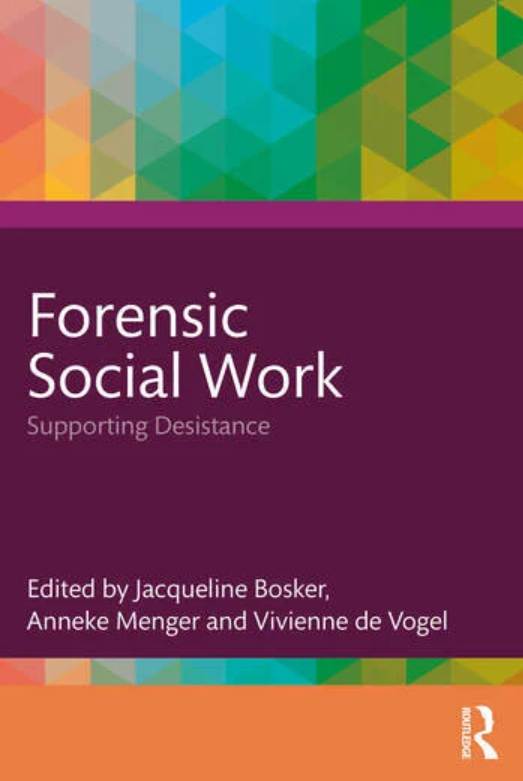
This book, Forensic Social Work – Supporting Desistance, has been released by Routledge. It is a practice-oriented resource exploring how forensic social work can support desistance and foster meaningful change in the lives of justice-involved individuals.
Reading corner

Criminal Justice
Parole Futures
18/08/2025
At a time when many parole systems are experiencing considerable strain, the aims of this collection are twofold: first, to encourage systematic and critical reflection on the rationalities, institutions and practices of parole. Second, to think big, and pose ambitious ‘what if’ questions about the possible futures of parole and prison release. Offering novel insights from Asia, Australia, Europe, North America and South America, this collection builds the case for, and then showcases, a ‘way of doing’ parole research that is global in outlook, interdisciplinary in approach and unapologetically normative in character.
Probation Journal

Violent Extremism
2025 EU Guidance document responding to the needs of victims of terorrism
23/06/2025
To mark the EU Day of Remembrance for Victims of Terrorism on 11 March, the EU Centre of Expertise for Victims of Terrorism has published a new Guidance Document on the Needs of Victims. This document is a significant step forward in reinforcing a victim-centred approach within counter-terrorism efforts across the European Union.

Research
Launch of the CEP Research and Development Strategy Summary
17/06/2025
We’re thrilled to announce that the Confederation of European Probation (CEP), in cooperation with the University of Glasgow (led by CEP Honorary Member Professor Fergus McNeill), and with the support of the CEP Expert Group on Research, has produced the CEP Research and Development Strategy. We are happy to share the summary with you!
Probation Journal

Alternatives to pre-trial detention
Unpacking criminal detention rules and regulations across the EU
21/05/2025
The EU Agency for Fundamental Rights (FRA) has updated its online criminal detention database, which includes national standards, laws, and monitoring reports on detention conditions in the EU and the UK.
Probation Journal

Technology
Is AI Putting Remote Probation Supervision at Risk Before It Even Starts?
09/04/2025
David Jackson and Jed Stone focus on the use of AI in probation and advocate for investigations to understand the opportunity, address issues and innovate for the good of all.
Subscribe to our bi-monthly email newsletter!
"*" indicates required fields
- Keep up to date with important probation developments and insights.