Previous Article
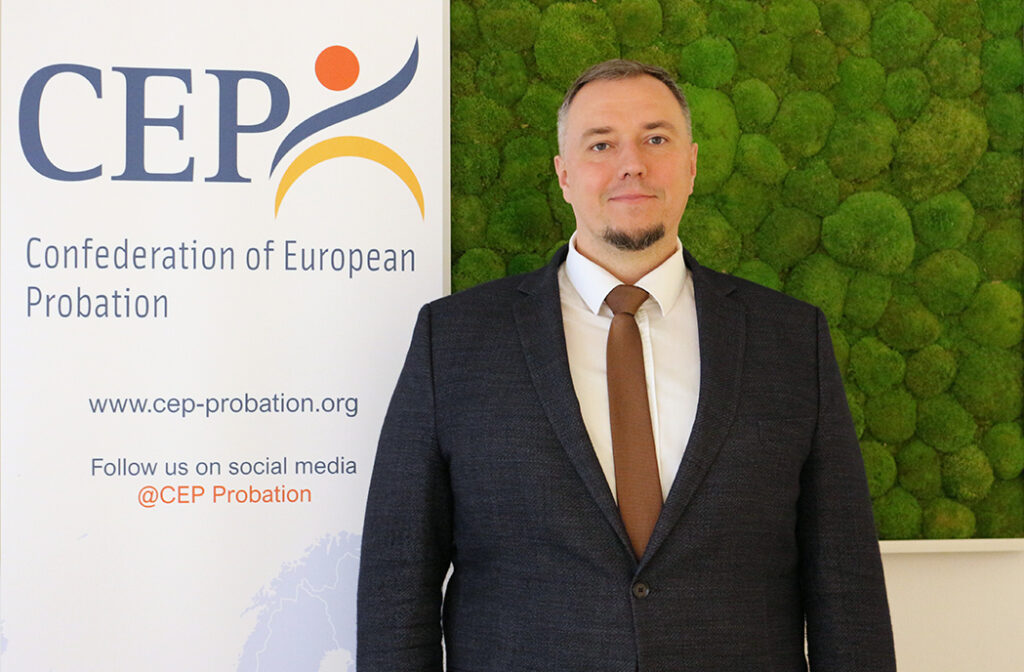
 Hello everyone, I hope you are doing well, I am writing to you from the capital of the newest state in Europe – Kosovo (born on: 17.02.2008).
I am Sami Hajrullahu, 41 years old, MSc clinical psychologist and licensed as a judicial expert of psychology. Since March 2006, I have been employed in the Kosovo probation service and since then I have been working as a probation officer in the regional probation service office here in Prishtina.
The usual workday for me starts at 06:30, where I have breakfast, meditate, take a shower, hug my wife and children and leave for work. It takes me about 20 minutes from home to my office, usually at intervals between 07:45 – 07:55 I arrive at the office.
First, I log in to my official e-mail to see the messages, invitations for meetings, different requests from different organizations for my clients, different requests from prosecutors, judges etc … and rarely any surprise where I am invited to make any study visit outside the country.
At 08:30, we usually have a meeting with a group of colleagues where everyone presents their daily agenda and the work they have to do with their clients.
Once I have set the agenda for the day, I return to my office and coordinate the appointments I will have with my clients. To do this I check the case priorities and immediately start contacting the clients and scheduling appointments for the meetings I wish to have with them. In the case of minors we invite them to come with their parent(s) or family member(s).
Once I have completed this process of meeting with my clients, which I consider to be the primary stage, I start with the contacts with the prosecutor’s office or the appointed judge and discuss with them the general condition of the clients. After writing reports for them we update the information of the clients under supervision and provide assistance to them as professionally and as quickly as possible. After that, I check the database of clients, make updates to it and see various details that might be of interest to my clients.
As a psychologist, I belong to the behavioral school of psychology and with all my clients in the work I do as a probation officer, I use various communication techniques that derive from the behavioral school of psychology. The Motivational Interview Technique derived from Cognitive-Behavioral Therapy (CBT) is proving to be one of the best, highest quality and most beneficial techniques for my clients in working as a probation officer. Motivational Interviews are showing to be successful for clients because its use is making clients feel better. It is creating conditions for them to express themselves more freely and is creating an environment where clients are generally open to communication and thus make it easier to achieve my goals.
The day passes rather quickly here in Prishtina and at 16:00 I turn off the PC, I run to get the children from kindergarten (my wife sends them there in the morning J) and the family gets together after about 30 minutes. Three days a week I prepare food, clean dishes, rest a bit, hug the kids and wife again and then go to the gym. Fitness for me represents the greatest physical, emotional and psychological satisfaction in terms of protection from daily workloads and I feel that for me it is the best antibiotic and natural infusion which keeps me energetic, strong and concentrated. Ohh good night, bedtime! It’s 22:30. J