Could you briefly introduce yourselves and tell us a bit about your professional background?
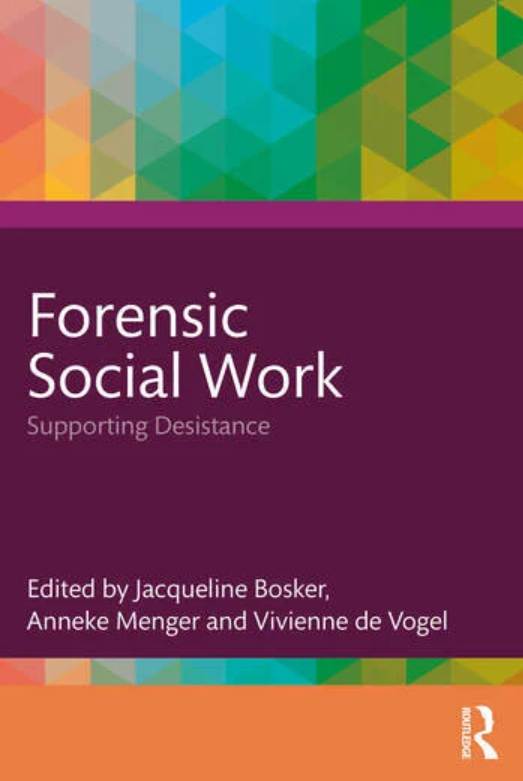
Forensic Social Work – Supporting Desistance was developed by three editors: Jacqueline Bosker, Anneke Menger, and Vivienne de Vogel.
Jacqueline Bosker is a professor within the research group Working With Mandated Clients at HU University of Applied Sciences Utrecht. Her research focuses on methods and practices for social professionals working with people in judicial settings. She is trained as a sociologist and previously worked as a policy officer at the Dutch Probation Service.
Anneke Menger is professor emeritus of the Working With Mandated Clients Research Group at HU University of Applied Sciences Utrecht. In this role, she initiated and led the development of a practice-based research programme for and with forensic social professionals, as well as educational programmes for bachelor’s and master’s degrees in higher professional education.
Vivienne de Vogel is a professor of Forensic Mental Health Care at Maastricht University and a member of the Working With Mandated Clients research group at HU University of Applied Sciences Utrecht. She also works as a researcher at the Van der Hoeven Kliniek, a forensic psychiatric centre in Utrecht. Her research focuses on gender-responsive approaches in forensic care, risk assessment, trauma treatment, and the mental resilience of professionals.
The book was created in collaboration with 31 additional authors from both academia and professional practice.
What motivated the team to create this English edition of the original Dutch book, and what do you hope it offers to professionals working with justice-involved individuals across Europe?
The Dutch version of the book is the basic methodology for probation officers in probation organisations in the Netherlands and is used by professionals in various organisations in the forensic field. Because the Dutch probation services have frequent contact with probation organisations in other countries and exchange expertise, we were regularly asked whether the book was also available in English.
After publishing a revised version of the Dutch book in 2024, we decided to produce an English version in collaboration with Routledge publishers. We believe that Forensic Social Work complements existing English-language books in this field because of the connection we make between scientific knowledge and daily practice. It is not a compilation of scientific insights but is written in such a way as to support professionals in their work.
The book places a strong emphasis on supporting desistance. How does it bridge theory and practice to help Criminal Justice Social Workers and other professionals foster meaningful change?
The book begins with a number of theoretical frameworks that we consider to be an important foundation. On one hand, this concerns theory about criminal behaviour and its reduction, such as insights from developmental criminology, desistance, the RNR model and the Good Lives Model. In addition, it covers theory about professionalism, professional reflection and mental resilience. It is important for professionals to base their actions on scientific knowledge about reducing criminal behaviour. However, how they do this depends on the client, the situation and who they are as professionals. It also depends on the organisation they work for and the context in which the work is done. Substantiated methods alone are not enough.
We then included a large number of chapters in the book in which scientifically based methods and working practices are elaborated, containing concrete tools for their application and illustrations from practice, such as case descriptions and reflections on them.
Which tools, strategies, or methods in the book would you consider most immediately useful for Forensic Social Workers or Probation Officers?
Our approach was to create a book that could be used by various professionals who work with adults who commit crimes. These include probation officers, prison staff, forensic care workers, social workers and local government employees. Many of the methods in the book are basic methods that all forensic social professionals can use in their contact with clients, such as building a working alliance, motivating change, assessing and identifying risks, or adopting a strength-based approach. In the section on specific characteristics of clients, we have chosen themes that are relevant to many clients, such as mental health issues and mild intellectual disability, but also themes that are currently topical and about which many professionals have questions, such as sensitivity to street culture in the digital era and cybercrime.
Which parts of the book are useful also depend on the context in which professionals work and the opportunities that are available to them. Consider, for example, the way in which a country views punishment, the size of the caseload, or the methods and tools that are already at its disposal. Conversational skills and knowledge about client characteristics are fairly generic, but some themes in the book will need to be translated to the specific context of a country.
The working alliance is central in the book. What practical advice does it offer for building effective relationships in mandated contexts such as probation or forensic settings?
Firstly, the importance of viewing the working alliance as a two-sided concept. It concerns a relationship between client and professional, so the perspective of both is relevant, and we also describe how professionals can reflect on their own role and perspective.
Secondly, the working alliance with mandated clients is not the same as the working alliance in voluntary interaction. In a forensic setting, it is about more than just building a relationship. We regularly see that in practice or in publications, the emphasis is placed on developing a good relationship in which there is sufficient trust and bonding to work together on change. That is important, but it is not enough.
In the book, we distinguish four aspects of the working alliance: goals and restrictions, bond, trust and reactance. These interact and reinforce each other, so all four must be given attention. Goals and restrictions concern the question of whether there is sufficient clarity and agreement about the imposed framework and the goals pursued during supervision. When professionals and clients work together towards the same goals, this provides a solid basis for achieving change. However, it is by no means a given that this agreement will be there from the start, so professionals need to invest in it. Clarity on this point makes the professional reliable, which lays the foundation for the development of bonding and trust. Reactance is a negative characteristic of the working alliance. It involves resistance to the imposed framework on the part of the client and sometimes also a feeling of loss of agency or energy on the part of the professional. The book provides concrete recommendations on how professionals can deal with this.
What is the key message you hope social workers and other professionals take away from reading the book?
A key theme running through the book is the dual role of forensic social professionals, whereby anticipating risks must go hand in hand with a positive and strength-based approach focused on change and rehabilitation. The emphasis may vary depending on the client and situation, but attention to both aspects plays a role in every process. Professionals sometimes find this difficult and opt for one of the two. However, in many scientific and professional publications, we also see a one-sided focus on risk management or, conversely, on rehabilitation and supporting the client’s process. Research has shown that a combined approach offers the best chance of success. That is why we believe it is important that publications for forensic social professionals pay attention to both aspects of the work. This supports professionals in how they can approach this in their daily work. So, the first message for professionals is that there must always be attention for both connecting with the client and supporting them in their process, as well as being aware of risks and anticipating them.
A second key theme is the importance of the professional as an essential actor in achieving effectiveness. In recent decades, there has been a great deal of focus on the effectiveness of specific methods. However, methods only work in the hands of well-trained, effective professionals. This has long been overlooked. Fortunately, the importance of these professionals has been recognised much more in recent years. An important message in the book is a further elaboration of what this requires, both from professionals and from the organisation. That is why, for example, attention is paid to themes such as professional reflection and mental resilience of professionals.
For CEP members who are busy in their daily work, is there a chapter, tool, or method that they could start using right away?
That depends, of course, on what they want to learn. The great thing about this book is that it covers a wide range of topics, so there are interesting chapters for both novice and experienced professionals. But if we have to mention something, it would be the three related chapters on involuntary interaction and the working alliance. That is, after all, the basis for working with clients in a forensic setting.
Jacqueline Bosker
Anneke Menger
Vivienne de Vogel