

Previous Article
News
Alternative sanctions for young delinquent refugees in Schleswig-Holstein
Refugee policy in Germany and Europe was a central topic in the media and controversially discussed in 2015 and 2016. At the same time, debates within the judiciary on how to deal with refugees who offend against the law started.
“Alternative sanctions for young delinquent refugees in Schleswig-Holstein” authors Kim Magiera, Jo Tein and Christopher Wein.
The article outlines Schleswig-Holstein’s process of developing and implementing alternative ambulant sanctions for delinquent young refugees. It discusses key criminological findings concerning the specific target group that were part of a scientific analysis delivered by the Schleswig-Holsteinischer Verband für soziale Straffälligenhilfe; Straffälligen- und Opferhilfe e.V.. This also includes recommendations for targeted alternative sanctions for delinquent young refugees in Schleswig-Holstein.
Based on these recommendations several non-government organisations developed special alternative sanctions for young refugees. After an assessment of the submitted concepts by the Ministry of Justice three projects were selected for implementation and started in spring 2017. They are introduced in the last part of the article.
Are you interested in reading the article “Alternative sanctions for young delinquent refugees in Schleswig-Holstein” by Christopher Wein, Jo Tein and Kim Magiera? Please click on the link.

Related News
Keep up to date with the latest developments, stories, and updates on probation from across Europe and beyond. Find relevant news and insights shaping the field today.
New

CEP Board
CEP board visit France
16/11/2026
On 13 November 2026, the CEP Board visited its French member organisation, the Direction Générale de l’Administration Pénitentiaire of the French Ministry of Justice. The visit coincided with the final CEP Board meeting of the year, hosted by CEP Vice-President Mr Daniel Danglades, who represents the French institution.
Recap
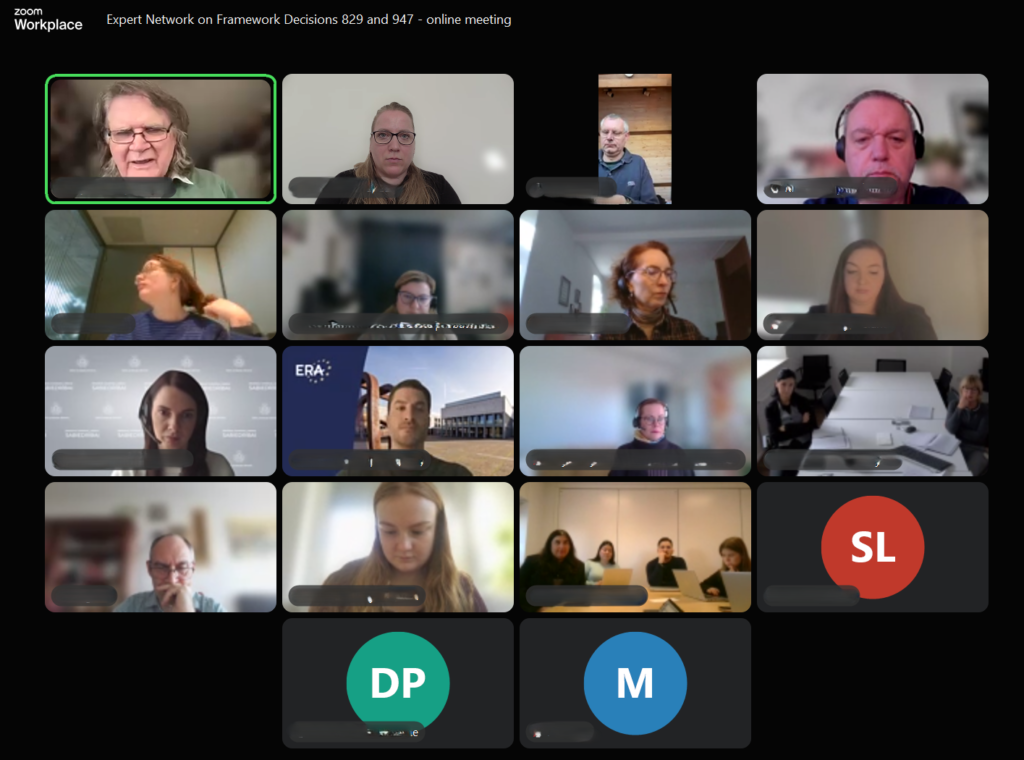
Framework Decisions
Recap: annual meeting of the Expert Network on Framework Decisions 829 and 947
09/11/2026
On Thursday 5 November an annual meeting of the Expert Network on Framework Decisions 829 and 947 took place online. Bringing together 20 participants from 12 EU jurisdictions including representatives of the Academy of European Law and European Judicial Network, the meeting provided an opportunity to exchange experiences, discuss current implementation challenges and identify priorities for enhancing cross-border cooperation in the application of the two Framework Decisions.
New

Education and Training, Probation in Europe
Justice programme: the judicial training call is open for applications!
09/11/2026
Are you ready to help address the training needs of justice professionals from different EU countries in the fields of civil law, criminal law and fundamental rights? This call supports cross-border training projects contributing to the effective and consistent application of EU law. In line with the new European Judicial Training Strategy, the call also supports the digitalisation of justice. Don’t miss this opportunity! Apply by 4 March 2027, 17:00 Brussels time.
Recap

CEP Board, Foreign Nationals in Prison and Probation, Probation in Europe
CEP at the 16th Plenary Meeting of the Council for Penological Co-operation
06/11/2026
From 3 to 5 November 2026, representatives of the Confederation of European Probation (CEP) participated in the 16th Plenary Meeting of the Council for Penological Co-operation (PC-CP).
New

CEP
Newsletter October 2026 out now
29/10/2026
CEP’s latest newsletter is out now! It includes:
- Deadline approaching for the Workshop on Technology and Alternatives to Detention
- Recap of the 14th EM and CEP Excellence Leadership Training
- New publications from Expert Groups on Technology and Expert Group on Violent Extremism
- Call for Proposals: Evaluation of CEP Expert Groups
- Engaging with Research – a new section in our newsletter
- and much more!
New
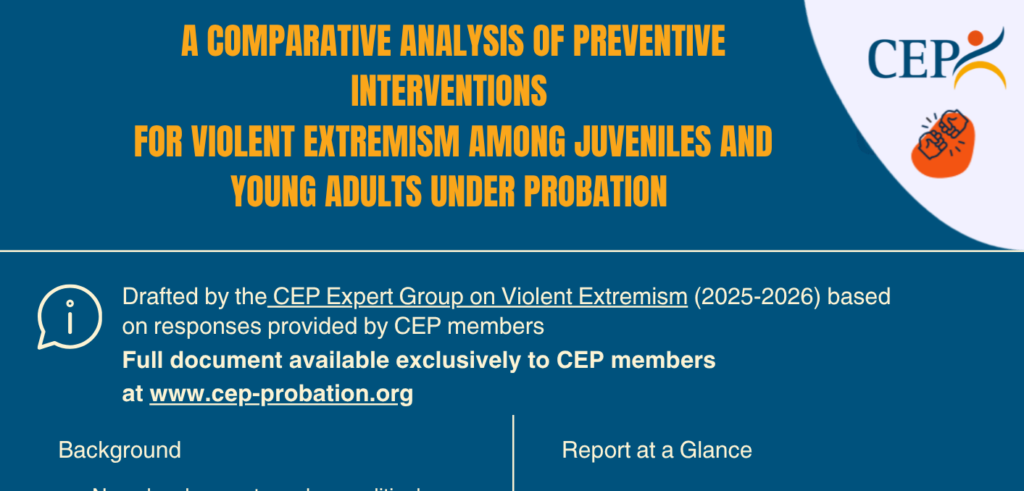
Violent Extremism
Understanding Youth Radicalisation: What Can Probation Services Do? | New Report from CEP’s Expert Group
27/10/2026
In recent decades, the violent radicalisation of juveniles and young adults has become a pressing concern for policymakers, researchers, practitioners, and communities worldwide. While considerable attention has been devoted to psychological vulnerabilities, socio-economic marginalisation, and community-level influences, the broader context in which violent radicalisation develops is often overlooked. At the same time, the increasing involvement of young people in violent extremist offences highlights the urgent need for effective prevention efforts. Addressing youth radicalisation has become a complex and evolving challenge for families, educators, mental health professionals, law enforcement agencies, probation services, and security authorities.
Subscribe to our bi-monthly email newsletter!
"*" indicates required fields
- Keep up to date with important probation developments and insights.