

Previous Article
News
Breidge Gadd and Jürgen Mutz appointed as CEP Patrons
It is now thirty-eight years since the formal establishment of CEP in 1981 in the city of Royaumont in France. In the decades since, CEP has grown as a strong network of probation bodies, institutions and individuals and has played a pivotal role in the development of community sanctions and measures not only in Europe, but also across the world. The important role and standing that CEP has achieved is a particular tribute to the vision, energy and commitment of the people who established it and led its early development. In recognition of their invaluable contribution to the development of CEP from the beginning, as the European network and organisation for probation organisations and interests, CEP appointed Breidge Gadd and Jürgen Mutz as Patrons of the organisation. CEP spoke to them about the establishment of the organisation and the development of probation in Europe since 1981.
How did you get involved in the start of CEP?
The first meeting was initiated by Nico van Zelst, Executive Director of the Dutch Association for Probation Work Institutions, says Jürgen Mutz. “He asked colleagues from Germany, Switzerland and the United Kingdom to join a probation work conference at European level. After some pre-talks in Bonn and Ulm, Germany, a conference was organised at the Castle of Reisensburg near Ulm in November 1980. Representatives of governmental and private organizations from14 European countries discussed the foundation of a permanent assembly.” In November 1981 at Royaumont, France, 50 delegates from 14 European countries have launched Conférence Permanente Européenne de la Probation. “The main concern according to the constitution was the promotion of international co-operation in the field of probation. Significant tasks were supposed to be: The exchange of information and experience, a documentation of legislation and practice of probation and the organization of workshops and other meetings for practitioners and persons bearing responsibility”.
Breidge Gadd was nominated by her boss, the Chief Probation Officer in Northern Ireland as a member of the UK delegation to attend the CEP meeting, in Royaumont. “At that time I was the Deputy Chief Probation Officer. I became the Chief Probation Officer in Northern Ireland in 2000. I was appointed to the first Board of CEP in 1981 and remained a board member until late 1990s. I attended most if not all of the Board and General Assembly meetings during that time.”
The two CEP Patrons remember the first meeting vividly. “In the beginning none of us was sure what this collection of individuals might achieve or how we might do it. At our first meeting we were a varied collection of very diverse people from a range of governmental and nongovernmental bodies, all from different positions (judges, and lawyers, probation practitioners, criminal justice policy maker’s administrators and academics) within our home organisations. The vision and commitment of a few amazing individuals from countries such as the Netherlands, Germany, France and Britain established a fledgling organisation with a draft constitution and articles of membership –and the new European Conference on Probation was given life. What we all had in common was a passionate commitment to establishing strengthening and developing the possibilities of community sanctions for offenders throughout Europe and for the synergy created by working together”, says Breidge Gadd.
What did probation in Europe look like when CEP was founded? Were countries cooperating with each other already?
“Remember at that time travel to and between countries especially from West to East and from islands to mainland was not as easy or as inexpensive as it is today”, says Breidge Gadd. “Most of the participants in those early days, (except those involved already with the Council of Europe) only knew about other probation services through reading academic research in books or published papers. Countries with common borders by necessity tended to co-operate more closely, but prior to the establishment of the CEP there was no European forum for planned sharing of ideas, and practices with regard to probation and community sanctions. So the opportunity to listen, learn discover from practitioners policy makers and academics from other countries was new, energising and exciting.”
What are your views on the current state of European probation?
Jürgen Mutz welcomes the development of probation in the course of the past decades. “Probation has expended and has met the requirements of the constant social change in Europe. Other than imprisonment, alternative ways in dealing with delinquent behaviour cover a wide field of activities. Community service, pre-trial reports, electronic monitoring, victim-offender-reconciliation, mediation, restorative justice are some keywords in this respect. They stand for the opening of the criminal justice system in favour of a strong influence of social policy.”
What do you think of the developments CEP went through since the start?
Breidge Gadd is delighted at the way CEP has developed and grown over the years. “CEP became a major player in influencing practice throughout Europe but also academic study and European penal policy. It will always be a tough challenge to persuade governments to invest in rehabilitation instead of only punishment. And in this increasingly punitive society a strong fearless voice of CEP evidence based, professional and confident is needed as much if not more than ever within Europe.”
“It is most important, to remain true to CEP’s principles, even if the public or published opinion and some vociferous politicians again and again demand more severe punishment and imprisonment. When we started the organisation in the eighties we were hoping for success. Today, 38 years later, we can say, that the project has become a complete success – thanks to all persons who have contributed towards CEP’s development: Board members, representatives of member countries and national organizations, those who have worked in conferences, seminars and workshops and, last but not least, the staff members at the secretariat”, concludes Jürgen Mutz.

Related News
Keep up to date with the latest developments, stories, and updates on probation from across Europe and beyond. Find relevant news and insights shaping the field today.
Recap
Uncategorized
22/09/2026
On 16 and 17 October, the Project and Policy Officers of the European Commission’s Directorate-General for Justice and Consumers (DG JUST) organised the Kick-off Meeting for the 2026 Operating and Action Grants. Opened with a video message from Commissioner McGrath, the meeting covered a range of topics related to project management, including reporting requirements and horizontal priorities such as gender mainstreaming, EU values, and the EU survey. Last but not least, participants were presented with the future developments of AgoraEU and the Justice Programmes under the new Multiannual Financial Framework (MFF) starting in 2028.
New

Others
Applications for the Cambridge MSt in Applied Criminology, Penology and Management are now open
16/09/2026
The Institute of Criminology, Cambridge, have opened up applications for the MSt in Applied Criminology, Penology and Management in the next academic year.
Recap
Probation in Europe
CEP at the Leadership Conference 2026
14/09/2026
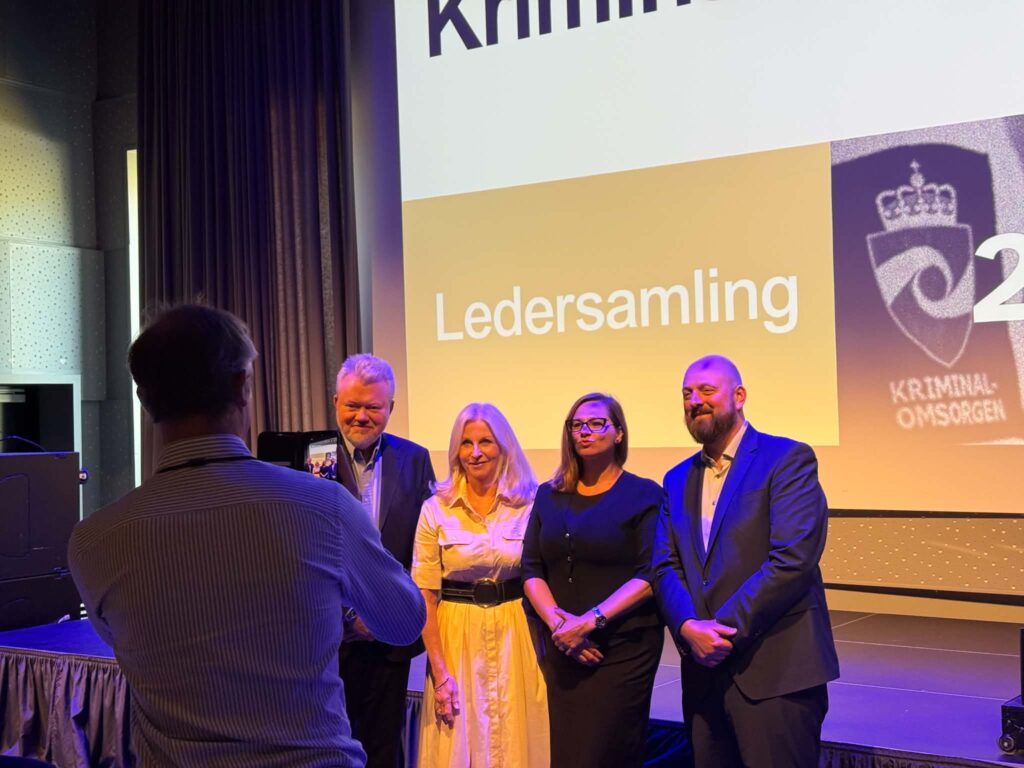
CEP Secretary General Jana Špero Kamenjarin was delighted to participate in the Leadership Conference 2026 of the Norwegian Correctional Service, held on 9–10 September in Oslo.
Recap

Foreign Nationals in Prison and Probation
Recap: Expert Group of CEP and EuroPris, on Foreign Nationals in Prison and Probation (FNPP)
14/09/2026
On 7 and 8 September 2026 the joint Expert Group of CEP and EuroPris, on Foreign Nationals in Prison and Probation (FNPP), came together in The Hague for a valuable exchange of ideas, experiences, and expertise on one of the most important challenges facing prison and probation services across Europe.
New

CEP
Newsletter August 2026 out now
27/08/2026
CEP’s latest newsletter is out now! It includes:
- Approaching deadlines for upcoming events (ITSCCS26, 14th EM and DG leadership training) and the Mental Health curriculum pilot)
- Call for European Probation Journal on the topic of Workload in Probation
- EU documents like SPACE II, revised Victims’ Rights directive and so on
- and much more!
New

Caseload and workload
Do you work in probation? We need your voice!
24/08/2026
As part of its long-standing cooperation with research, CEP invites its members to contribute to a special edition of the European Probation Journal on the topic of Workload in Probation.
Subscribe to our bi-monthly email newsletter!
"*" indicates required fields
- Keep up to date with important probation developments and insights.