

Previous Article
News
Winner of the CEP Research Award: “Developing gender-responsive and jurisdictionally appropriate evaluation systems for offender services”
Understandably, the effectiveness of probation services is a concern for politicians, media and the public as well as the agencies themselves. Ideas about what constitutes effective practice, or what evidence of effectiveness is meaningful, are, however, hotly contested, presenting a dilemma to services and evaluators alike. Happily, progress is being made towards integrating all the available evidence to develop and support practices that reduce reoffending by adhering to the risk-need-responsivity (RNR) principles derived from ‘what works’ endeavours (Bonta and Andrews, 2017), whilst also attending to specific pathways into (and out of) criminalisation and supporting desistance by means of the social reintegration of people who have offended (Maruna & Mann, 2019).
An article by Dr. Bridget Kerr
Research undertaken at Swansea University has identified that, in line with evidence from Canada and the US (Latessa, 2018), there is need for evaluation of the extent to which probation services in Europe employ strategies that have been proven to “work”. Such evaluations have the potential to enable projects to articulate the work they do in terms of effective practice, identify the strengths and weaknesses of services, and develop strategies to improve their service.
Having been trained and accredited by Canadian forensic psychologists, Dr Bridget Kerr introduced their structured, evidence-based instrument for the evaluation of offender intervention services (the Correctional Program Assessment Inventory-2010 (CPAI-2010); Gendreau, Andrews & Thériault, 2010) to a women’s project in Wales and probation services in Jersey. Working alongside probation managers, practitioners and service-users to implement and refine the instrument for use in these European jurisdictions quickly exposed turbulent political environments and cultural differences which had far-reaching implications for the potential of evaluation. Dr Kerr’s study demonstrated that if evaluation as a resource for change and development is to be sustainable in Europe, it must respond to and reflect the political context of agencies, integrate all relevant approaches (eg, Risk-Need-Responsivity, desistance-focused contributions, gender-responsive work, etc) and engage all key social actors (service-users, practitioners, managers, etc) in a process of reflection. Its findings indicate that adopting a motivational language, placing a service on a continuum and timing evaluation at an appropriate frequency are all factors that can reflect and ameliorate organisational difficulties. Furthermore, the study highlighted that evaluation of organisational context is key to meaningful engagement with the core issues of a service, indicating the inadequacy of evaluation systems focusing solely on practice and/or outcomes.
The study supported evidence that recidivism rates may be a particularly inadequate outcome measure for women’s projects, which have their emphasis on the provision of holistic and diversionary approaches, aiming to keep women (who, as a service-user group, present a low risk of re-offending in any case) out of the disproportionately punitive prison system.
As a result of this research, Dr Kerr has developed an evidence-based evaluation approach that meets the specific needs of women’s projects in the British Isles: the Swansea Service Evaluation Inventory – Women’s Projects (SSEI-W). With the aim of bridging the gap between theory and practice in probation services through the development of responsive, empirically-validated evaluation systems, the next stage will be piloting the SSEI-W and refining it to respond to practice-level developments as well as the wider literature. Though it is not the ‘final word’ on effective gender-responsive practices, it is expected that the SSEI-W will nonetheless be a valuable addition to the suite of evaluation instruments available in practice and will equip probation services for women with the capacity to move forward under the aegis of an unparalleled scientific body of evidence in order to demonstrate their effectiveness and provide genuine, effective alternatives to the imprisonment of women.
References
Bonta, J. & Andrews, D. A. (2017) The Psychology of Criminal Conduct, 6th edition. New York: Routledge
Gendreau, P., Andrews, D. A. & Thériault, Y. (2010). Correctional Program Assessment Inventory – 2010 (CPAI-2010): Scoring Manual and Interview Guide. Ottawa, ON: Available from paulgend@bell.net or yvetheri@yahoo.ca
Latessa, E. J. (2018) Does Treatment Quality Matter? Of Course it Does and There Is Growing Evidence to Support It. Criminology & Public Policy, 17, 181-188
Maruna, S. & Mann, R. (2019) Reconciling ‘Desistance’ and ‘What Works’. HM Inspectorate of Probation Academic Insights 2019/1. Available at: https://www.justiceinspectorates.gov.uk/hmiprobation/wp-content/uploads/sites/5/2019/02/Academic-Insights-Maruna-and-Mann-Feb-19-final.pdf

Related News
Keep up to date with the latest developments, stories, and updates on probation from across Europe and beyond. Find relevant news and insights shaping the field today.
Recap

Electronic monitoring, Technology
14th Electronic Monitoring Conference, Electronic Monitoring in a Changing World – Perception vs Reality
08/10/2026
On 6-8 October 2026, Antalya hosted the 14th Electronic Monitoring Conference “Electronic Monitoring in a Changing World – Perception vs Reality”. More than 350 participants coming from 30 countries across Europe and worldwide representing probation services, Ministries of Justice, victims´ services, EM providers, researchers as well as local participants representing the Turkish Prison and Probation Service gathered to discuss how electronic monitoring (EM) is understood by all stakeholders involved including the victims and the public, and how these perceptions compare to the evidence and experiences of those affected. While the gap between perception and reality in electronic monitoring has been recognised for over a decade, the rapid expansion of EM into areas such as victim protection, high-risk supervision and digital innovation has brought new challenges and questions to the forefront.
Recap

ITSCCS
Core Correctional Skills in Digital Probation: highlights from the 6th ITSCCS in Barcelona
05/10/2026
The sixth International Training School on Core Correctional Skills (ITSCCS) took place in Barcelona from 28 September to 2 October 2026, bringing together 26 participants for a week of learning, practical training and international exchange. Organised by the Confederation of European Probation (CEP) and the Centre for Legal Studies and Specialised Training (CEJFE), the programme focused on “Clicks and Empathy: Core Correctional Skills in Digital Probation.”
Recap
Framework Decisions
Recap: ERA workshop on Framework Decisions 829 and 947 in Bucharest
02/10/2026
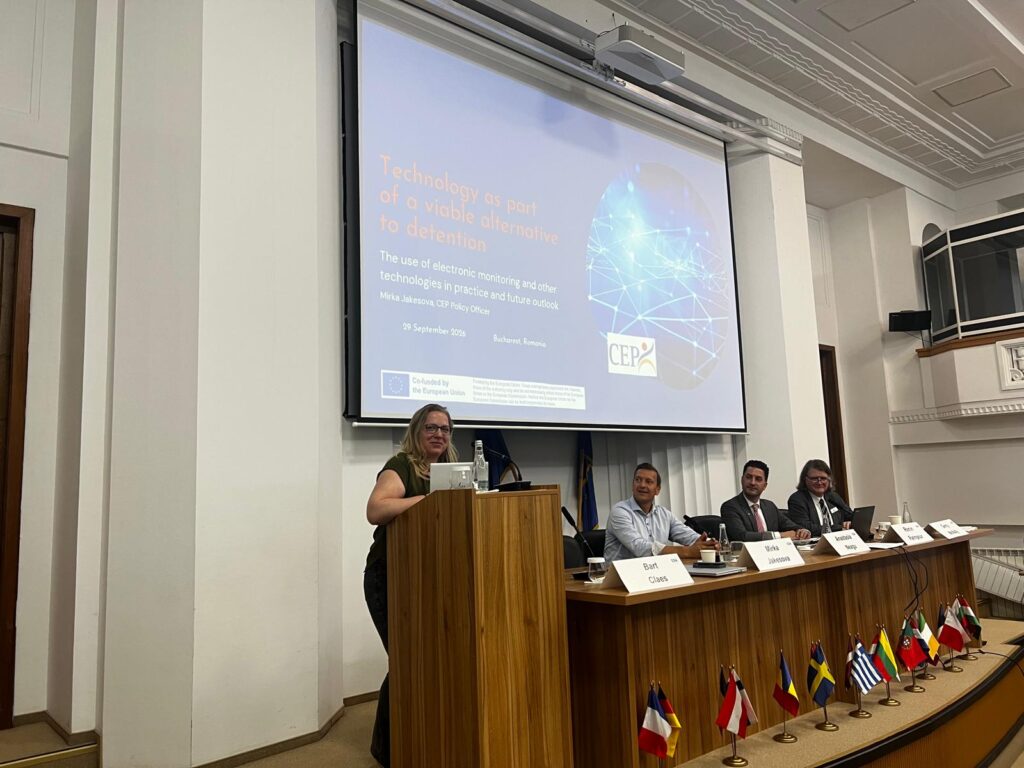
CEP Vice-President Daniel Danglades, Ambassador Gerry McNally and Policy Officer Mirka Jakesova participated in the Seminar on Framework Decisions 829 and 947 and their Impact on Alternatives in the EU organized under the EU project run by the Academy of European Law on 28-29 September in Bucharest, Romania. The seminar brought together judges, prosecutors, probation practitioners, academics, and policy experts to discuss the growing role of alternatives to detention within European criminal justice systems.
New

CEP
CEP and Catalan justice leaders reaffirm longstanding cooperation
29/09/2026
Representatives of the Confederation of European Probation (CEP) met with senior officials from the Catalan Department of Justice and Democratic Quality in Barcelona on 28 September 2026, alongside the opening of the sixth International Training School on Core Correctional Skills. The meeting offered an opportunity to recognise a longstanding partnership and discuss its continued development.
Updated
Mental Health
DEADLINE EXTENDED: Call for Pilot Implementation of the European Mental Health Training Curriculum
29/09/2026
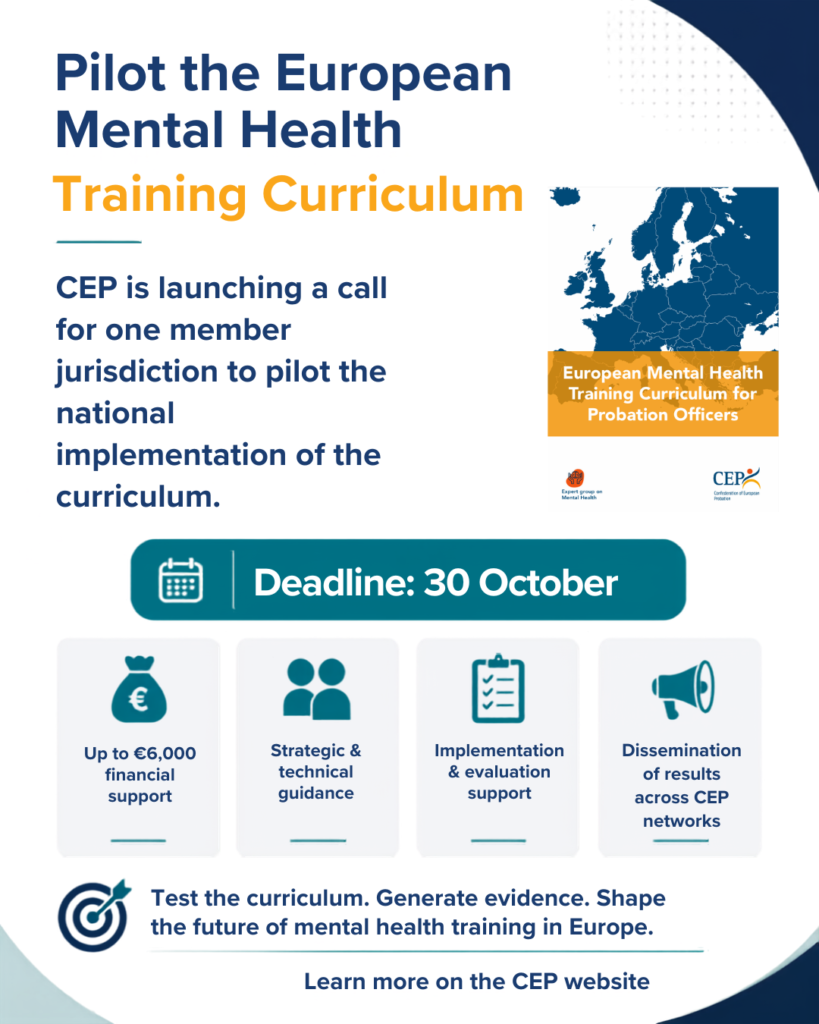
Good news for CEP members! Following requests from our members, CEP has extended the deadline to apply for the pilot implementation of the European Mental Health Training Curriculum for Probation Officers.
Recap

ITSCCS, Technology
6th International Training School opens in Barcelona with a focus on digital probation
28/09/2026
How can probation professionals use new technologies in their interactions while building trust, showing empathy and supporting change? This question is at the heart of the sixth International Training School on Core Correctional Skills, which opened in Barcelona on 28 September 2026.
Subscribe to our bi-monthly email newsletter!
"*" indicates required fields
- Keep up to date with important probation developments and insights.