

Previous Article
News
Recap: 5th CEP conference on electronic monitoring, Egmond aan Zee
Electronic monitoring is hot and it showed during the 5th CEP conference on electronic monitoring, held from 10-12 May in Egmond aan Zee, the Netherlands. More than 130 people took part in the conference, representing 25 countries. Participants came as far as Saudi-Arabia, the US, South-Korea and Japan. In order to give an impression for the CEP-website, three participants look back at the conference.
Monika Seiler, probation officer in the canton of Bern, is closely involved in an electronic monitoring pilot in Switzerland. The pilot is about to end. ‘We hope to stretch the pilot period with another two years’, she says. ‘The political situation is not entirely favourable to the extension of the pilot, so there is our big concern. We have very good experiences with electronic monitoring. Even the inmates in the pilot were positive. If we get these two more years, we can show the necessity of electronic monitoring. At the CEP conference I got a lot of information about how other countries in Europe and the US deal with electronic monitoring. It is good to know if you run a programme like we do, what pitfalls you might encounter, and what opportunities there are. My supervisor was here too, so we had a lot to discuss.’
‘This my third time at a CEP conference on electronic monitoring. Electronic monitoring is evolving quickly. The way it is used, new technologies etc. Therefore it is good to come to a place where you can hear so many new experiences and ideas. You will see me on the next conference for sure!’
Sabrina Cajoly is a programme advisor of the Council of Europe. One of the focal points in her work is community sanctions in Serbia. ‘I only started recently in this job, so you can say I am new in the field of prison work and alternative sanctions’, she comments. ‘Of course the Council of Europe has a long standing interest in alternatives to imprisonment. I just mention the recommendation on community sanctions and measures from 1992, which set a number of guiding principles in this field, and its complementary text from 2000 the recommendation on improving the implementation of the European Rules on community sanctions and measures. In particular, Appendix 2 of this last mentioned recommendation lists a range of possible community sanctions and measures among which electronic monitoring is expressly mentioned. The need for a specific recommendation on EM by the Council of Europe has not yet been identified. However, the Council of Europe may upon request assist the elaboration of a code of ethics in order to better regulate the implementation of this specific community sanction. So you can imagine the Council of Europe likes to know where the member states are standing regarding this issue. Moreover, I was eager to learn about the topic of electronic monitoring. In fact I did learn a lot on this conference. Before I came here, it sounded to me like that electronic monitoring was a community sanction like others. So I didn’t really see the point in looking at ethics more in detail. Now I understand better what the challenge is, what the risks are, and why there probably should be stricter rules about this. When I get back in my office in Strasbourg I will see what the possibilities are for the Council of Europe to provide a forum for discussions for possible new recommendations on electronic monitoring or on a code of ethics.’
‘Looking back at the conference I am quite impressed by the work of the CEP. The organisation, the agenda, the technical aspects were very well organised. But maybe even more important, the topics were well-deepend.’
Anne Kruusement is project leader Electronic Monitoring at the Ministry of Justice in Estonia. Estonia is the first Eastern European country which has integrated electronic monitoring in its probation service. ‘In Estonia there was an urge to introduce it, as my country has the highest number of prisoners per capita in the whole of Europe: some 5,000 prisoners on a population of only 1.4 million people’, she explains. ‘Our Minister of Justice needed to do something and electronic monitoring was one way to deal with it. We have introduced electronic monitoring in about one year, so that is rather quick. The thing is that Estonian law doesn’t leave room for small pilots, so we had to implement the system all over the country at once. In order to win public support for our plans we gave the public very thorough information. We explained what we are doing, and why. We made clear that serious offenders will remain behind bars, and won’t be in the electronic monitoring programme. Of course there were some people and newspapers objecting the programme. But politicians were in favour of our plans and we haven’t had much problems with the community.’
‘I think the conference was very interesting. It is a good place to learn about the technological aspects, other systems etc. I also was surprised by the interest in the Estonian system. I could give other participants some good advice. Now that I have this experience of my first CEP conference on electronic monitoring, I in fact regret that I was not present during the previous conference 2 years ago.’
Presentations
- Offender tracking in England 2004 – 2006 (by Steve Birkett)
- Electronic monitoring in Swedish prisons (by Kjell Carlsson)
- Developments on Electronic Monitoring in the USA (by Peggy Conway)
- Electronic monitoring in Denmark (by Lisbet Heine)
- Privatisation in Electronic Monitoring (by Bob Lilly)
- Portugal Bail Curfew – House Arrest (by Susana Pinto and Nuno Caiado)
- Strategies for evaluation of impact of GPS on high risk offenders in the USA (by Marc Renzema)
- Two tracking & tracing experiments within prison facilities (by Frank Schulpen)
- Dangerous Offenders (by John Scott)
- On the way to electronic monitoring of offenders in Poland (by Dariusz Sielicki)
- Integration of electronics within probation supervision in the Netherlands (by Jan Verhoeff)
- Ethics, Politics and Practise (by Dick Whitfield)
Presentations of sponsors of the conference:

Related News
Keep up to date with the latest developments, stories, and updates on probation from across Europe and beyond. Find relevant news and insights shaping the field today.
New

Others
Applications for the Cambridge MSt in Applied Criminology, Penology and Management are now open
16/09/2026
The Institute of Criminology, Cambridge, have opened up applications for the MSt in Applied Criminology, Penology and Management in the next academic year.
Recap
Probation in Europe
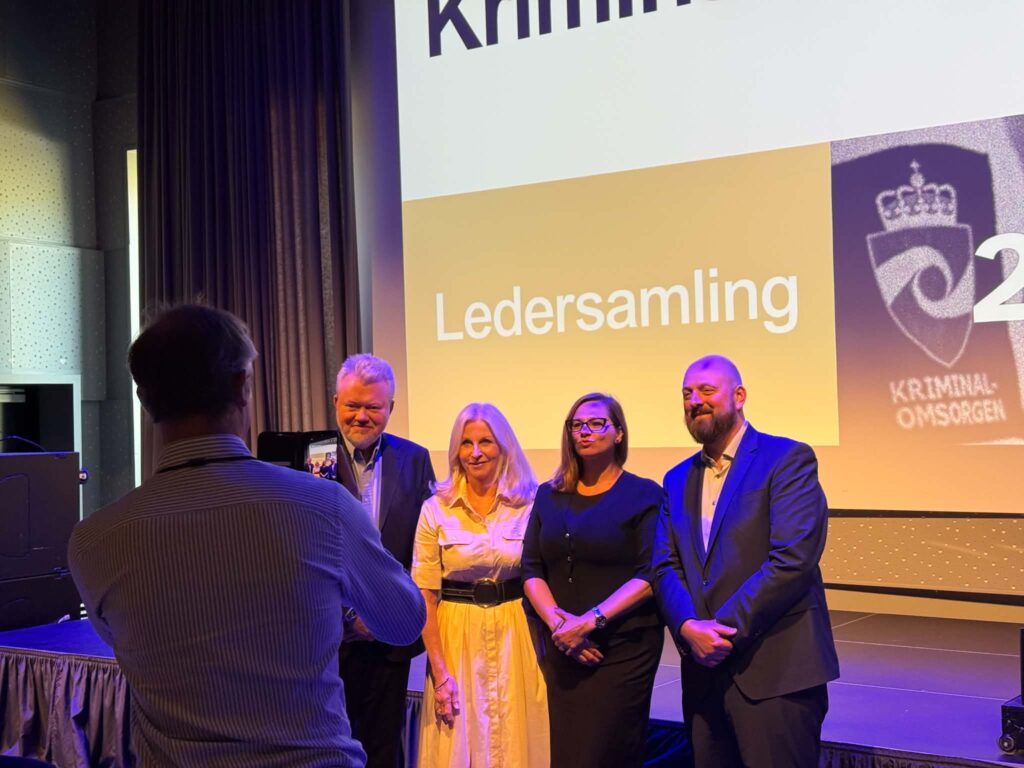
CEP at the Leadership Conference 2026
14/09/2026
CEP Secretary General Jana Špero Kamenjarin was delighted to participate in the Leadership Conference 2026 of the Norwegian Correctional Service, held on 9–10 September in Oslo.
Recap

Foreign Nationals in Prison and Probation
Recap: Expert Group of CEP and EuroPris, on Foreign Nationals in Prison and Probation (FNPP)
14/09/2026
On 7 and 8 September 2026 the joint Expert Group of CEP and EuroPris, on Foreign Nationals in Prison and Probation (FNPP), came together in The Hague for a valuable exchange of ideas, experiences, and expertise on one of the most important challenges facing prison and probation services across Europe.
New

CEP
Newsletter August 2026 out now
27/08/2026
CEP’s latest newsletter is out now! It includes:
- Approaching deadlines for upcoming events (ITSCCS26, 14th EM and DG leadership training) and the Mental Health curriculum pilot)
- Call for European Probation Journal on the topic of Workload in Probation
- EU documents like SPACE II, revised Victims’ Rights directive and so on
- and much more!
New

Caseload and workload
Do you work in probation? We need your voice!
24/08/2026
As part of its long-standing cooperation with research, CEP invites its members to contribute to a special edition of the European Probation Journal on the topic of Workload in Probation.
New

Alternatives to pre-trial detention, Foreign Nationals in Prison and Probation, Gender Equality, Probation in Europe
SPACE II report is now available
24/08/2026
The use of community sanctions and measures that allow individuals to remain in the community – also known as alternatives to imprisonment – continues to grow overall in Europe, although at a moderate pace, according to the latest Council of Europe annual penal statistics on persons under the supervision of probation agencies (2025 SPACE II survey).
Subscribe to our bi-monthly email newsletter!
"*" indicates required fields
- Keep up to date with important probation developments and insights.