

News
Recap: annual meeting of the Expert Network on Framework Decisions 829 and 947
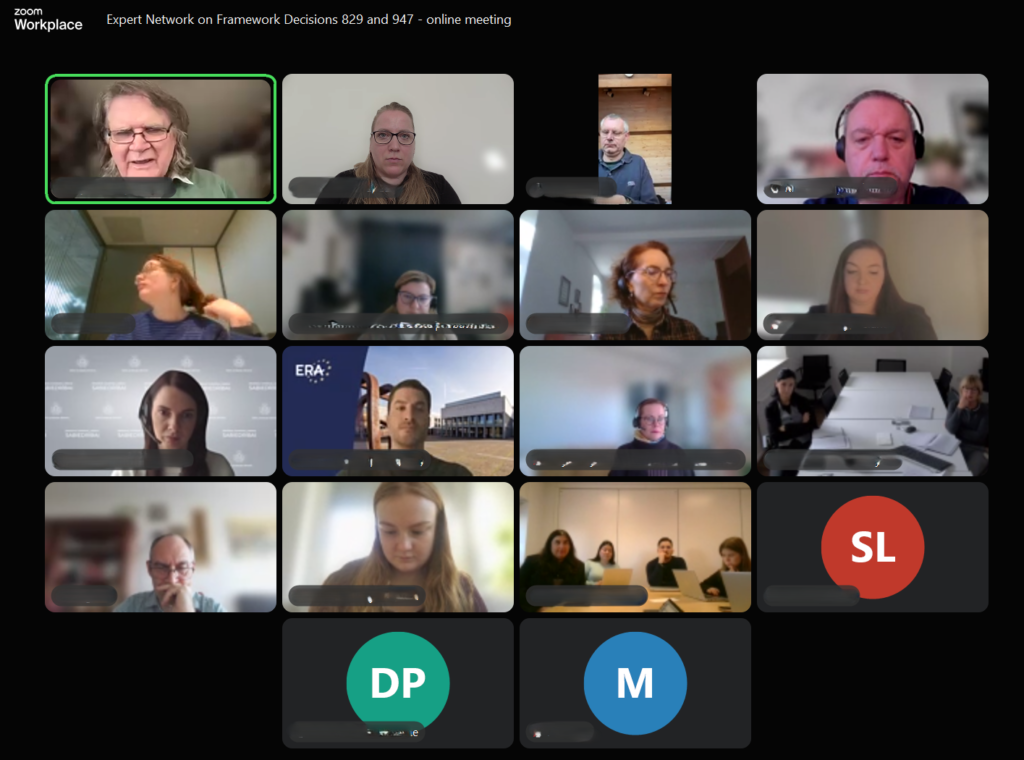
On Thursday 5 November an annual meeting of the Expert Network on Framework Decisions 829 and 947 took place online. Bringing together 20 participants from 12 EU jurisdictions including representatives of the Academy of European Law and European Judicial Network, the meeting provided an opportunity to exchange experiences, discuss current implementation challenges and identify priorities for enhancing cross-border cooperation in the application of the two Framework Decisions.
Participants reported that the use of FD 947 remains generally low across Europe, with many jurisdictions experiencing only a small number of incoming and outgoing cases. Despite this, several countries noted increasing cross-border mobility and a growing number of foreign nationals under supervision, which may lead to greater use of the instrument in the future. A common challenge identified was the limited awareness and understanding of the Framework Decisions among judges, prosecutors and other practitioners. Many participants highlighted ongoing efforts to address this through training activities, webinars, guidance materials and enhanced cooperation between probation services and judicial authorities. The discussion also pointed to persistent procedural and administrative obstacles, including delays in decision-making, incomplete documentation, differences in national procedures and difficulties in meeting statutory deadlines. Participants agreed on the importance of practical tools, clear guidance and continued information exchange to support the more effective implementation of the Framework Decisions.
CEP representatives, Gerry McNally, Chair of the Expert Network, and Mirka Jakesova, Policy Officer, provided participants with a presentation of the follow-up to the explanatory study commissioned by the European Commission, a comparison with the findings and recommendations of the 9th Round of Mutual Evaluations (2019-2023), and a discussion on the outcomes of the High-Level Forum on the Future of EU Criminal Justice and their relevance for the further development of mutual recognition instruments in the field of probation and supervision measures.
The presentation highlighted the study’s key findings, namely that mutual recognition remains central to EU judicial cooperation, while disparities in implementation, the limited use of the instruments and digitalisation challenges continue to affect their effectiveness. Participants were also informed that Member States generally favour non-legislative approaches, placing greater emphasis on awareness-raising, practitioner training and operational efficiency, alongside a preference for practical solutions that facilitate the day-to-day application of the Framework Decisions rather than legislative reform.
Participants then exchanged information on the currently running project – Detention, Alternatives, Mutual Trust and Mutual Legal Assistance run by the Academy of European Law (ERA) as well as EMPRO run by the French Prison and Probation Service. The two projects where CEP is an Associated Partner will come to its end in the coming months. Participants can already use the training materials developed within the framework of the project run by ERA.
Lastly, the discussion session focused on the Workshop on Transfer of Sentences: Managing Foreign Nationals, which is being jointly organised by CEP and EuroPris on 6-7 April 2027 in Antwerp, Belgium. Participants were invited to contribute ideas and proposals that could enrich the workshop programme and support further cooperation and knowledge exchange in this area. The workshop will serve as an annual meeting for the Expert Network alongside two other specialised groups: the Foreign Nationals in Prison and Probation Group, run jointly by CEP and EuroPris, and the Expert Network on Framework Decision 909, run by EuroPris. This will provide an opportunity to bring together practitioners from across the prison and probation sectors to exchange expertise, identify common challenges and strengthen cooperation on issues relating to foreign nationals and the transfer of sentences.

Related News
Keep up to date with the latest developments, stories, and updates on probation from across Europe and beyond. Find relevant news and insights shaping the field today.
Recap
Framework Decisions
Recap: annual meeting of the Expert Network on Framework Decisions 829 and 947
09/11/2026
On Thursday 5 November an annual meeting of the Expert Network on Framework Decisions 829 and 947 took place online. Bringing together 20 participants from 12 EU jurisdictions including representatives of the Academy of European Law and European Judicial Network, the meeting provided an opportunity to exchange experiences, discuss current implementation challenges and identify priorities for enhancing cross-border cooperation in the application of the two Framework Decisions.
New

Education and Training, Probation in Europe
Justice programme: the judicial training call is open for applications!
09/11/2026
Are you ready to help address the training needs of justice professionals from different EU countries in the fields of civil law, criminal law and fundamental rights? This call supports cross-border training projects contributing to the effective and consistent application of EU law. In line with the new European Judicial Training Strategy, the call also supports the digitalisation of justice. Don’t miss this opportunity! Apply by 4 March 2027, 17:00 Brussels time.
Recap

CEP Board, Foreign Nationals in Prison and Probation, Probation in Europe
CEP at the 16th Plenary Meeting of the Council for Penological Co-operation
06/11/2026
From 3 to 5 November 2026, representatives of the Confederation of European Probation (CEP) participated in the 16th Plenary Meeting of the Council for Penological Co-operation (PC-CP).
New

CEP
Newsletter October 2026 out now
29/10/2026
CEP’s latest newsletter is out now! It includes:
- Deadline approaching for the Workshop on Technology and Alternatives to Detention
- Recap of the 14th EM and CEP Excellence Leadership Training
- New publications from Expert Groups on Technology and Expert Group on Violent Extremism
- Call for Proposals: Evaluation of CEP Expert Groups
- Engaging with Research – a new section in our newsletter
- and much more!
New
Violent Extremism
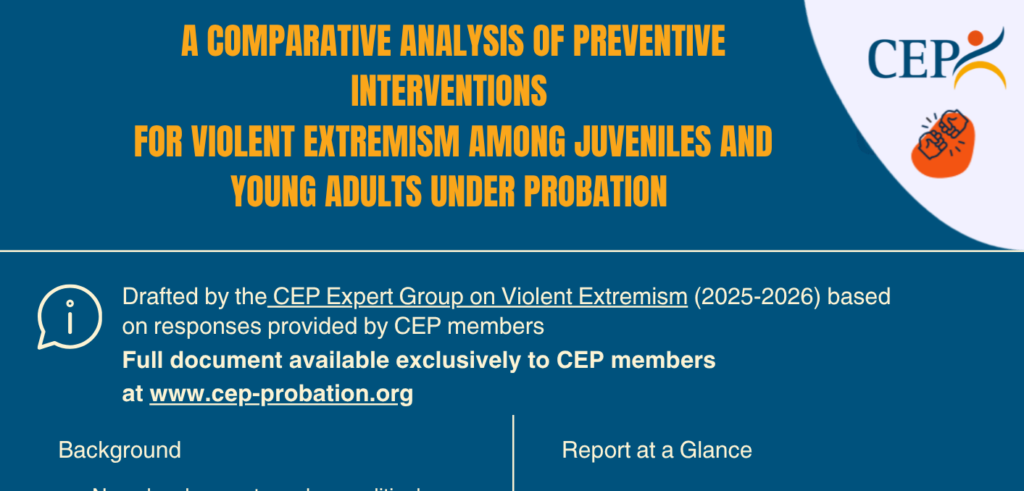
Understanding Youth Radicalisation: What Can Probation Services Do? | New Report from CEP’s Expert Group
27/10/2026
In recent decades, the violent radicalisation of juveniles and young adults has become a pressing concern for policymakers, researchers, practitioners, and communities worldwide. While considerable attention has been devoted to psychological vulnerabilities, socio-economic marginalisation, and community-level influences, the broader context in which violent radicalisation develops is often overlooked. At the same time, the increasing involvement of young people in violent extremist offences highlights the urgent need for effective prevention efforts. Addressing youth radicalisation has become a complex and evolving challenge for families, educators, mental health professionals, law enforcement agencies, probation services, and security authorities.
Recap

Probation in Europe
Reflections on the European Society of Criminology Conference 2026 | From Criminological Research to Probation Practice
26/10/2026
At CEP, we are fascinated by research from across Europe and beyond, and by helping it reach the people who can use it. Ruth Armstrong, CEP Research and Policy Officer, went to the 26th Annual Conference of the European Society of Criminology (EuroCrim 2026 – Working Group on Community Sanctions and Measures) that took place in Warsaw, Poland, from 9–12 September 2026.
Against a backdrop of overcrowded prisons and net-widening (with ever more people drawn into supervision), three questions kept coming up in the research: how time shapes justice, what we mean by success, and how we define harm.
Subscribe to our bi-monthly email newsletter!
"*" indicates required fields
- Keep up to date with important probation developments and insights.