
Skip to content

News

‘The Monkey Robert’, a children’s probation story by Intress

One day a group of savanna animals wake up and see that someone has stolen the shoes from the store of Pere the hippopotamus. This is the beginning of the story ‘The Monkey Robert’, a book produced by the Catalan organisation Intress to explain to children what probation means. We spoke to Meritxell Campmajo, the author and Director of the Intress Probation Service in Catalonia, about the book.

What is the story about?

The story begins when one day in the savanna, some animals wake up and see how overnight someone has stolen shoes from the store of the Pere the hippopotamus. The police elephants find out that the Monkey Robert is the one who committed this crime. The owl, a judge, gives him the choice between a prison sentence and repairing the damage he has done under the supervision of the Eagle, a probation officer. Robert the Monkey agrees on cleaning the market and help the other animals out. At first, he does not like his job, but the animals tell him how beautiful and clean the market looks after he cleaned it. This makes him proud and appreciate his work. After he is finished Pere the hippopotamus even offers him a job at his shoe store. Robert the Monkey has learned to work in a different way and Pere also learns what it is like to give people a second chance.

How did Intress come up with the idea of producing a story about probation for children?

Intress, as a nonprofit association, has been working on a selection of a tales that wants to teach children about the social values of community intervention. ‘The Monkey Robert’ is the second book of the collection. The first one was about Iris, a little elephant, explaining the welcome in a migration process.

Why is it so important to produce a story for children about these topics?

We are an organisation of professional experts in the social field that detects needs, designs projects and manages services with a model of attention focused on the person and the community. For us it is important to inform as many people as possible about the work we do. Especially for children it is important to learn about alternative measures to prison. We work to raise awareness  about the importance of aiming for a more restorative and less punitive penal model.

How was the book produced?

The text in Robert Monkey story  was written by me, and it was reviewed by different professionals working in the probation service managed by INTRESS. The illustrations are carried out by Kira Diaz, who had already illustrated the first tale of our collection.

The book is published in Spanish and Catalan. 

Related News

Keep up to date with the latest developments, stories, and updates on probation from across Europe and beyond. Find relevant news and insights shaping the field today.

New

CEP

Newsletter October 2026 out now

29/10/2026

CEP’s latest newsletter is out now! It includes:

 >> Read here

>>Read previous newsletters

New

Violent Extremism

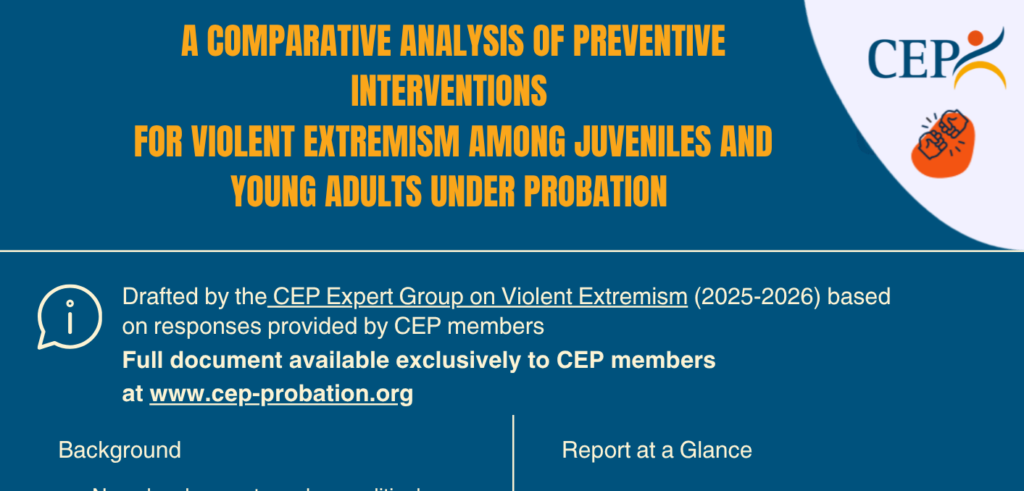
Understanding Youth Radicalisation: What Can Probation Services Do? | New Report from CEP’s Expert Group

27/10/2026

In recent decades, the violent radicalisation of juveniles and young adults has become a pressing concern for policymakers, researchers, practitioners, and communities worldwide. While considerable attention has been devoted to psychological vulnerabilities, socio-economic marginalisation, and community-level influences, the broader context in which violent radicalisation develops is often overlooked. At the same time, the increasing involvement of young people in violent extremist offences highlights the urgent need for effective prevention efforts. Addressing youth radicalisation has become a complex and evolving challenge for families, educators, mental health professionals, law enforcement agencies, probation services, and security authorities.

Recap

Probation in Europe

Reflections on the European Society of Criminology Conference 2026 | From Criminological Research to Probation Practice

26/10/2026

At CEP, we are fascinated by research from across Europe and beyond, and by helping it reach the people who can use it. Ruth Armstrong, CEP Research and Policy Officer, went to the 26th Annual Conference of the European Society of Criminology (EuroCrim 2026 – Working Group on Community Sanctions and Measures) that took place in Warsaw, Poland, from 9–12 September 2026.

Against a backdrop of overcrowded prisons and net-widening (with ever more people drawn into supervision), three questions kept coming up in the research: how time shapes justice, what we mean by success, and how we define harm.

New

Technology

Registration deadline approaching: Join CEP’s final workshop of 2026 on technology in probation

22/10/2026

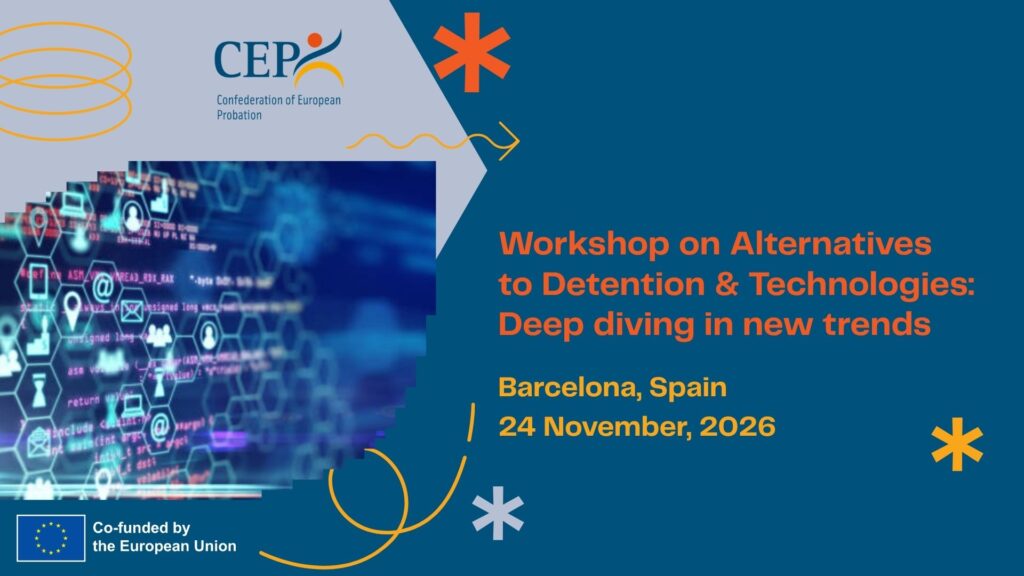
📢 Have you registered yet? CEP’s final workshop of 2026 takes place on 24 November in Barcelona, bringing together professionals to explore how technology is being used across probation services in Europe.

The Workshop on Alternatives to Detention and Technologies: Deep Diving into New Trends will look beyond artificial intelligence to examine the different ways technology is shaping probation practice, from staff training to working with clients and collaborating with other criminal justice partners.

Recap

Directors General Meetings

CEP Leadership Excellence Training: strengthening leadership and cooperation across Europe

22/10/2026

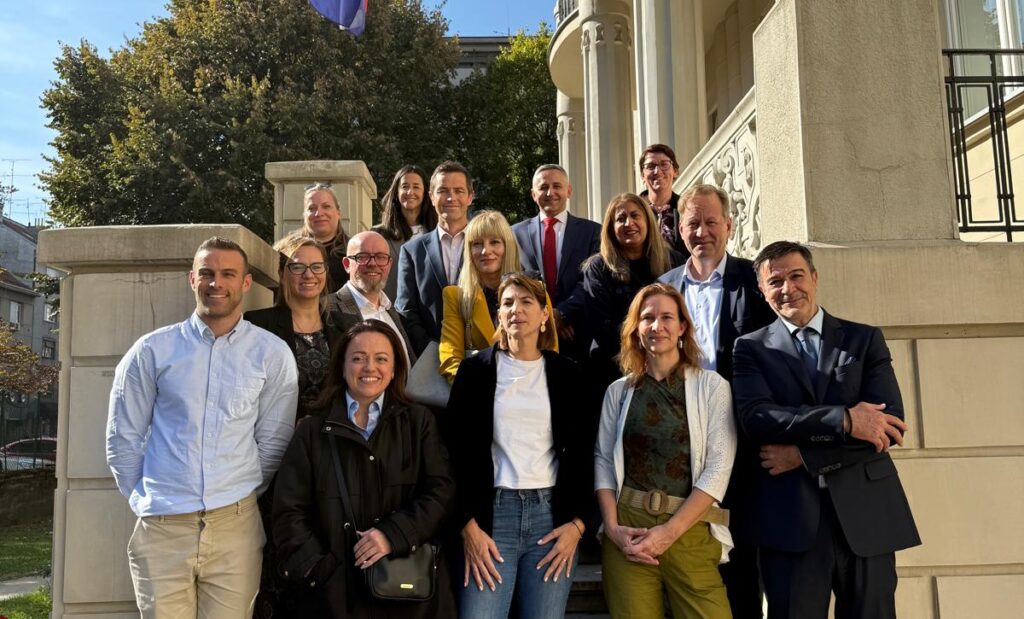
The CEP Leadership Excellence Training, held on 20–21 October in Zagreb, Croatia, brought together Directors General and senior probation managers from 11 European countries for a two-day interactive programme focused on leadership, communication, staff development, and international cooperation.

New

CEP

Call for Proposals: Evaluation of CEP Expert Groups

21/10/2026

On behalf of Ms. Jana Å pero Kamenjarin, CEP Secretary General, it is my pleasure to invite you to submit a proposal to conduct an evaluation within the CEP work programme.

Subscribe to our bi-monthly email newsletter!