

Previous Article
Probation library
Recap: Expert meeting on the Implementation of the Framework Decision on Probation
As the EU Framework Decision was adopted in 2008, it seemed timely to organise a conference for all experts involved, in order to share information about the implementation. CEP in conjunction with the Probation Service in Ireland hosted the expert meeting on the EU Framework Decision on 8th and 9th October 2009. The conference was attended by policy makers from relevant Ministries and delegates from key Probation organisations, the smaller Member States were especially well represented.
At the conference the Framework Decision was identified as “a new and exciting development, which offers a ‘third option’ for the courts in addition to prison sentences or fines and gives Probation agencies an opportunity to showcase what supervision in the community can achieve.” The Probation Service in Ireland was very happy to take the lead role in hosting and organising this international conference. As the Framework Decision is important to all the participants and CEP members, there was great interest in the presentations and positive contributions by the participants, according to Suzanne Vella, CEP Board Member and Deputy Director of the Probation Service. “The discussion groups were energetic and informative. They played an important part in setting the agenda for the next steps in the implementing of the Framework Decision as well as equipping and motivating the participants to ensure actions.”
To maximise the discussions among the participants, the discussion groups consisted on the one hand of policy issues groups and on the other hand of operational issues groups. Suzanne Vella noted: “In the policy groups it emerged that different states were at different stages in the implementation process and had different ideas about what the Competent Authority would look like, but none had made final decisions.” The Competent Authorities (CA) will be issuing and receiving orders from courts in other States. On receiving an order, the CA has 60 days to decide whether to accept it. “Participants concluded that there needs to be further clarification about the functions and skills (administrative, legal, probation practice) involved. Furthermore the Competent Authorities need to know how to communicate with each other.” There was a wide spectrum of knowledge and skills evident in the operational groups. They noted also that some states are well-advanced, while others have yet to begin. There was also concern about the steps involved in how it would be implemented as there was an awareness that time is short. December 2011 is the date by which Member States must have taken the necessary measures for the implementation. One of the major challenges, according to Suzanne Vella, is to give this task an appropriate priority.
A Next Steps document was produced at the conference which outlined the steps necessary for successful implementation. This document provided a checklist which included the following:
- General Steps: Undertaking a mapping exercise which would also serve to chart key processes.
- Competent Authority: Identify functions, key players, responsible persons and set timelines and targets.
- Legislation: Examine existing legislation to establish how it fits with the Framework Decision and whether legislative amendments required. Undertake this from the viewpoint of both issuing and executing state, considering 11 measures and breach/revocation.
- Progressing Conference Objectives: Compile a template for each Member State to outline basic information on community sanctions available and which could be incorporated into a manual.
- Additional Steps: Develop contacts with likely partner states.
This gave participants a clear checklist for progressing work on the Framework Decision. “There was an enthusiasm expressed by delegates about the task facing them on returning home”, Suzanne Vella recalled.
Recapitulating Suzanne Vella says: “The conference highlighted the need for urgent action in each jurisdiction to incorporate the Framework Decision in domestic legislation, to identify functions, key players, responsible persons and timelines and targets for implementation, the importance keeping of the structures as simple as possible and making the implementation of the Framework Decision a priority action for 2009-2011. The real benefit of this conference is that it provided an opportunity for policy and practice to come together to see how it will work.” In addition the conference also provided an opportunity for networking. The official reception at the start, high standard of service through out the conference, the conference dinner, tour and entertainment at the Jameson Distillery Visitor Centre were enjoyed by all. “As result of their visit every participant at this conference is now a trained and certified Irish Whiskey drinker”, concludes Suzanne Vella.
Conference based documents
Report of the Expert Meeting (by Deidre Healy)
Implementation checklist ‘Next Steps’
Impact analysis Framework Decision 2008/JHA/947 (by the Dutch Ministry of Justice)
Presentations
Word of Welcome (by Leo Tigges)
Operational issues implementing the FD in the Netherlands (by Hayke Everwijn)
Policy Issues: Choices to be Made (by Ursula Fernée)
Review of Findings – Policy (by Ita Burke)
Review of Findings – Practice (by Gerry McNally)
Role and Objectives of the EU in relation to the FD (by David O’Donovan)
Texts of relevant EU Framework Decisions:
Council Framework Decision 2008/947/JHA on the mutual recognition of probation measures
Council Framework Decision 2008/909/JHA on the mutual recognition of
custodial sentences
Council Framework Decision 2009/829/JHA on the mutual recognition of supervision measures

Probation library
Probation Journal

Women, youth
Understanding the needs of girls and young women in youth justice
10/03/2026
New research highlights the underlying needs that influence girls’ and young women’s contact with youth justice systems and calls for more gender responsive approaches in policy and practice. Drawing on a review of recent studies, the authors identify several factors shaping girls’ pathways into the justice system, including persistent abuse, trauma, gendered expectations, and systemic failures. Girls involved in youth justice are often affected by multiple forms of victimisation, such as sexual abuse, neglect, and domestic violence, with experiences frequently beginning in early childhood.
Reading corner

Probation in Europe
The Routledge Handbook of European Penology
05/01/2026
The Routledge Handbook of European Penology, published by Routledge. This comprehensive volume has been edited by Sonja Snacken, Gaëtan Cliquennois, Ioan Durnescu, Diete Humblet and Elena Larrauri.
Reading corner

Criminal Justice
Bridging Research and Practice in Forensic Social Work: An interview with the editors of Forensic Social Work – Supporting Desistance
17/12/2025
Supporting desistance while managing risk is at the heart of criminal justice social work across Europe. In Forensic Social Work – Supporting Desistance, editors Jacqueline Bosker, Anneke Menger and Vivienne de Vogel bring together scientific insights and everyday professional practice to support those working with justice-involved individuals. In this interview, they reflect on the motivation behind the English edition of the book, its core themes, and how professionals can use its tools and approaches in their daily work.
Probation Journal

Domestic violence, Gender-based violence
New evaluation on whole family approach to domestic abuse
26/11/2025
Interventions Alliance has published a new evaluation of a Hub coordinated on behalf of police forces in the south of England, focused on tackling violence against women and children through a whole family approach. The Hub supports victims and perpetrators of domestic abuse and works across policing, health and social services.
Reading corner
Probation in Europe
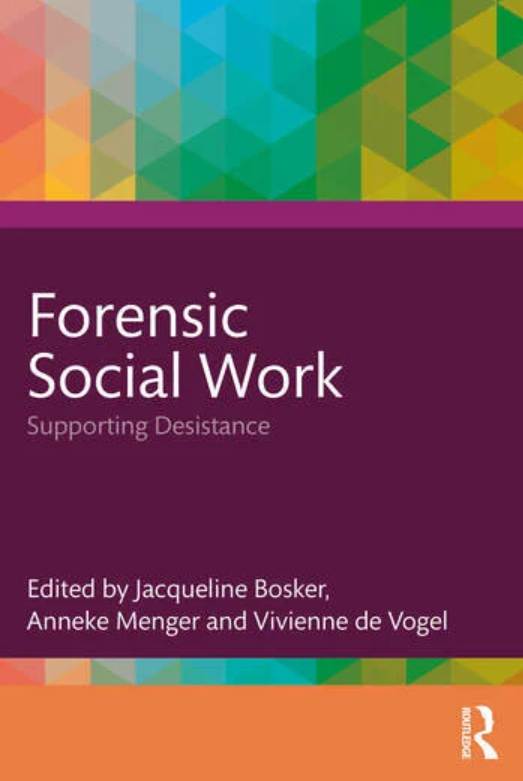
New Release: Forensic Social Work – Supporting Desistance
13/11/2025
This book, Forensic Social Work – Supporting Desistance, has been released by Routledge. It is a practice-oriented resource exploring how forensic social work can support desistance and foster meaningful change in the lives of justice-involved individuals.
Reading corner

Criminal Justice
Parole Futures
18/08/2025
At a time when many parole systems are experiencing considerable strain, the aims of this collection are twofold: first, to encourage systematic and critical reflection on the rationalities, institutions and practices of parole. Second, to think big, and pose ambitious ‘what if’ questions about the possible futures of parole and prison release. Offering novel insights from Asia, Australia, Europe, North America and South America, this collection builds the case for, and then showcases, a ‘way of doing’ parole research that is global in outlook, interdisciplinary in approach and unapologetically normative in character.
Probation Journal

Violent Extremism
2025 EU Guidance document responding to the needs of victims of terorrism
23/06/2025
To mark the EU Day of Remembrance for Victims of Terrorism on 11 March, the EU Centre of Expertise for Victims of Terrorism has published a new Guidance Document on the Needs of Victims. This document is a significant step forward in reinforcing a victim-centred approach within counter-terrorism efforts across the European Union.

Research
Launch of the CEP Research and Development Strategy Summary
17/06/2025
We’re thrilled to announce that the Confederation of European Probation (CEP), in cooperation with the University of Glasgow (led by CEP Honorary Member Professor Fergus McNeill), and with the support of the CEP Expert Group on Research, has produced the CEP Research and Development Strategy. We are happy to share the summary with you!
Probation Journal

Alternatives to pre-trial detention
Unpacking criminal detention rules and regulations across the EU
21/05/2025
The EU Agency for Fundamental Rights (FRA) has updated its online criminal detention database, which includes national standards, laws, and monitoring reports on detention conditions in the EU and the UK.
Probation Journal

Technology
Is AI Putting Remote Probation Supervision at Risk Before It Even Starts?
09/04/2025
David Jackson and Jed Stone focus on the use of AI in probation and advocate for investigations to understand the opportunity, address issues and innovate for the good of all.
Subscribe to our bi-monthly email newsletter!
"*" indicates required fields
- Keep up to date with important probation developments and insights.