

Projects
Enhancing Cross-border Mutual Legal Assistance and Recognition of Decisions within the Context of Detention
This project, led by the Europäische Rechts Akademie (ERA) and co-financed by the Justice Programme 2014-2020 of the European Union, consists of five seminars, two of which were planned to take place in Bucharest and Strasbourg in 2020, and three in Bucharest and Brussels in 2021. Each seminar focused on a different aspect of enhancing cross-border mutual legal assistance and recognition of decisions within the context of detention, with the aim to provide practical training for judges, prosecutors and lawyers in private practice, as well as prison and probation staff, in the field of detention. Unfortunately due to Covid-19 all events in 2021 had to be replaced by online ones, but a face-to-face seminar in Bucharest was scheduled on 28 February-1 March 2022.
Our knowledge of Framework Decisions
The European Union and the Council of Europe have become increasingly important players in the development of probation in Europe. CEP is not only the voice of probation in Europe, it also wants to stimulate and support initiatives of international cooperation on probation and on the implementation of EU regulations. Below you will find all the information about the implementation of Framework Decisions 2009/829/JHA and 2008/947/JHA.

Related News
Check out the latest news and updates on this project’s focus area.
New

CEP
Newsletter October 2026 out now
29/10/2026
CEP’s latest newsletter is out now! It includes:
- Deadline approaching for the Workshop on Technology and Alternatives to Detention
- Recap of the 14th EM and CEP Excellence Leadership Training
- New publications from Expert Groups on Technology and Expert Group on Violent Extremism
- Call for Proposals: Evaluation of CEP Expert Groups
- Engaging with Research – a new section in our newsletter
- and much more!
New
Violent Extremism
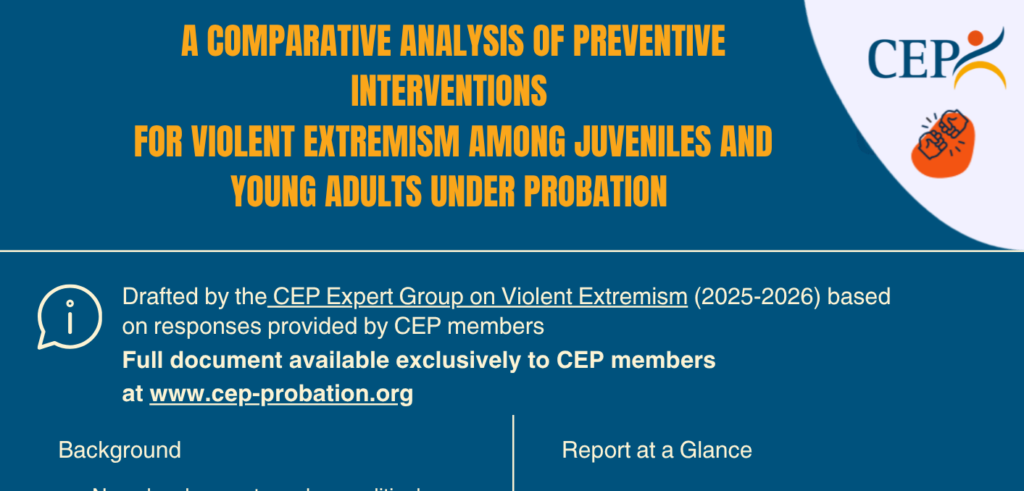
Understanding Youth Radicalisation: What Can Probation Services Do? | New Report from CEP’s Expert Group
27/10/2026
In recent decades, the violent radicalisation of juveniles and young adults has become a pressing concern for policymakers, researchers, practitioners, and communities worldwide. While considerable attention has been devoted to psychological vulnerabilities, socio-economic marginalisation, and community-level influences, the broader context in which violent radicalisation develops is often overlooked. At the same time, the increasing involvement of young people in violent extremist offences highlights the urgent need for effective prevention efforts. Addressing youth radicalisation has become a complex and evolving challenge for families, educators, mental health professionals, law enforcement agencies, probation services, and security authorities.
Recap

Probation in Europe
Reflections on the European Society of Criminology Conference 2026 | From Criminological Research to Probation Practice
26/10/2026
At CEP, we are fascinated by research from across Europe and beyond, and by helping it reach the people who can use it. Ruth Armstrong, CEP Research and Policy Officer, went to the 26th Annual Conference of the European Society of Criminology (EuroCrim 2026 – Working Group on Community Sanctions and Measures) that took place in Warsaw, Poland, from 9–12 September 2026.
Against a backdrop of overcrowded prisons and net-widening (with ever more people drawn into supervision), three questions kept coming up in the research: how time shapes justice, what we mean by success, and how we define harm.
New
Technology
Registration deadline approaching: Join CEP’s final workshop of 2026 on technology in probation
22/10/2026
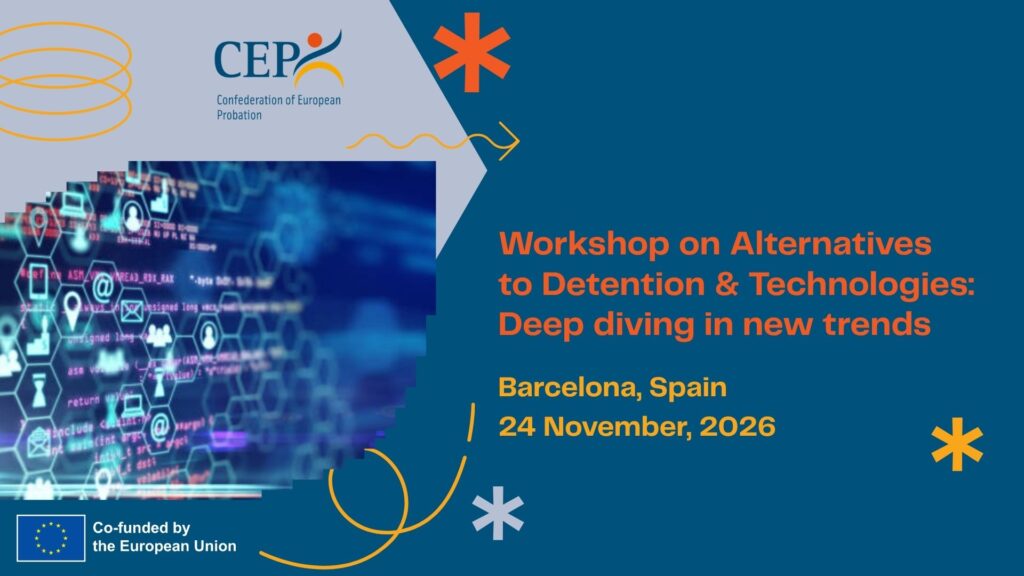
📢 Have you registered yet? CEP’s final workshop of 2026 takes place on 24 November in Barcelona, bringing together professionals to explore how technology is being used across probation services in Europe.
The Workshop on Alternatives to Detention and Technologies: Deep Diving into New Trends will look beyond artificial intelligence to examine the different ways technology is shaping probation practice, from staff training to working with clients and collaborating with other criminal justice partners.
Recap
Directors General Meetings
CEP Leadership Excellence Training: strengthening leadership and cooperation across Europe
22/10/2026
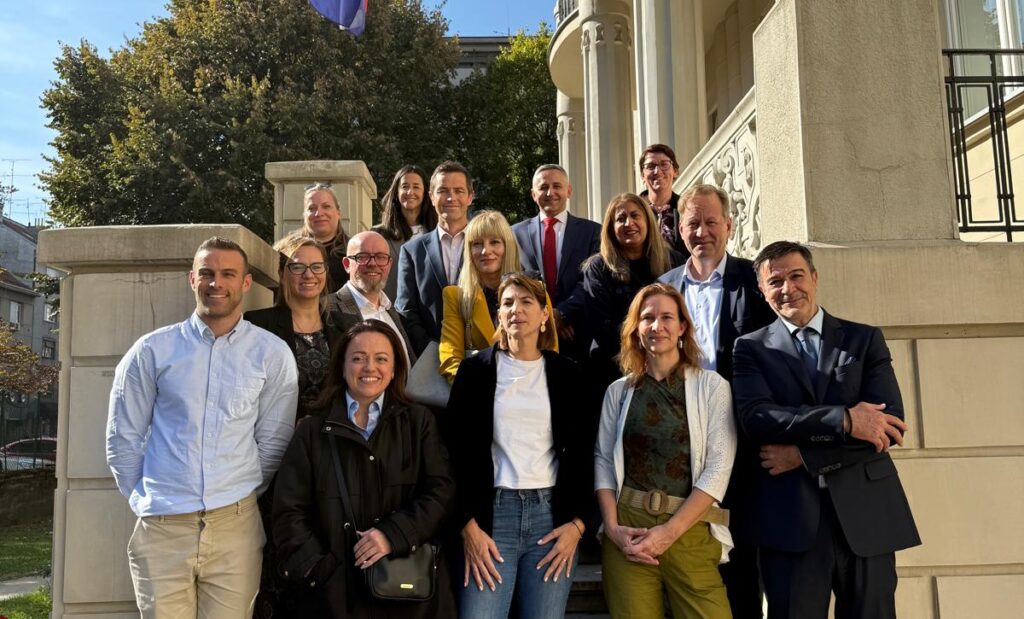
The CEP Leadership Excellence Training, held on 20–21 October in Zagreb, Croatia, brought together Directors General and senior probation managers from 11 European countries for a two-day interactive programme focused on leadership, communication, staff development, and international cooperation.
New

CEP
Call for Proposals: Evaluation of CEP Expert Groups
21/10/2026
On behalf of Ms. Jana Špero Kamenjarin, CEP Secretary General, it is my pleasure to invite you to submit a proposal to conduct an evaluation within the CEP work programme.
Subscribe to our bi-monthly email newsletter!
"*" indicates required fields
- Keep up to date with important probation developments and insights.