
Previous Article
News
Czech Probation and Mediation Service opens the first Halfway House
On Thursday 24 November 2022 the Probation and Mediation Service opened the first Halfway House in the Czech Republic. The Halfway House has been built within the project „Back to life“ funded by the Norway grants 2014-2021. The objective of the Halfway House is to support conditionally released offenders with reintegration into society and help them set up their lives in the first months upon their release which are considered the most crucial for successful rehabilitation.

The newly opened Halfway House is situated in Písek (South Bohemia) and is designed for 16 clients. It offers a six month´ resocialization program to conditionally released offenders and is aimed at adult male clients with imposed probation supervision and obligation to attend the in-house resocialization programs led by the Halfway House team. Other prerequisites for clients to enroll in the Halfway House are, among others, the need for more thorough and long-term support but also the motivation to work on themselves.
„This form of support to people with criminal pasts has been quite common in the world as it significantly contributes to reduce recidivism in the period upon release that is considered high-risk when the client finds himself free yet very often without support from his family or those around him. The Probation and Mediation Service has made use of high-quality and proven experience from around the world, and this type of facility (project) is definitely one of them,“ says Andrea Matouskova, Director General of the Service.
As part of the operation of the Halfway House, the daily routine is scheduled to be as similar as possible to daily life but with a clearly defined set of rules. The clients are obliged to stay within the premises of the House during certain periods of time, cooperate with the Halfway House team and take an active part in dealing with any issues arising, refrain from consuming alcohol and drugs, treat other clients in well manners and take care of premises of the House. During their stay in the House the clients will work together with the Halfway House team to become self-sufficient, be aware of the need to solve their problems and eventually to indicate the moment when it is necessary for them to seek professional support.
The operation of the Halfway House in Písek was ceremonially opened by H.E. Mr. Victor Conrad Ronnenberg, the Ambassador of Norway in the Czech Republic, together with the Director General of the Probation and Mediation Service, Mrs. Andrea Matouskova, and Mr. Petr Dohnal, Deputy Minister of Justice for the Management of the Prison Section and Departmental Control.

„Such projects as the Halfway House are part of the modern justice. They offer further professional work and support to people with criminal past and I am convinced that the operation of the House will demonstrate in practice that this is the way we need to go ahead to keep up with the current world and its needs. The help to people to leave their criminal past behind, refrain from recidivism and show them the way how to reintegrate into society and live ordinary life is for sure the right way to reduce criminality,“ Petr Dohnal, Deputy Minister of Justice for the Management of the Prison Section and Departmental Control.
Related News
Keep up to date with the latest developments, stories, and updates on probation from across Europe and beyond. Find relevant news and insights shaping the field today.
New
CEP Board
CEP board visit France
16/11/2026
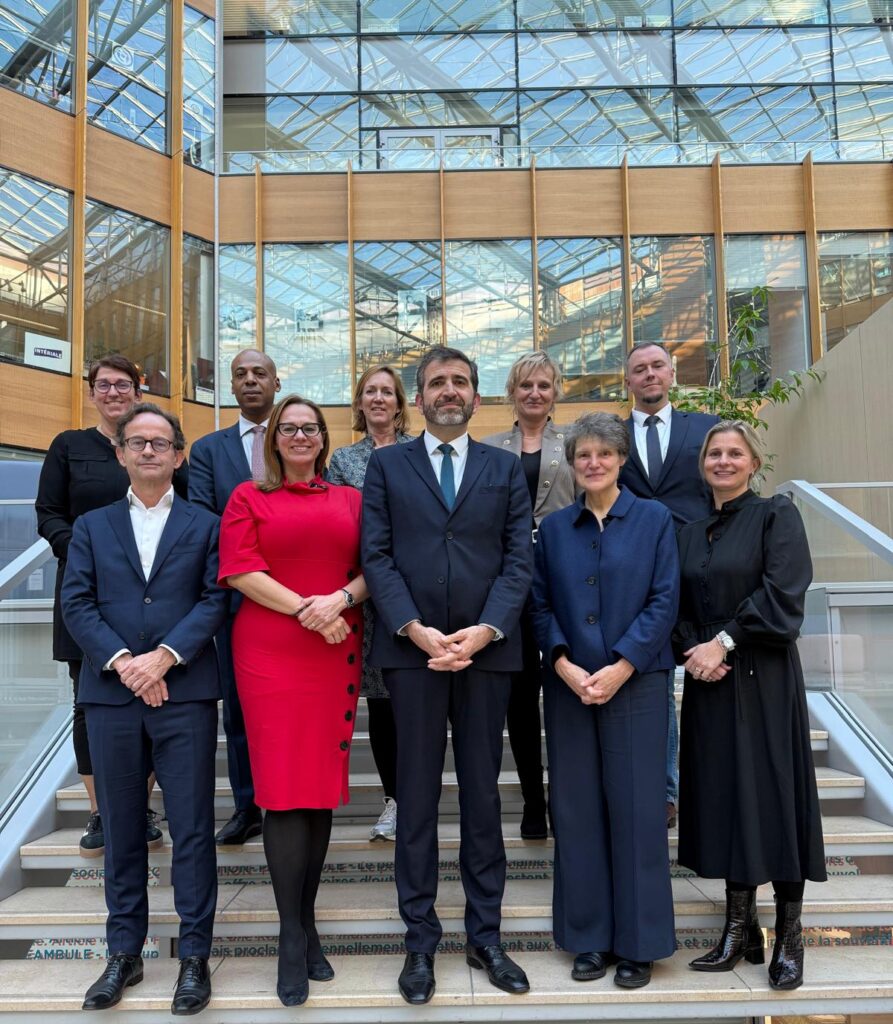
On 13 November 2026, the CEP Board visited its French member organisation, the Direction Générale de l’Administration Pénitentiaire of the French Ministry of Justice. The visit coincided with the final CEP Board meeting of the year, hosted by CEP Vice-President Mr Daniel Danglades, who represents the French institution.
Recap
Framework Decisions
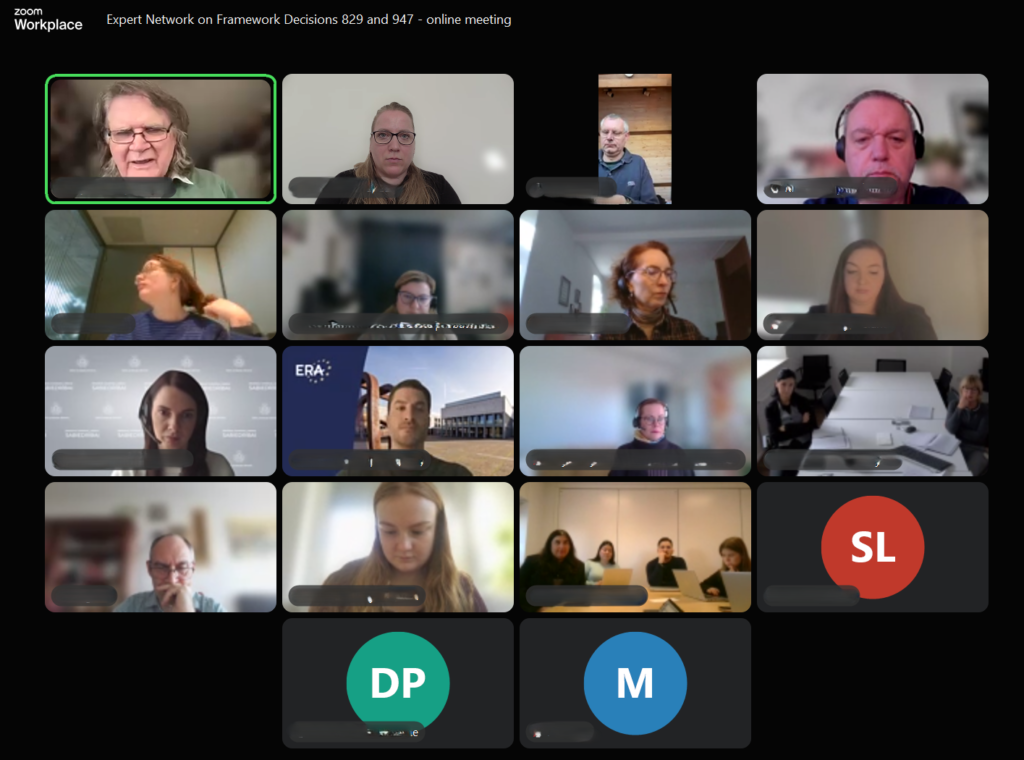
Recap: annual meeting of the Expert Network on Framework Decisions 829 and 947
09/11/2026
On Thursday 5 November an annual meeting of the Expert Network on Framework Decisions 829 and 947 took place online. Bringing together 20 participants from 12 EU jurisdictions including representatives of the Academy of European Law and European Judicial Network, the meeting provided an opportunity to exchange experiences, discuss current implementation challenges and identify priorities for enhancing cross-border cooperation in the application of the two Framework Decisions.
New
Education and Training, Probation in Europe
Justice programme: the judicial training call is open for applications!
09/11/2026
Are you ready to help address the training needs of justice professionals from different EU countries in the fields of civil law, criminal law and fundamental rights? This call supports cross-border training projects contributing to the effective and consistent application of EU law. In line with the new European Judicial Training Strategy, the call also supports the digitalisation of justice. Don’t miss this opportunity! Apply by 4 March 2027, 17:00 Brussels time.
Recap
CEP Board, Foreign Nationals in Prison and Probation, Probation in Europe
CEP at the 16th Plenary Meeting of the Council for Penological Co-operation
06/11/2026
From 3 to 5 November 2026, representatives of the Confederation of European Probation (CEP) participated in the 16th Plenary Meeting of the Council for Penological Co-operation (PC-CP).
New
CEP
Newsletter October 2026 out now
29/10/2026
CEP’s latest newsletter is out now! It includes:
- Deadline approaching for the Workshop on Technology and Alternatives to Detention
- Recap of the 14th EM and CEP Excellence Leadership Training
- New publications from Expert Groups on Technology and Expert Group on Violent Extremism
- Call for Proposals: Evaluation of CEP Expert Groups
- Engaging with Research – a new section in our newsletter
- and much more!
New
Violent Extremism
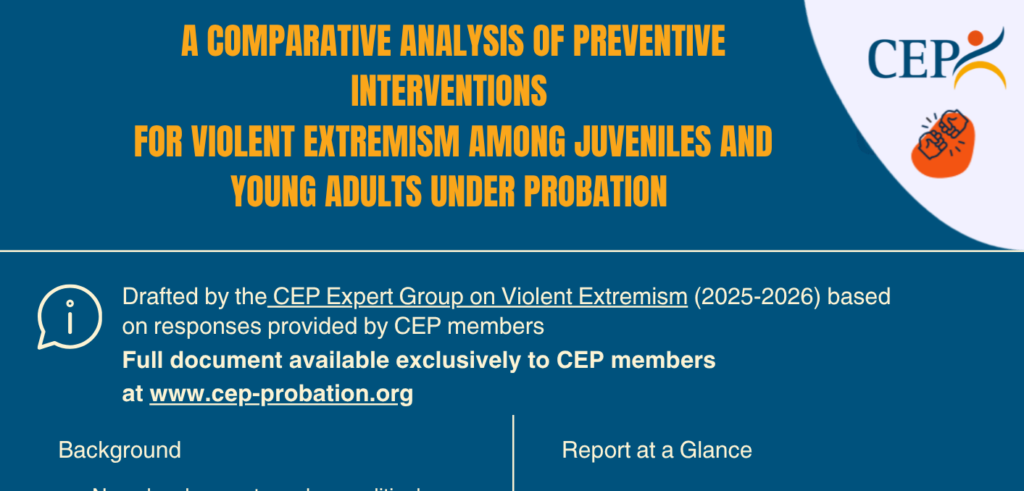
Understanding Youth Radicalisation: What Can Probation Services Do? | New Report from CEP’s Expert Group
27/10/2026
In recent decades, the violent radicalisation of juveniles and young adults has become a pressing concern for policymakers, researchers, practitioners, and communities worldwide. While considerable attention has been devoted to psychological vulnerabilities, socio-economic marginalisation, and community-level influences, the broader context in which violent radicalisation develops is often overlooked. At the same time, the increasing involvement of young people in violent extremist offences highlights the urgent need for effective prevention efforts. Addressing youth radicalisation has become a complex and evolving challenge for families, educators, mental health professionals, law enforcement agencies, probation services, and security authorities.
Subscribe to our bi-monthly email newsletter!
"*" indicates required fields
- Keep up to date with important probation developments and insights.