

Previous Article
News
Research on Improving Health Outcomes for People on Probation: A Narrative Systematic Review
CEP’s vision for probation in Europe is “to contribute to safer communities by rehabilitating and reintegrating offenders and providing the best possible interventions to reduce offending and the impact of crime”. If we are to achieve this ambition, it is important that we develop our understanding of how we can best address the complex health needs that people on probation often have.
This article is written by Dr Coral Sirdifield, and Professor Charlie Brooker.
As part of a wider research study, researchers from the University of Lincoln, and Royal Holloway, University of London, UK, conducted a systematic review of the literature to identify studies on the most effective ways of providing healthcare for adults on probation to achieve good health outcomes. Articles from this study, which present findings on mental health, suicide, and substance misuse respectively, are being submitted for publication. The first of these can be accessed on the website of Science Direct. A probation healthcare commissioning toolkit was also developed for this project.
The article presented here provides an overview of the entire systematic review, which encompassed a broad definition of health. The search, included nine databases, the grey literature, and hand-searching of key journals. Overall, we identified 45 research papers. Given the real world difficulties associated with conducting research on interventions with criminal justice populations, we did not assign low quality ratings to studies with small sample sizes. Nevertheless, we were only able to identify 33 papers that were rated as high quality, the majority (n=27) of which were about treatment for substance misuse. Given the high prevalence of mental illness and suicide in probation populations, it is disappointing that we were only able to include four research studies in our mental health paper, and one research study in our paper on suicide. Clearly probation practitioners are encountering people with mental illness and suicidal ideation on a daily basis, and practical guidance on how best to manage these issues and get people into treatment is sorely needed.
These studies point to potential value in particular forms of treatment, partnership working, appropriate location of services, specialist approved premises, and basing roles such as Health Trainers within criminal justice settings to improve engagement with treatment and achieve positive health outcomes. However, further research would be needed to establish the generalisability of findings from many studies. Heterogeneity within the identified studies makes it difficult to draw firm conclusions on what the most effective ways of improving health outcomes for adults on probation are. For example, whilst there is some evidence of positive outcomes from drug courts, there is also variation between the courts that have been studied in terms of the content of their programmes, their eligibility criteria, and their referral procedures.
Overall, our review highlights that internationally, there is a lack of research on this important topic. If we are serious about achieving the goal of rehabilitating and reintegrating offenders, then we need substantial investment in high quality research into their health needs, and how best to meet them.
We believe that the construction of a European probation research network is necessary and that health, especially mental health should be an initial priority for such a network. In particular, research is needed into ways of reducing suicide and self-harm amongst people on probation, and into ways of improving engagement with mental health services.
This article presents independent research funded by the National Institute for Health Research (NIHR) under its Research for Patient Benefit (RfPB) Programme (Grant Reference Number PB-PG-0815-20012). The views expressed are those of the author(s) and not necessarily those of the NIHR or the Department of Health and Social Care.

Related News
Keep up to date with the latest developments, stories, and updates on probation from across Europe and beyond. Find relevant news and insights shaping the field today.
New
Technology
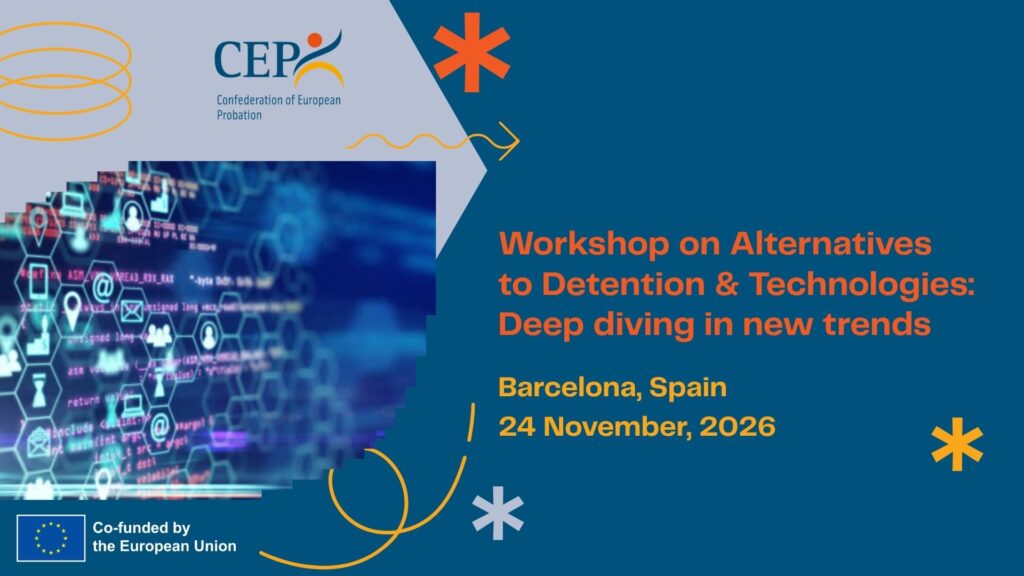
Registration deadline approaching: Join CEP’s final workshop of 2026 on technology in probation
22/10/2026
📢 Have you registered yet? CEP’s final workshop of 2026 takes place on 24 November in Barcelona, bringing together professionals to explore how technology is being used across probation services in Europe.
The Workshop on Alternatives to Detention and Technologies: Deep Diving into New Trends will look beyond artificial intelligence to examine the different ways technology is shaping probation practice, from staff training to working with clients and collaborating with other criminal justice partners.
Recap

Directors General Meetings
CEP Leadership Excellence Training: strengthening leadership and cooperation across Europe
22/10/2026
The CEP Leadership Excellence Training, held on 20–21 October in Zagreb, Croatia, brought together Directors General and senior probation managers from 11 European countries for a two-day interactive programme focused on leadership, communication, staff development, and international cooperation.
New

CEP
Call for Proposals: Evaluation of CEP Expert Groups
21/10/2026
On behalf of Ms. Jana Špero Kamenjarin, CEP Secretary General, it is my pleasure to invite you to submit a proposal to conduct an evaluation within the CEP work programme.
Recap

Uncategorized
CEP at UNODC: Contributing to the Development of Probation Services Worldwide
19/10/2026
The Confederation of European Probation (CEP) was represented by its Secretary General, Jana Špero Kamenjarin, at the Expert Group Meeting on the Establishment of Probation Services and Probation Practices, organised by the United Nations Office on Drugs and Crime (UNODC) and held at the Vienna International Centre (VIC) from 12 to 14 October 2026.
Recap

Electronic monitoring, Technology
14th Electronic Monitoring Conference, Electronic Monitoring in a Changing World – Perception vs Reality
08/10/2026
On 6-8 October 2026, Antalya hosted the 14th Electronic Monitoring Conference “Electronic Monitoring in a Changing World – Perception vs Reality”. More than 350 participants coming from 32 countries across Europe and worldwide representing probation services, Ministries of Justice, victims´ services, EM providers, researchers as well as local participants representing the Turkish Prison and Probation Service gathered to discuss how electronic monitoring (EM) is understood by all stakeholders involved including the victims and the public, and how these perceptions compare to the evidence and experiences of those affected. While the gap between perception and reality in electronic monitoring has been recognised for over a decade, the rapid expansion of EM into areas such as victim protection, high-risk supervision and digital innovation has brought new challenges and questions to the forefront.
Recap

ITSCCS
Core Correctional Skills in Digital Probation: highlights from the 6th ITSCCS in Barcelona
05/10/2026
The sixth International Training School on Core Correctional Skills (ITSCCS) took place in Barcelona from 28 September to 2 October 2026, bringing together 26 participants for a week of learning, practical training and international exchange. Organised by the Confederation of European Probation (CEP) and the Centre for Legal Studies and Specialised Training (CEJFE), the programme focused on “Clicks and Empathy: Core Correctional Skills in Digital Probation.”
Subscribe to our bi-monthly email newsletter!
"*" indicates required fields
- Keep up to date with important probation developments and insights.