

Skip to content

News

Public opinion research on probation in Czech Republic

In the Czech Republic, before the onset of the Covid-19 pandemic, a public opinion survey was carried out on attitudes and opinions about probation and the possibilities of using it in working with offenders. It was carried out on a representative sample of the population over 15 years of age.

Public opinion research: the majority of Czech citizens consider probation to be an appropriate way of dealing with offenders

written by Jan Tomasek (researcher at the Czech Research Institute)

In the Czech Republic, before the onset of the Covid-19 pandemic, a public opinion survey was carried out on attitudes and opinions about probation and the possibilities of using it in working with offenders. It was carried out on a representative sample of the population over 15 years of age.

The results

The results can be considered broadly favourable. Only 17% of the respondents considered probation to be a fundamentally inappropriate way of treating offenders, all others considered it to be an acceptable alternative to imprisonment. However, opinions on the suitability of probation vary according to the type of offender. While the majority of the public (80%) would find it suitable for juveniles, this is only 42% for offenders who avoid employment long‑term, 35% for alcohol or drug addicts, 15% for offenders who had failed probation in the past and just 11% for recidivists.

Moreover, it cannot be overlooked that the public would set strict rules for probationary period. In a situation where they had to decide, as judges, on the conversion of probation into a prison sentence, most respondents (64%) would only forgive the client one unexcused missed meeting at the PMS centre; in all other cases included on our questionnaire, they would end the probationary period. For example, only 13% would not send a client to prison if he/she did not repay the damage caused by his/her crime, and 15% if he/she used drugs or lied to a probation officer about important matters.

The benefits

Some of the questions also focused on the potential contribution of probation to criminal policy. Optimism was most often directed at the chance this measure would bring economic benefits to the state (two‑thirds of respondents believed this). According to 56% of respondents, probation would increase the chances of victims getting compensation from the offender, 43% believed in the rehabilitation effect of probation on the offender and 33% believed in its effect on the overall reduction of crime.

2008 vs 2022

It turned out that the awareness of citizens about the existence of the Probation and Mediation Service has improved compared to the earlier research. In 2008, only 8% of the public had a clear idea of its activities, while 73% did not know the organisation at all (the rest of the respondents only had a vague idea). At present, 22% of the public knows the Service, at least 35% have heard about it and 43% have no idea of its existence.

The research publication, which includes a summary in English, can be obtained here.

In addition, the research data was also used in an article recently published in the European Journal of Probation.




Related News

Keep up to date with the latest developments, stories, and updates on probation from across Europe and beyond. Find relevant news and insights shaping the field today.

Recap

Electronic monitoring, Technology

14th Electronic Monitoring Conference, Electronic Monitoring in a Changing World – Perception vs Reality

08/10/2026

On 6-8 October 2026, Antalya hosted the 14th Electronic Monitoring Conference “Electronic Monitoring in a Changing World – Perception vs Reality”. More than 350 participants coming from 30 countries across Europe and worldwide representing probation services, Ministries of Justice, victims´ services, EM providers, researchers as well as local participants representing the Turkish Prison and Probation Service gathered to discuss how electronic monitoring (EM) is understood by all stakeholders involved including the victims and the public, and how these perceptions compare to the evidence and experiences of those affected. While the gap between perception and reality in electronic monitoring has been recognised for over a decade, the rapid expansion of EM into areas such as victim protection, high-risk supervision and digital innovation has brought new challenges and questions to the forefront.

Recap

ITSCCS

Core Correctional Skills in Digital Probation: highlights from the 6th ITSCCS in Barcelona

05/10/2026

The sixth International Training School on Core Correctional Skills (ITSCCS) took place in Barcelona from 28 September to 2 October 2026, bringing together 26 participants for a week of learning, practical training and international exchange. Organised by the Confederation of European Probation (CEP) and the Centre for Legal Studies and Specialised Training (CEJFE), the programme focused on “Clicks and Empathy: Core Correctional Skills in Digital Probation.”

Recap

Framework Decisions

Recap: ERA workshop on Framework Decisions 829 and 947 in Bucharest

02/10/2026

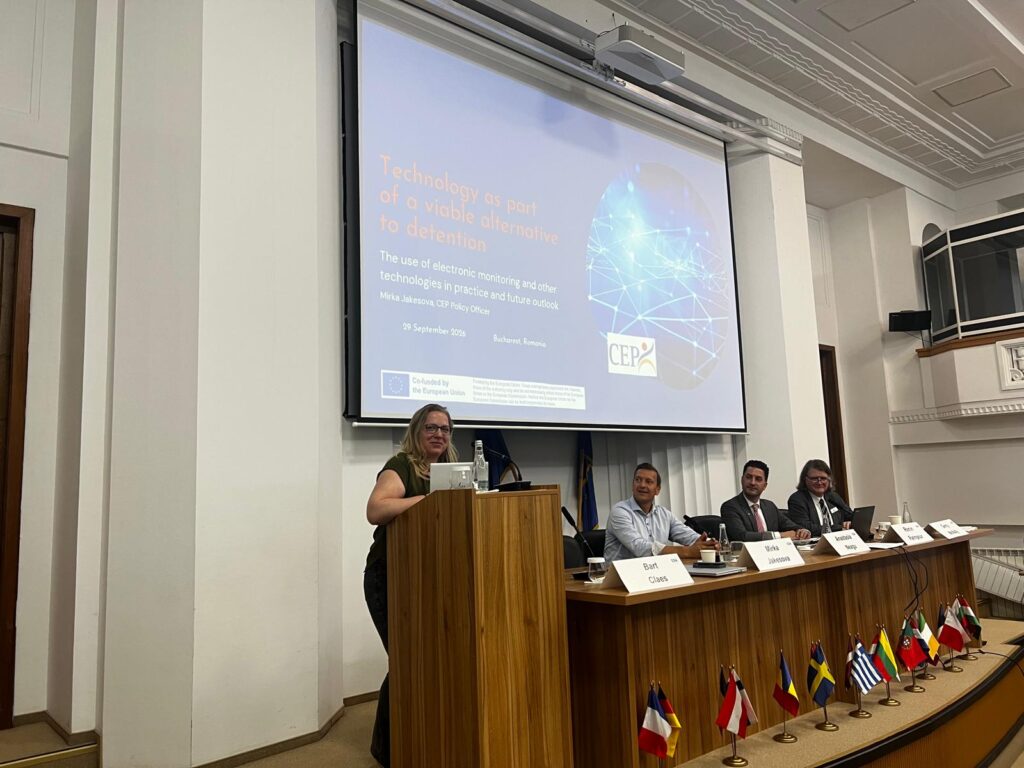
CEP Vice-President Daniel Danglades, Ambassador Gerry McNally and Policy Officer Mirka Jakesova participated in the Seminar on Framework Decisions 829 and 947 and their Impact on Alternatives in the EU organized under the EU project run by the Academy of European Law on 28-29 September in Bucharest, Romania. The seminar brought together judges, prosecutors, probation practitioners, academics, and policy experts to discuss the growing role of alternatives to detention within European criminal justice systems. 

New

CEP

CEP and Catalan justice leaders reaffirm longstanding cooperation

29/09/2026

Representatives of the Confederation of European Probation (CEP) met with senior officials from the Catalan Department of Justice and Democratic Quality in Barcelona on 28 September 2026, alongside the opening of the sixth International Training School on Core Correctional Skills. The meeting offered an opportunity to recognise a longstanding partnership and discuss its continued development.

Updated

Mental Health

DEADLINE EXTENDED: Call for Pilot Implementation of the European Mental Health Training Curriculum

29/09/2026

Good news for CEP members! Following requests from our members, CEP has extended the deadline to apply for the pilot implementation of the European Mental Health Training Curriculum for Probation Officers.

Recap

ITSCCS, Technology

6th International Training School opens in Barcelona with a focus on digital probation

28/09/2026

How can probation professionals use new technologies in their interactions while building trust, showing empathy and supporting change? This question is at the heart of the sixth International Training School on Core Correctional Skills, which opened in Barcelona on 28 September 2026.

Subscribe to our bi-monthly email newsletter!