

Previous Article
News
Personal story of Magdalena: ”How I Almost Lost Myself in the Justice System Maze”
Hi, everyone. I am so pleased to be here today with you. I will try to tell you the story of my life, or better to say, how I almost lost my myself trying to have a normal life, first of a child, and then of a young girl.
My name is Magdalena. I am 20 years old, and I am from Serbia, a lovely place but with some injustice. That is why I decided to study law once I finished Grammar school. Now, I am at the second year of the Law Faculty. I am an active member of the Child Advisory Board established by the Child Rights Centre from Serbia, within the regional project FOCUS on my needs: Working together for children in criminal proceedings, which is implemented in the partnership with other European partners and coordinated by Terre des hommes Regional Office in Hungary.
Let me try lead you through the maze of my life.
So, first it started when I was a little girl. It was my first contact with justice system. My parents separated. My struggle started. I remember going from one social worker to another and kept answering their questions. A zillion of them! It was very exhausting. And very frustrating at the same time. They were focused on my parents’ story. I was thinking…and what about me, is there my story, or I am just a witness of my parents’ story. No one asked me how I felt.
When they finished their story, we went to the court. Yet another place of frustration! Still no one thinking about my feelings, my fears, my story. I felt so uncomfortable, scared, alone and lost. The judge decided that I should stay with my mother and live with her. And that I can see my father only at weekends which was a hard time for me.
I changed… Everything changed… My behaviour changed because of the situation and I was punished in the Grammar School for the things I did and the thing was that I acted like a bad child but no psychologist worked with me and I had to be alone with that and marked as a child with the bad behaviour. You can imagine how I felt.
It was just the beginning of my bad feelings and my loneliness in this struggle through the maze.
Once my dad and I were travelling to Austria. But at the Hungarian border, he was arrested for unpaid fine. And, again the same scenario, just other actors. This time police officers. They didn’t care about me, and I was just 13. My dad and I were 10 hours without food and water, because the focus again was on what my dad did, on his story, and I almost ended up in a place for homeless kids in Hungary. I was terrified. It was very traumatising. They didn’t call my mother. I again felt lost.
Teenage period was very difficult. Now I can see it better. Back in those days I just felt alone, scared, even angry and lost. When I was a teenager, it happened that I stole something from a store. It was a small thing and they said it was a little crime. I had a very uncomfortable situation at the store. The police officers were treating me very bad. They yelled at me and took me to the police station like the biggest criminal, and I was 17 and I didn’t know what I was doing. They took me to the police station, and they didn’t call my mother. I felt very uncomfortable sitting there with old people who did some crime and they’re yelling at me 4 hours. They were not acting professionally. They were angry with me, they sent me by Court to institution for teenagers who had problem with law where I was supposed to go occasionally.
Only there I met some psychologists who tried to help me. There were two professional psychologists who worked hard with me. And they did it. They helped me change my behaviour, they helped me deal with my trauma. A social worker was very nice to me and she worked so hard that I got through that traumatic maze of my life in the best possible way. As I finished my visits there, I stayed there for 2 years. My friends and I made a formal association to help kids like we were. I still go there and they still help me and talk to me and work with me even on those stuff that happened years ago.
One day, I will be a lawyer. One day there will be children whose parents will be separating. One day, I promise, no one will be suffering for my lack of understanding, for my lack of professionalism, for my negligence.
Thank you all!

Related News
Keep up to date with the latest developments, stories, and updates on probation from across Europe and beyond. Find relevant news and insights shaping the field today.
New

CEP
Newsletter October 2026 out now
29/10/2026
CEP’s latest newsletter is out now! It includes:
- Deadline approaching for the Workshop on Technology and Alternatives to Detention
- Recap of the 14th EM and CEP Excellence Leadership Training
- New publications from Expert Groups on Technology and Expert Group on Violent Extremism
- Call for Proposals: Evaluation of CEP Expert Groups
- Engaging with Research – a new section in our newsletter
- and much more!
New
Violent Extremism
Understanding Youth Radicalisation: What Can Probation Services Do? | New Report from CEP’s Expert Group
27/10/2026
In recent decades, the violent radicalisation of juveniles and young adults has become a pressing concern for policymakers, researchers, practitioners, and communities worldwide. While considerable attention has been devoted to psychological vulnerabilities, socio-economic marginalisation, and community-level influences, the broader context in which violent radicalisation develops is often overlooked. At the same time, the increasing involvement of young people in violent extremist offences highlights the urgent need for effective prevention efforts. Addressing youth radicalisation has become a complex and evolving challenge for families, educators, mental health professionals, law enforcement agencies, probation services, and security authorities.
Recap

Probation in Europe
Reflections on the European Society of Criminology Conference 2026 | From Criminological Research to Probation Practice
26/10/2026
At CEP, we are fascinated by research from across Europe and beyond, and by helping it reach the people who can use it. Ruth Armstrong, CEP Research and Policy Officer, went to the 26th Annual Conference of the European Society of Criminology (EuroCrim 2026 – Working Group on Community Sanctions and Measures) that took place in Warsaw, Poland, from 9–12 September 2026.
Against a backdrop of overcrowded prisons and net-widening (with ever more people drawn into supervision), three questions kept coming up in the research: how time shapes justice, what we mean by success, and how we define harm.
New
Technology
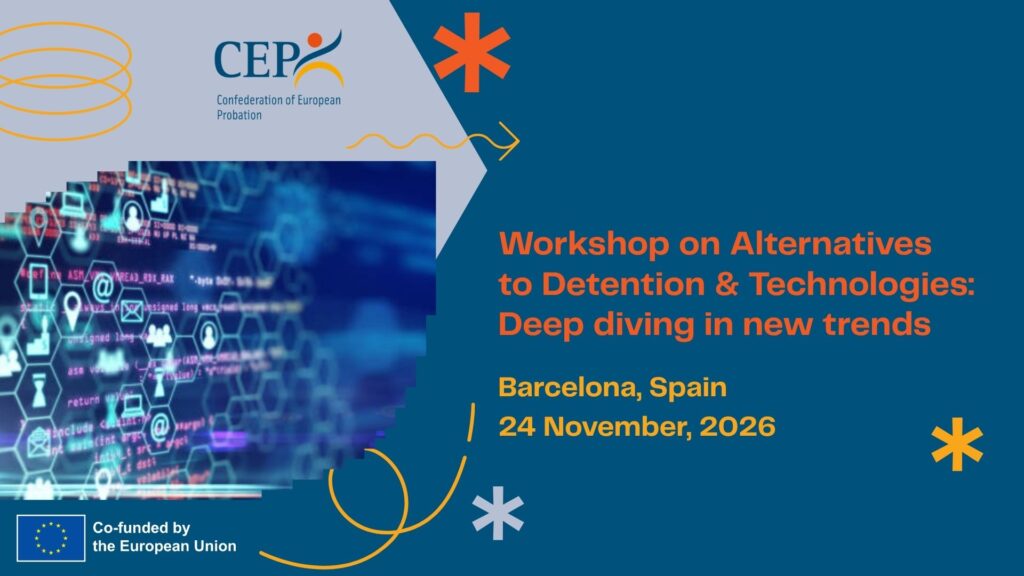
Registration deadline approaching: Join CEP’s final workshop of 2026 on technology in probation
22/10/2026
📢 Have you registered yet? CEP’s final workshop of 2026 takes place on 24 November in Barcelona, bringing together professionals to explore how technology is being used across probation services in Europe.
The Workshop on Alternatives to Detention and Technologies: Deep Diving into New Trends will look beyond artificial intelligence to examine the different ways technology is shaping probation practice, from staff training to working with clients and collaborating with other criminal justice partners.
Recap
Directors General Meetings
CEP Leadership Excellence Training: strengthening leadership and cooperation across Europe
22/10/2026
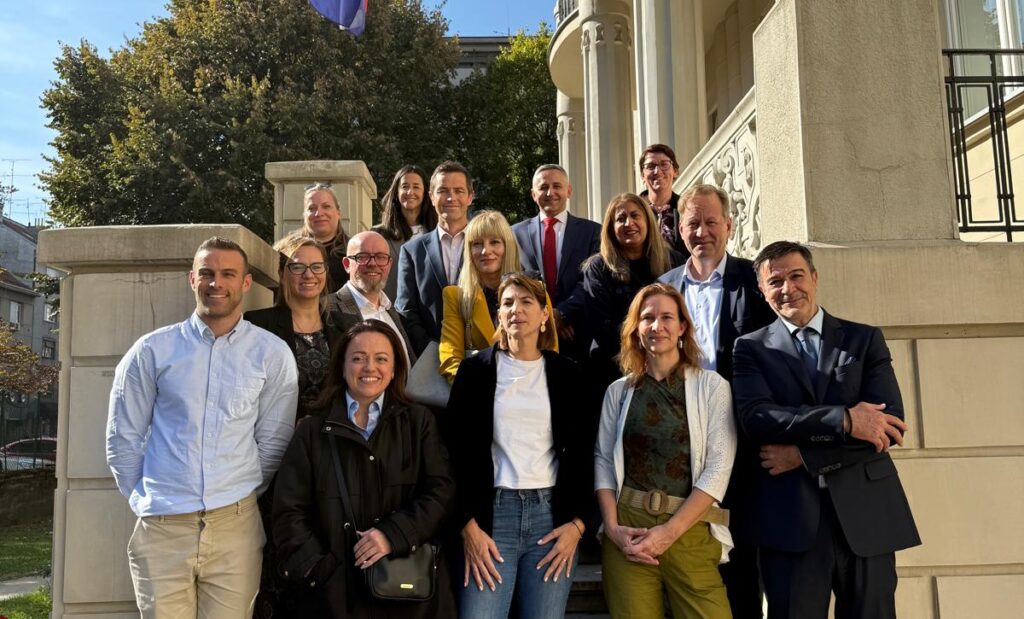
The CEP Leadership Excellence Training, held on 20–21 October in Zagreb, Croatia, brought together Directors General and senior probation managers from 11 European countries for a two-day interactive programme focused on leadership, communication, staff development, and international cooperation.
New

CEP
Call for Proposals: Evaluation of CEP Expert Groups
21/10/2026
On behalf of Ms. Jana Špero Kamenjarin, CEP Secretary General, it is my pleasure to invite you to submit a proposal to conduct an evaluation within the CEP work programme.
Subscribe to our bi-monthly email newsletter!
"*" indicates required fields
- Keep up to date with important probation developments and insights.