Skip to content

News

Finnish and Chinese probation services continue to cooperate to improve community sanctions

Finland and China, two completely different countries, with different cultures and criminal justice systems. Despite all these differences, the cooperation between their probation services goes back 22 years. The Finnish Criminal Sanctions Agency was one of the first European probation organisations that started working together with the Chinese probation service. After all those years, the connection between them is still very strong. The Finnish and Chinese probation services recently started a four year project for the improvement of community sanctions in the countries.


Every 4 years Finland and China make a new action plan that is concentrated on a certain theme. This time their plan focusses on community sanctions. Virva Ojanperä, Head of International Affairs at the Finnish Criminal Sanctions Agency, explains that they organise different seminars together with the Chinese probation service. “In September 2017, we held an introductory seminar in Helsinki, in February we arrange a development seminar in Xiamen and we draft common recommendations on the theme. There will also be a seminar on ministerial level, were we make an assessment on the results that are achieved. In addition to that, we have quite a lot of visitors from China yearly.”

Community sanctions

For a long time China did not have community sanctions, but in 2009 they were introduced in a few pilot provinces. In 2014 they were implemented in the entire country. “The idea of belonging to a community is very strong in the Chinese culture, community sanctions can play an important role here. But the public acceptance of community sanctions is still very low in China. The sanctions are considered to be too mild by the society.” According to Virva Ojanperä, China is eager to look at examples abroad and in some way Finland deals with the same challenges as China does.

Approximately 3.5 million people have served community sanctions in China in the past years. However, a law still has to be issued. This also is an important part of the cooperation project: “One theme in our seminars is the introduction of good practices and experiences from Finland that can be used to promote good legislation in China”, says Ojanperä.

The Finnish vs. the Chinese system

The probation systems and the way they handle community sanctions in the two countries are very different from each other. “An important difference is that in China they are more focused on arranging training, education and work in groups and not only public officials are responsible for the execution of community sanctions, but the whole society is involved.” In Finland it works completely different. Only public officials are responsible for managing the execution of community sanctions.

Another difference is the place were the community sanctions are carried out. In China they have special centres were the offenders carry out their community sanction. “They remind us of the Finnish open prisons, but they are only open during the day. The sentenced people are obligated to go there as scheduled, for instance twice a month for eight hours. The activities can vary from production work to law studies and everything in between.”

Virva Ojanperä says that despite the differences they have a good consensus in the way they cooperate. “We often also see many similarities or common challenges that we need to discuss. These discussions are always very lively.” She explains that as long as both countries respect each others way of working, cooperation is not that difficult.

Other countries

China is one of the two countries outside Europe that the Finnish Criminal Sanctions Agency regularly cooperates with. Another important partner is the Russian probation service. “We think it is important to continue the professional dialogue with them. We share the same commitments, we try to make changes in the lives of offenders. We are often confronted with the same kind of challenges, for example promoting milder punishment, like community sanctions.” Other matters, for example politics, are not discussed.

 

Related News

Keep up to date with the latest developments, stories, and updates on probation from across Europe and beyond. Find relevant news and insights shaping the field today.

New

Probation in Europe

New Vodcast Episode: Anke Spoorendonk on the Role of Probation in Justice Policy

21/05/2026

The 20th episode of Division_Y features Anke Spoorendonk, former State Minister of Justice in Schleswig-Holstein, Germany, representing the Danish minority party SSW.

New

Mental Health

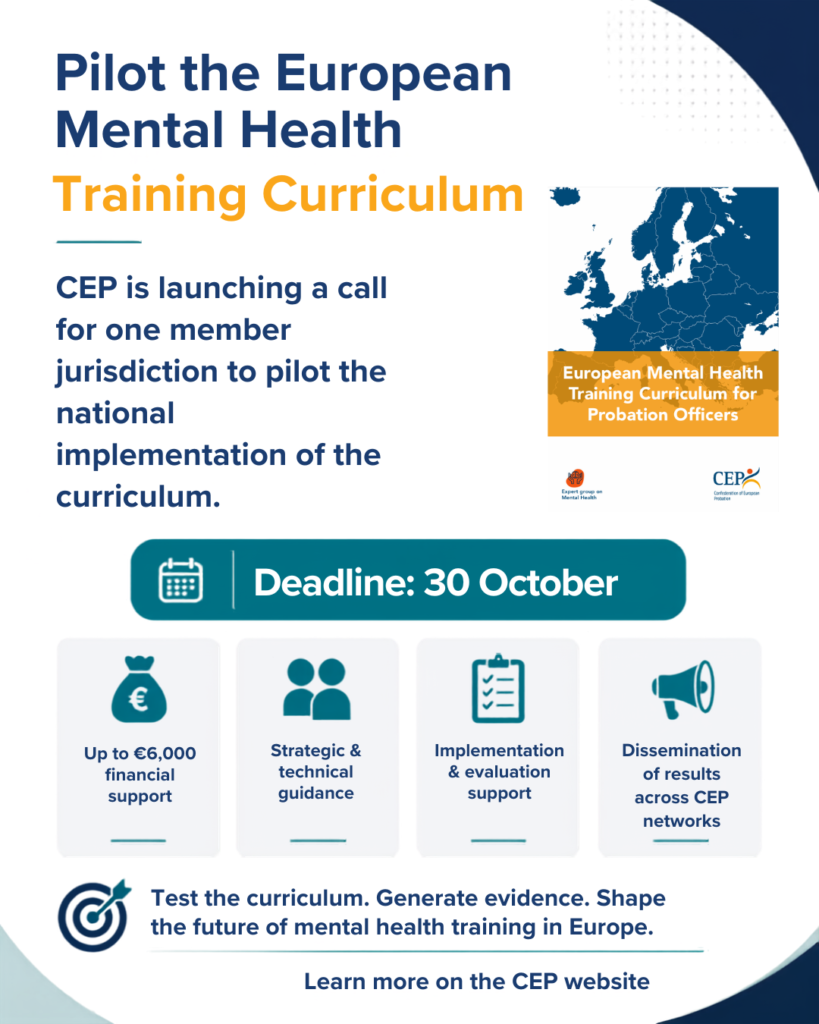
CEP publishes European Mental Health Training Curriculum for Probation Staff and launches Pilot Implementation Initiative

19/05/2026

In this article, you can explore the newly published European Mental Health Training Curriculum for Probation Officers, learn about the call for a national pilot implementation, and find details about the upcoming webinar on 21 May presenting the curriculum modules.

New

Mental Health

European Mental Health Week: strengthening probation practice through mental health

13/05/2026

This week, during Mental Health Awareness Week, the Confederation of European Probation is highlighting the importance of mental health in probation practice across Europe.

New
screenshot website krimdock

Probation in Europe, Research

Free Research Resource: KrimDok

12/05/2026

Looking for reliable criminological literature? KrimDok is a free online database developed by the University of Tübingen and supported by the German Research Foundation (DFG).

The database contains nearly 400,000 references to books, journal articles, reports, and other publications covering criminology and related fields such as criminal justice, psychology, sociology, education, and law. It draws on a specialist criminology library established in 1969, with a collection of around 150,000 titles, and includes indexed articles from more than 200 academic journals.

Reading corner

Violent Extremism

New newsletter available: EU Knowledge Hub on Prevention of Radicalisation

11/05/2026

The latest edition of the EU Knowledge Hub newsletter brings together policy, research, and practice to address evolving radicalisation threats across Europe.

New

Gender-based violence

New European Master’s Programme on Perpetrator Intervention Launched

07/05/2026

The European Network for the Work with Perpetrators of Domestic Violence (WWP EN), in collaboration with Blanquerna – Universitat Ramon Llull (Barcelona), has launched a pioneering new programme:
Lifelong Learning Master’s Degree in Intervention Strategies with Perpetrators of Gender-Based Violence: Social, Clinical, and Legal Perspectives
This initiative represents the first international lifelong learning Master’s programme specifically focused on perpetrator intervention, offering a unique opportunity for professionals working to address and prevent gender-based violence across Europe and beyond.

Subscribe to our bi-monthly email newsletter!