
Skip to content

News

A trilateral agreement for further cooperation in the field of probation among the Baltic States

On 3rd August in Vilnius, Lithuania Mrs. Živilė Mikėnaitė (Director of Prison Department of the Ministry of Justice of Lithuania), Mr. Mihails Papsujevičs (Head of State Probation Service of Latvia), and Mr. Pritt Kama (Secretary General of the Prison Department of the Ministry of Justice of Estonia) signed a trilateral agreement to further cooperation in the field of probation among the Baltic States.  The event was attended by the Minister of Justice of Lithuania, Mr. Juozas Bernatonis, and representatives from Latvian and Estonian embassies in Lithuania.

The agreement foresees a closer cooperation among the Baltic countries in the fields of dissemination of research results, sharing of practical experience, as each county have their unique success stories. The agreement also envisages sharing of experience in career and staff matters, as well as organising joint conferences and seminars, which would contribute to the development of probation systems of each country.

“I am confident that this is a necessary cooperation platform, which could show first good results by contributing to an effective development of probation systems in each country. Already on 4th August the first Baltic conference on probation matters took place in Panevezys, Lithuania. During the conference all three Baltic countries presented their probation systems, discussed the similarities and differences, the best practices in each of the countries were discussed.” Mihails Papsujevičs (Head of State Probation Service of Latvia).


Related News

Keep up to date with the latest developments, stories, and updates on probation from across Europe and beyond. Find relevant news and insights shaping the field today.

New

CEP Board

CEP board visit France

16/11/2026

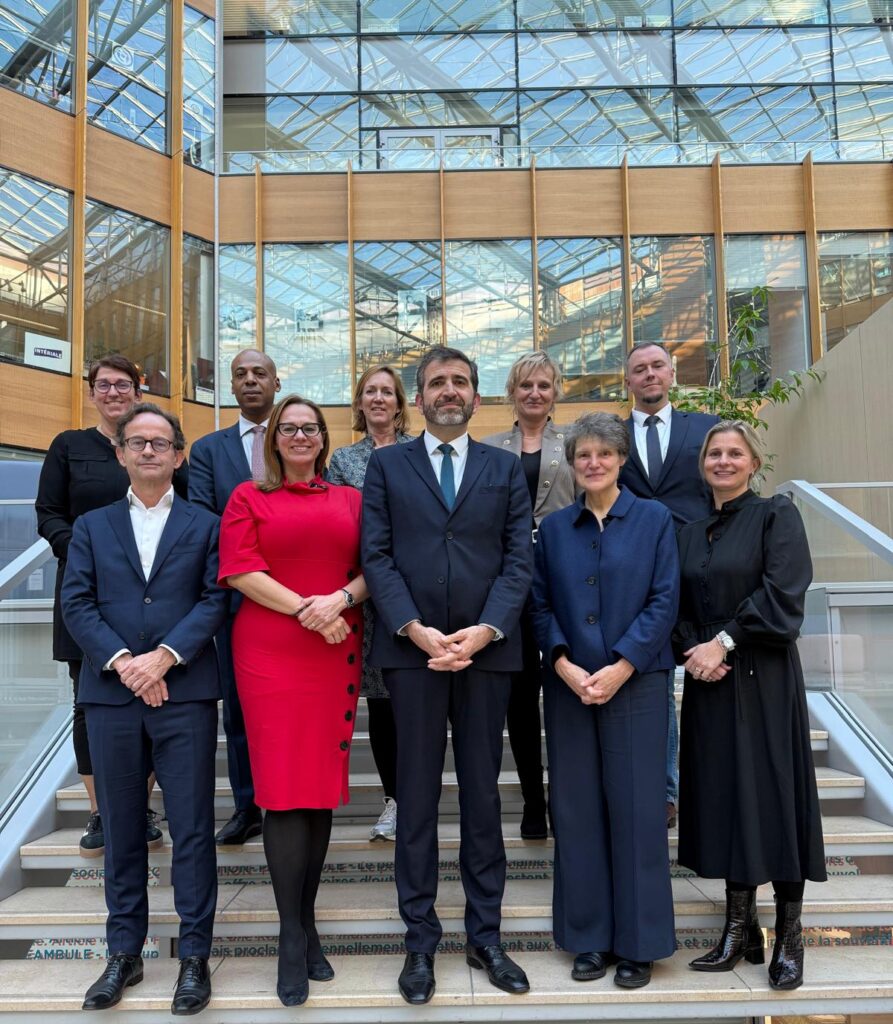
On 13 November 2026, the CEP Board visited its French member organisation, the Direction Générale de l’Administration Pénitentiaire of the French Ministry of Justice. The visit coincided with the final CEP Board meeting of the year, hosted by CEP Vice-President Mr Daniel Danglades, who represents the French institution.

Recap

Framework Decisions

Recap: annual meeting of the Expert Network on Framework Decisions 829 and 947

09/11/2026

On Thursday 5 November an annual meeting of the Expert Network on Framework Decisions 829 and 947 took place online. Bringing together 20 participants from 12 EU jurisdictions including representatives of the Academy of European Law and European Judicial Network, the meeting provided an opportunity to exchange experiences, discuss current implementation challenges and identify priorities for enhancing cross-border cooperation in the application of the two Framework Decisions. 

New

Education and Training, Probation in Europe

Justice programme: the judicial training call is open for applications!

09/11/2026

Are you ready to help address the training needs of justice professionals from different EU countries in the fields of civil law, criminal law and fundamental rights? This call supports cross-border training projects contributing to the effective and consistent application of EU law. In line with the new European Judicial Training Strategy, the call also supports the digitalisation of justice. Don’t miss this opportunity! Apply by 4 March 2027, 17:00 Brussels time.

More info


Recap

CEP Board, Foreign Nationals in Prison and Probation, Probation in Europe

CEP at the 16th Plenary Meeting of the Council for Penological Co-operation

06/11/2026

From 3 to 5 November 2026, representatives of the Confederation of European Probation (CEP) participated in the 16th Plenary Meeting of the Council for Penological Co-operation (PC-CP).

New

CEP

Newsletter October 2026 out now

29/10/2026

New

Violent Extremism

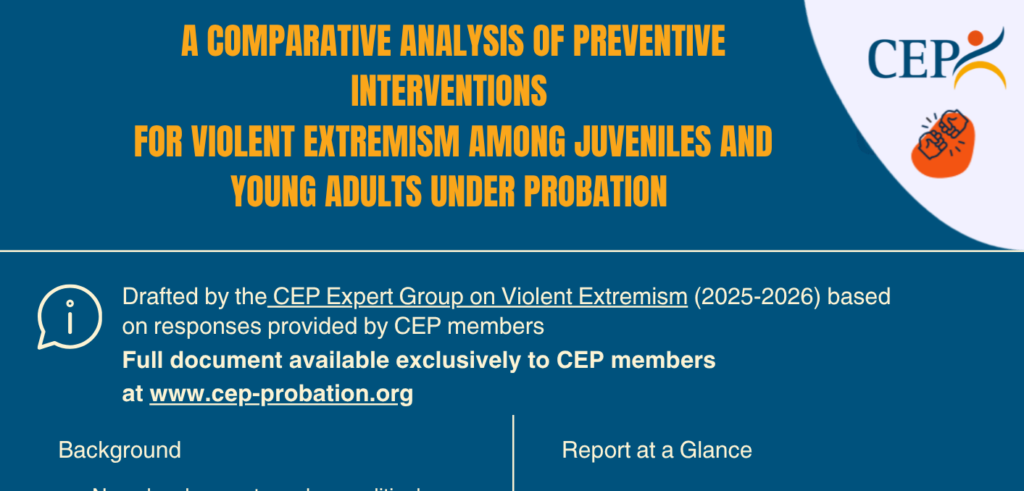
Understanding Youth Radicalisation: What Can Probation Services Do? | New Report from CEP’s Expert Group

27/10/2026

In recent decades, the violent radicalisation of juveniles and young adults has become a pressing concern for policymakers, researchers, practitioners, and communities worldwide. While considerable attention has been devoted to psychological vulnerabilities, socio-economic marginalisation, and community-level influences, the broader context in which violent radicalisation develops is often overlooked. At the same time, the increasing involvement of young people in violent extremist offences highlights the urgent need for effective prevention efforts. Addressing youth radicalisation has become a complex and evolving challenge for families, educators, mental health professionals, law enforcement agencies, probation services, and security authorities.

Subscribe to our bi-monthly email newsletter!