

Previous Article
News
Reflections on the European Soceity of Criminology Conference 2026 | From Criminological Research to Probation Practice
In CEP we are fascinated to learn from research across Europe and beyond and help it reach the people who can use it. So, in Warsaw I spent most of my time with the ESC’s Working Group on Community Sanctions and Measures. Against a backdrop of overcrowded prisons and net-widening (ever more people drawn into supervision), three questions kept coming up in the research: how time shapes justice, what we mean by success, and how we define harm.
Time is not a neutral backdrop
Helen Kosc studied the move from prison to the community in England and Wales and found that how people experience time was central. Many felt ‘whiplash’ going from the slow wait of prison to a rush of appointments in the first 24 hours after release. As one participant put it, “you feel like you’re late for your own release.” Victoria Rambaud’s work in Belgium adds that imprisonment can weaken self-control: both stopping what we don’t want to do and starting what we do. For practitioners, recognising reduced capacity for self-control and how much time warps in the first days post release can matter: how we pace early requirements may decide whether someone starts supervision with hope or with a sense of failure.
Rethinking success
Justin Tetrault spoke about Indigenous people leaving prison in Canada. Strong community belonging underpinned high wellbeing despite ‘material disadvantage’, yet barely registered in standard assessments. His findings asked might success lie in community connections, beyond institutional priorities and if so, how might probation strengthen the community ties people already have, rather than pulling them towards compliance with institutional priorities?
In Spain, Meritxell Pérez Ramírez studied Circles of Support and Accountability, where support is deliberately reduced halfway through the programme to encourage independence. Counter-intuitively, she found those with the most contact in the first six months were the least likely to complete the programme, and more likely to return to prison, though not for new offences. Her findings could suggest a need for ongoing support even as probation requirements or programme supports draw to an end. The Grand Avenues pilot in Wales, where support continues after a sentence ends, offers a different example for pracitioners, and its approach fits with Alejandro Rubio Arnal’s suggestion that the real goal of reintegration may be membership, not independence.
The stories behind the numbers
Probation numbers often reflect socio-legal decisions about what counts as harm, not just how much crime there is. In Finland, Aaro Beuker showed that a fall in community sanctions was largely due to a change in how drink driving is sentenced. In Slovakia, Jakub Jan Ferenčák showed that supervision rates only make sense alongside studying legal change. And in wartime Ukraine, Rita Haverkamp and Dmytro Yagunov reported that 80% of the huge rise in people convicted of crimes against national security are on probation, simply because there are too many to imprison.
Our ideas about what counts as harm and what counts as reform have deep roots too. The RaRiE team used exploration of ancient plays and folklore to show why our thinking still focus on individual vice and self-mastery grounded in the logigs of the reformation and (my addition) a less communal orientation to justice that also coincided with the rise of a new form of patriarchy. Our current justice systems are often highlighted as failing women, but arguably the underpinning versions of harm and reform are not serving men or women well. The stories behind the numbers seem to suggest that reducing overcrowding may need not only a change in laws, but a change in logics.
Trust as the thread for practice
The presentation of the SPACE II statistics, by Edoardo Cocco from Marcelo Aebi’s team, showed current trends in the map of probation across Europe, but as Professor Aebi cautioned, numbers only tell part of the story. Putting flesh on the numbers, Jennifer Doekhie found that in the Netherlands, completing an order relates to how officers use their discretion when responding to breaches, supported by clear law, a strong working relationship and access to the right care. The Netherlands also scored highly on Ioan Durnescu’s measures of ‘organisational care’, which go hand in hand with staff wellbeing. Trusting staff seems good for them and for the people they supervise. And Louise Kennefick and Deirdre Healy’s work which traced a ‘probation imaginary’ in Ireland suggests that how you shape probation culture is really important to shared, often unspoken ideas about what probation is for among staff, and this can be more important for practice than official policy.
From research to practice
Across these studies, approaches to time, definitions of success and responses to harm are not fixed: they are choices we can make differently. CEP is looking forward to ESC 2027 in North Macedonia, and hopefully to even more research presentations that showcase academics working with practitioners and people with lived experience, as highlighted in the presentation by the North Macedonain team describing their implementation of probation practice and Stephanie Fanfan’s work using photography with women in France and French Guiana.
by Dr Ruth Armstrong, Research and Policy Officer

Related News
Keep up to date with the latest developments, stories, and updates on probation from across Europe and beyond. Find relevant news and insights shaping the field today.
New
Violent Extremism
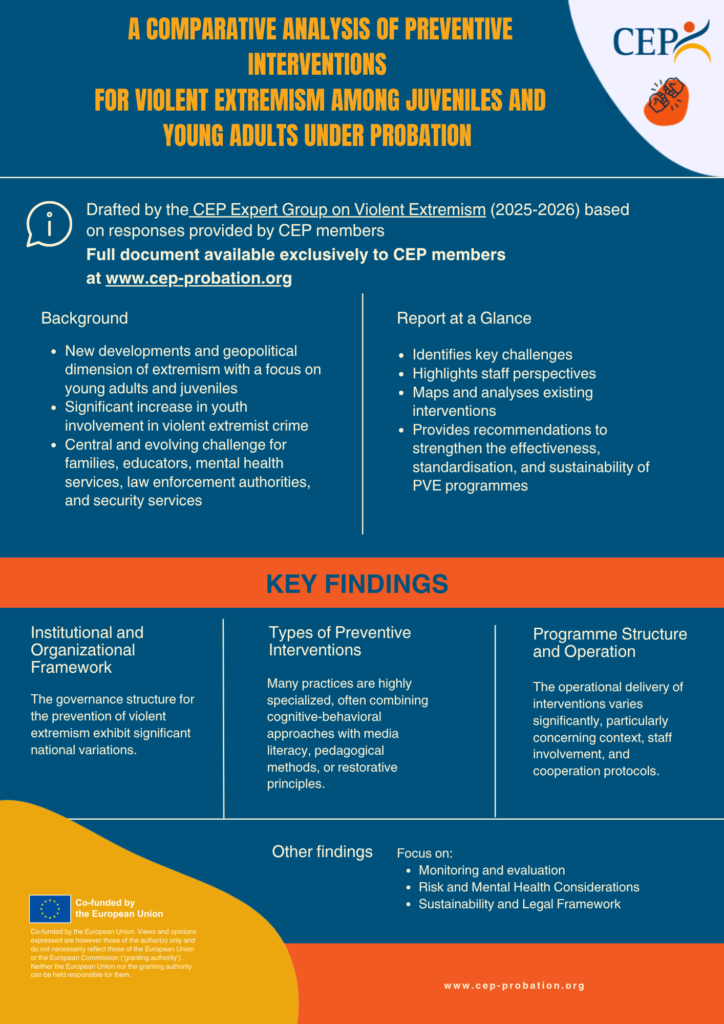
Understanding Youth Radicalisation: What Can Probation Services Do? | New Report from CEP’s Expert Group
27/10/2026
In recent decades, the violent radicalisation of juveniles and young adults has become a pressing concern for policymakers, researchers, practitioners, and communities worldwide. While considerable attention has been devoted to psychological vulnerabilities, socio-economic marginalisation, and community-level influences, the broader context in which violent radicalisation develops is often overlooked. At the same time, the increasing involvement of young people in violent extremist offences highlights the urgent need for effective prevention efforts. Addressing youth radicalisation has become a complex and evolving challenge for families, educators, mental health professionals, law enforcement agencies, probation services, and security authorities.
Recap

Probation in Europe
Reflections on the European Soceity of Criminology Conference 2026 | From Criminological Research to Probation Practice
26/10/2026
In CEP we are fascinated to learn from research across Europe and beyond and help it reach the people who can use it. So, in Warsaw I spent most of my time with the ESC’s Working Group on Community Sanctions and Measures. Against a backdrop of overcrowded prisons and net-widening (ever more people drawn into supervision), three questions kept coming up in the research: how time shapes justice, what we mean by success, and how we define harm.
New

Technology
Registration deadline approaching: Join CEP’s final workshop of 2026 on technology in probation
22/10/2026
📢 Have you registered yet? CEP’s final workshop of 2026 takes place on 24 November in Barcelona, bringing together professionals to explore how technology is being used across probation services in Europe.
The Workshop on Alternatives to Detention and Technologies: Deep Diving into New Trends will look beyond artificial intelligence to examine the different ways technology is shaping probation practice, from staff training to working with clients and collaborating with other criminal justice partners.
Recap
Directors General Meetings
CEP Leadership Excellence Training: strengthening leadership and cooperation across Europe
22/10/2026
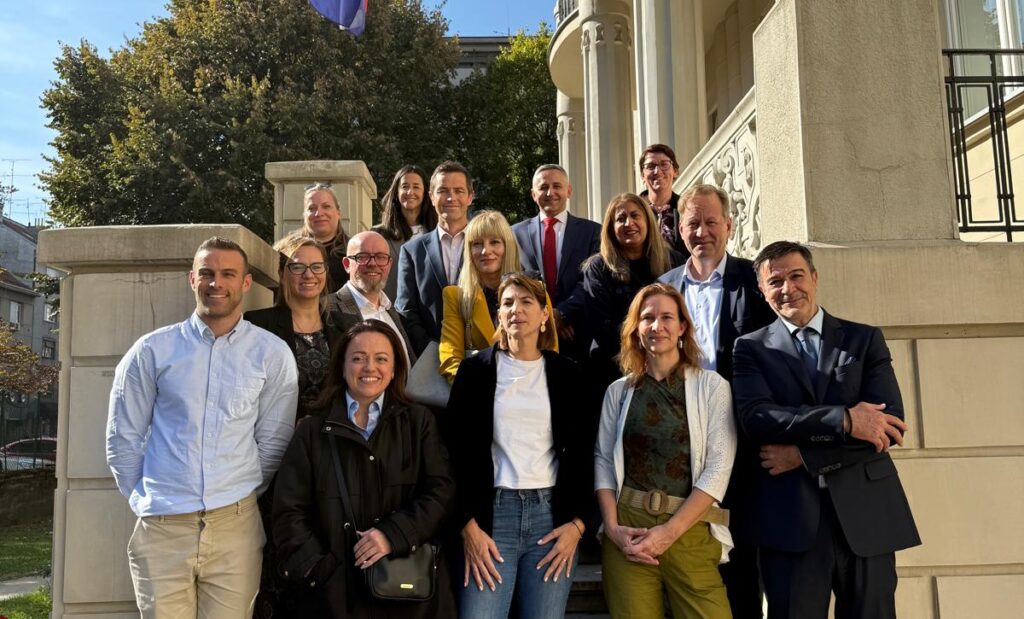
The CEP Leadership Excellence Training, held on 20–21 October in Zagreb, Croatia, brought together Directors General and senior probation managers from 11 European countries for a two-day interactive programme focused on leadership, communication, staff development, and international cooperation.
New

CEP
Call for Proposals: Evaluation of CEP Expert Groups
21/10/2026
On behalf of Ms. Jana Špero Kamenjarin, CEP Secretary General, it is my pleasure to invite you to submit a proposal to conduct an evaluation within the CEP work programme.
Recap

Uncategorized
CEP at UNODC: Contributing to the Development of Probation Services Worldwide
19/10/2026
The Confederation of European Probation (CEP) was represented by its Secretary General, Jana Špero Kamenjarin, at the Expert Group Meeting on the Establishment of Probation Services and Probation Practices, organised by the United Nations Office on Drugs and Crime (UNODC) and held at the Vienna International Centre (VIC) from 12 to 14 October 2026.
Subscribe to our bi-monthly email newsletter!
"*" indicates required fields
- Keep up to date with important probation developments and insights.