

Previous Article
News
A new target group in probation: cybercrime offenders
Probation Officers in the Netherlands noticed an increase of ‘atypical’ clients: offenders convicted of cybercrime. “How do we deal with this new category of clients?”, is what they asked their policy advisors. Jelle van Triest set up the National Expertise Network Cybercrime for the Dutch Probation Service when he worked there as a Policy Advisor (he currently works as a Policy Advisor for the Dutch Ministry of Justice). In his National Expertise Network Cybercrime he combined scientific research, specialist expertise and daily practice. We asked him five questions about the network.
What is cybercrime?
“In scientific literature two categories of cybercrime are being distinguished. The first one is ‘cyber-dependent crimes’: new types of crimes that not only use IT, but also have IT as a target. Think of hacking, DDos attacks, infecting computers with malware or ransomware and using computers for botnets. The second category is ‘cyber-enabled crimes’: ‘traditional’ crimes that use IT as a recourse. Think of cyberbullying, fraud via the internet and online stalking. ‘Cybercrime’ is the umbrella term for both categories.”
What makes dealing with cybercrime offenders different from dealing with other offenders?
“That is what we are trying to find out. Research in this field is all very recent. It seems that most of the cybercrime offenders have a different risk profile from the more traditional offenders. They usually don’t seem to have a lot of problems like homelessness, debts, alcohol or drug abuse or hanging in the streets with peers that have a negative influence on them. They have done things that had or could have had serious impact on their victims’ lives, companies or on the society as a whole.
There are differences in bullying someone online and doing it in the real world. For a start, online you cannot see what you are doing to the victim, what the consequences are and how the victim reacts. The offenders feel like they are anonymous on the internet and they easily get the feeling that whatever they do, they will never be punished for it. In fact, the chance of getting caught while committing crimes online is indeed much lower than in the real world. There also is a group of offenders that does not see their behavior as offending at all. These are mainly young men, very good with computers and quite often bullied or not respected at school. In their online community, they can convince each other that hacking, for example, a bank is just a bit of fun.”
But it isn’t…?
“No, it certainly is not. These hacks undermine the trust of the public in the safety of banks and in the ability of the government or companies to safeguard the storage of personal information. These institutions will spend a lot of money and time trying to prevent hacks or find out who did it. Hackers usually do not realise what the consequences of their behaviour are. A few weeks ago a Dutch teenager set up a DDoS attack against a bank, an internet provider and the Dutch tax authority. Before he was arrested, he gave an interview by email to one of the main newspapers. He was very proud about the fact that the press was speculating that what he had done, could have been a cyberattack from Russia. He thought that was cool. “Why did you do it?”, the newspaper asked. “Because it is fun”, was his answer. Clearly, he did not realise that you can go to jail for committing this kind of crimes. School kids that hack the computer of a teacher to obtain a school test often see this as a joke. As a way of being cool. But breaking in to someone’s computer or using someone’s email password is a serious crime, for which you could be sent to jail.”
How should probation officers deal with a teenager hacking ‘for fun’?
“Recent scientific research has shown that these cyber-dependent criminals have much more self-control than ‘normal’ offenders that, for example, commit violent crimes. They put a lot of effort in trying to hide their tracks. Not only when they are hacking a bank for fun, but also if they perform DDoS attacks for personal intrinsic gain or sell malware to criminals, knowing that they use their work to steal bank passwords or rob people. On the other side, cybercriminals do have exceptional skills. The trick is to get them to use these skills in a positive way. For example by working for an IT company to help making the internet a safer place. The first step in that direction would be to make them see why their behavior was wrong, to give them a moral compass. That is the core business of any probation officer dealing with any offender.”
Does that mean that probation services don’t need specialised knowledge about cybercrime?
“We don’t need a lot of specific technical knowledge. It is not our task to detect cybercrime offenders. We do need to know what their world looks like. Especially when we are dealing with offenders that committed cyber-dependent crimes. In that way we will not only be able to prevent recidivism, but we can also help these clients in a better way. We must understand the clients, we need to know why they have done what they have done. If we know this, we can involve their social networks in a way that they will help the offender to keep them on the right path in the online world. Keeping a cybercrime offender away from his negative online world is not the same as keeping an offender that has committed crimes on the streets away from his street gang, but of course there are similarities. Dealing with offenders of cyber-enabled crimes in many cases, online fraudsters, is not very different from treating offenders that have tricked old ladies at their front door.”
How do you explain the increase of cybercrime offenders that probation officers deal with?
“In the first place: we all use computers, tablets and smartphones much more than in the past. This means more crimes take place in the digital world, it is as simple as that. Secondly, the police now has more expertise and resources to deal with cybercrime. More police investigations can lead to more prosecutions and more probation cases. Thirdly, our National Expertise Network Cybercrime is actively informing the police, prosecutors and judges about how the Probation Service deals with cybercrime offenders. The better our partners in the criminal justice system know what we can do, the better we can contribute and the more judges will give the Probation Service a role in dealing with cybercrime offenders.”
Are you interested in reading more about cybercrime offenders? Please read Cyber-offenders versus traditional offenders: an empirical comparison, written by Marleen Weulen Kranenbarg, VU University Amsterdam.

Related News
Keep up to date with the latest developments, stories, and updates on probation from across Europe and beyond. Find relevant news and insights shaping the field today.
New
Violent Extremism
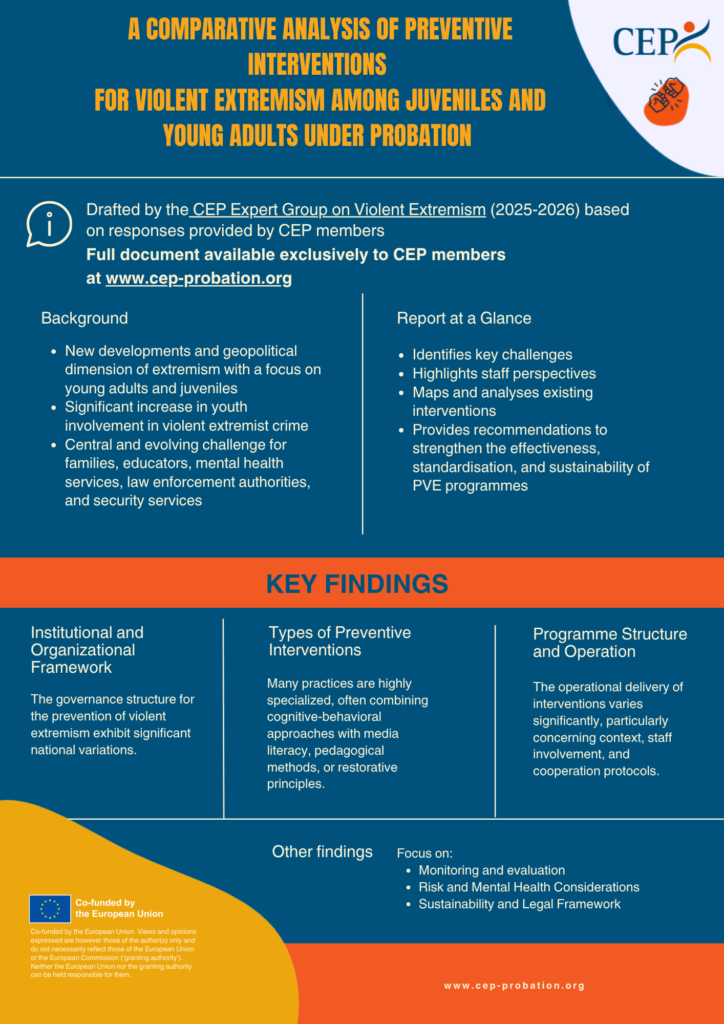
Understanding Youth Radicalisation: What Can Probation Services Do? | New Report from CEP’s Expert Group
27/10/2026
In recent decades, the violent radicalisation of juveniles and young adults has become a pressing concern for policymakers, researchers, practitioners, and communities worldwide. While considerable attention has been devoted to psychological vulnerabilities, socio-economic marginalisation, and community-level influences, the broader context in which violent radicalisation develops is often overlooked. At the same time, the increasing involvement of young people in violent extremist offences highlights the urgent need for effective prevention efforts. Addressing youth radicalisation has become a complex and evolving challenge for families, educators, mental health professionals, law enforcement agencies, probation services, and security authorities.
Recap

Probation in Europe
Reflections on the European Society of Criminology Conference 2026 | From Criminological Research to Probation Practice
26/10/2026
At CEP, we are fascinated by research from across Europe and beyond, and by helping it reach the people who can use it. Ruth Armstrong, CEP Research and Policy Officer, went to the 26th Annual Conference of the European Society of Criminology (EuroCrim 2026 – Working Group on Community Sanctions and Measures) that took place in Warsaw, Poland, from 9–12 September 2026.
Against a backdrop of overcrowded prisons and net-widening (with ever more people drawn into supervision), three questions kept coming up in the research: how time shapes justice, what we mean by success, and how we define harm.
New
Technology
Registration deadline approaching: Join CEP’s final workshop of 2026 on technology in probation
22/10/2026
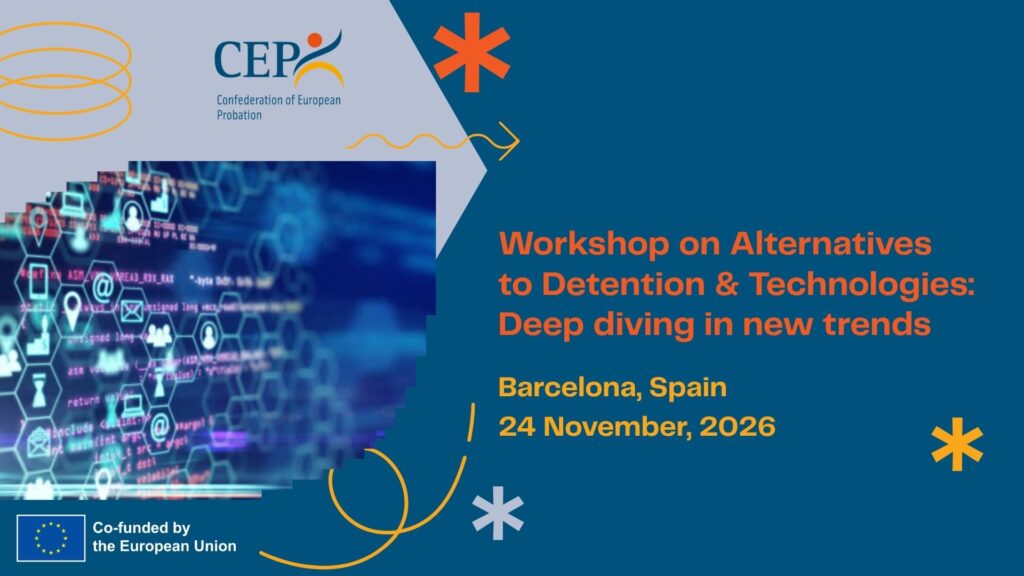
📢 Have you registered yet? CEP’s final workshop of 2026 takes place on 24 November in Barcelona, bringing together professionals to explore how technology is being used across probation services in Europe.
The Workshop on Alternatives to Detention and Technologies: Deep Diving into New Trends will look beyond artificial intelligence to examine the different ways technology is shaping probation practice, from staff training to working with clients and collaborating with other criminal justice partners.
Recap

Directors General Meetings
CEP Leadership Excellence Training: strengthening leadership and cooperation across Europe
22/10/2026
The CEP Leadership Excellence Training, held on 20–21 October in Zagreb, Croatia, brought together Directors General and senior probation managers from 11 European countries for a two-day interactive programme focused on leadership, communication, staff development, and international cooperation.
New

CEP
Call for Proposals: Evaluation of CEP Expert Groups
21/10/2026
On behalf of Ms. Jana Špero Kamenjarin, CEP Secretary General, it is my pleasure to invite you to submit a proposal to conduct an evaluation within the CEP work programme.
Recap

Uncategorized
CEP at UNODC: Contributing to the Development of Probation Services Worldwide
19/10/2026
The Confederation of European Probation (CEP) was represented by its Secretary General, Jana Špero Kamenjarin, at the Expert Group Meeting on the Establishment of Probation Services and Probation Practices, organised by the United Nations Office on Drugs and Crime (UNODC) and held at the Vienna International Centre (VIC) from 12 to 14 October 2026.
Subscribe to our bi-monthly email newsletter!
"*" indicates required fields
- Keep up to date with important probation developments and insights.